
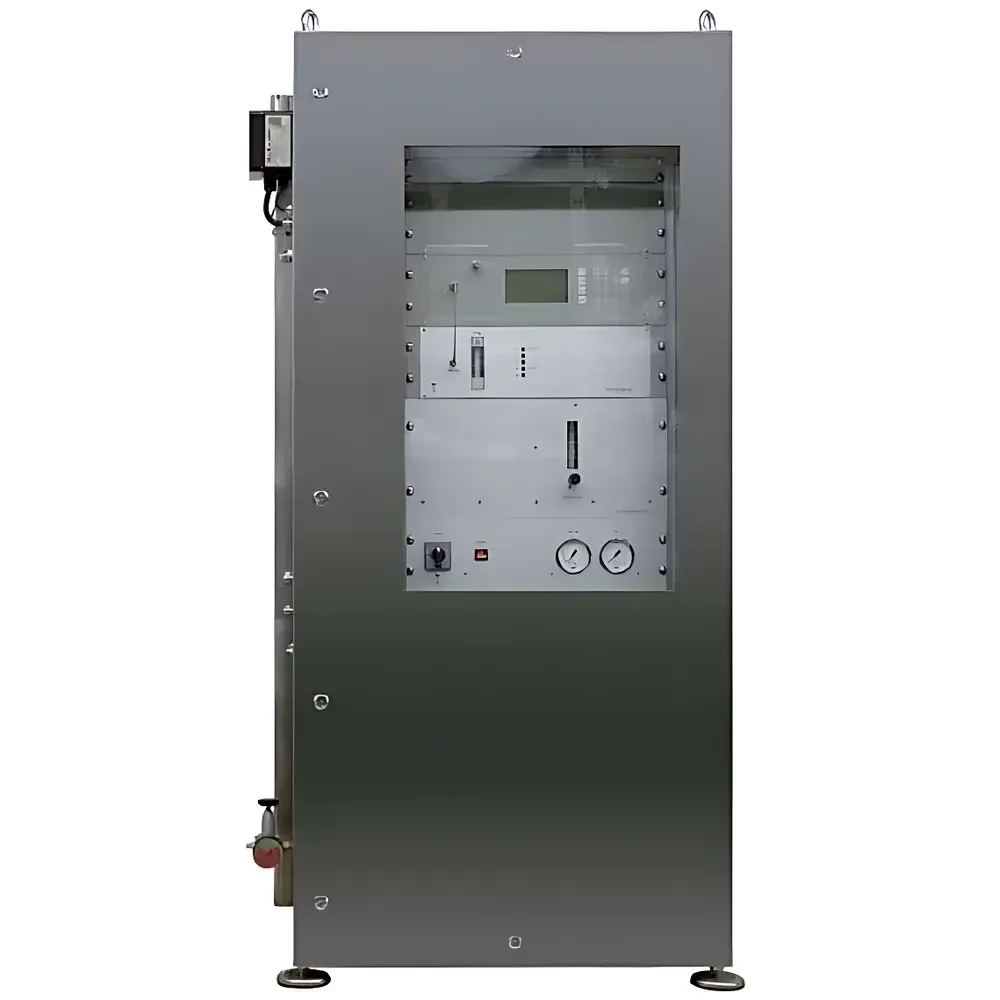
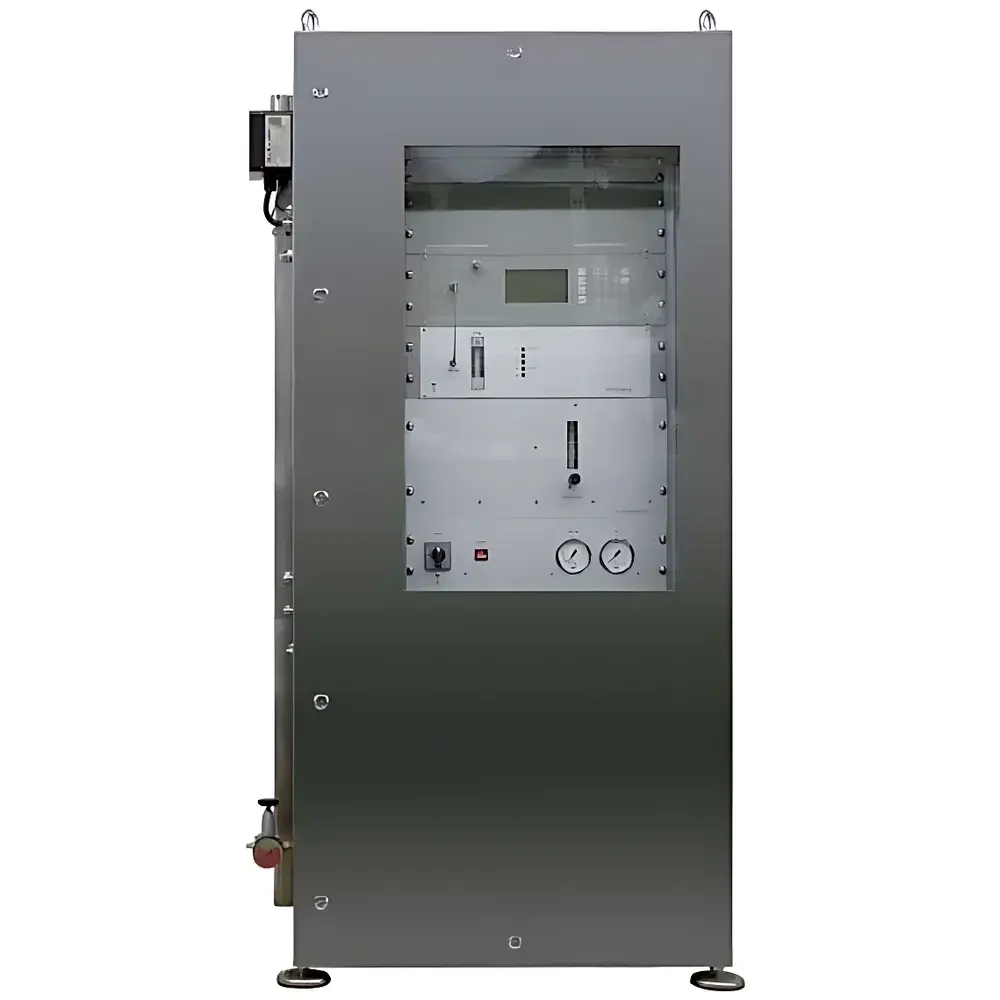
Mercury Instruments MMS-NG Online Mercury Analyzer
| Brand | Mercury Instruments |
|---|---|
| Origin | Germany |
| Model | MMS-NG |
| Instrument Type | Online Analyzer |
| Measurement Principle | Cold Vapor Atomic Absorption Spectroscopy (CVAAS) |
| Detection Limit | ≤0.1 ng/m³ |
| Repeatability | ≤1.0% (CVAAS) |
| Linearity Error | ±1% (CVAAS) |
| Measurement Range | 0.001–50 µg/m³ (extendable to 2000 µg/m³ with integrated dilution system) |
| Wavelength | 253.7 nm |
| Sample Inlet Pressure | up to 240 bar (3480 psi) |
| Sampling Points | 2–16 via multiplexed valve manifold |
| Cycle Time | ~3 minutes per point |
| Calibration Method | Saturated mercury vapor generation (NIST-recommended vapor pressure equation) |
| Certifications | ATEX 2G IIC T4 EEx p, IECEx, ISO/DIS 6978-3, ASTM D5954, VDI 2267 Part 8, ISO 6978-1 |
Overview
The Mercury Instruments MMS-NG is a certified online mercury analyzer engineered for continuous, real-time monitoring of elemental and covalently bound mercury in natural gas and other flammable process streams. It operates on the principle of Cold Vapor Atomic Absorption Spectroscopy (CVAAS), where mercury vapor—thermally liberated and quantitatively transferred from the sample matrix—is atomized in a quartz cell and measured at the resonance wavelength of 253.7 nm. Unlike batch or laboratory-based techniques, the MMS-NG integrates directly into high-pressure process lines (up to 240 bar), eliminating offline sampling artifacts and enabling trace-level detection (≤0.1 ng/m³) under field conditions. Its design prioritizes operational safety and metrological integrity in hazardous environments, meeting ATEX 2G IIC T4 EEx p certification for use in Zone 1 explosive atmospheres. The system is purpose-built for upstream and midstream natural gas facilities, particularly for verifying the performance of Mercury Removal Units (MRUs) and ensuring compliance with pipeline specification limits and occupational exposure thresholds.
Key Features
- True online operation with direct high-pressure inlet (240 bar / 3480 psi), eliminating need for pressure reduction or external regulators
- Gold-coated enrichment trap technology to eliminate matrix interferences and enhance sensitivity for low-concentration measurement
- Heated, low-adsorption stainless-steel sample path with passivated surface treatment to minimize mercury loss during transport
- Integrated multiplexed sampling manifold supporting 2–16 independent process points with automatic sequencing and individual flow control
- Onboard saturated mercury vapor calibration generator compliant with NIST-recommended vapor pressure equations (ISO/DIS 6978-3)
- Automatic leak detection and emergency shutdown: built-in hydrocarbon sensor triggers immediate isolation upon fugitive emission detection
- No carrier gas required—reducing consumables, maintenance, and potential contamination sources
- Robust architecture with explosion-proof enclosure (ATEX/IECEx) and intrinsically safe electronics for Zone 1 deployment
Sample Compatibility & Compliance
The MMS-NG is validated for gaseous matrices including dry and wet natural gas, sour gas (H₂S-containing), biogas, and syngas. It accommodates variable moisture content and hydrocarbon composition without signal quenching, thanks to its gold-trap preconcentration and thermal desorption protocol. All wetted components are constructed from electropolished 316L stainless steel and Hastelloy C-276 where required. The system complies with international standards governing mercury analysis in hydrocarbon streams: ISO 6978-1 (sampling and preparation), ISO/DIS 6978-3 (online CVAAS methodology), ASTM D5954 (mercury determination in natural gas), and VDI 2267 Part 8 (emission monitoring guidelines). Full audit trails, electronic signatures, and calibration history logging support GLP/GMP-aligned operations and regulatory inspections.
Software & Data Management
The embedded firmware supports dual-mode operation: autonomous unattended monitoring or integration into centralized DCS/SCADA systems via Modbus RTU (RS485), Modbus TCP (Ethernet), or 4–20 mA analog output. Data timestamps are synchronized to UTC with onboard real-time clock and battery backup. Raw absorbance values, calculated concentrations, diagnostic flags (e.g., trap saturation, pressure deviation, calibration drift), and event logs are stored locally for ≥30 days and exportable via secure FTP or USB. Optional MercuryView™ software provides remote configuration, trend visualization, alarm management (configurable thresholds and hysteresis), and automated report generation aligned with ISO 17025 documentation requirements.
Applications
- Continuous verification of Mercury Removal Unit (MRU) efficiency in natural gas processing plants
- Monitoring mercury breakthrough across activated carbon or sulfur-impregnated adsorbent beds
- Feed gas qualification prior to cryogenic separation units (e.g., LNG trains) to prevent amalgam-induced equipment embrittlement
- Leak detection and source identification in compressor stations and metering skids
- Compliance reporting for national emissions inventories (e.g., UNFCCC, EU ETS) and pipeline custody transfer specifications
- Commissioning support and long-term stability assessment of mercury scavenging technologies
FAQ
Does the MMS-NG require carrier gas or purge gas for operation?
No. The system operates without any external carrier or purge gas, relying solely on process stream pressure for sample transport and internal zero-air generation for baseline stabilization.
Can it measure both elemental Hg⁰ and oxidized mercury species (e.g., HgCl₂)?
The MMS-NG quantifies total mercury after thermal conversion to elemental form in the gold trap; speciation requires upstream selective sorbent trapping or complementary techniques such as CVAFS with species-selective digestion.
What is the minimum detectable concentration in high-pressure natural gas?
The specified detection limit of ≤0.1 ng/m³ is validated at operating pressures up to 240 bar, with signal-to-noise optimization achieved through extended integration time and multi-cycle averaging.
How is calibration traceability ensured?
Calibration employs NIST-traceable mercury vapor generation via temperature-controlled saturator, following the internationally accepted Antoine-type vapor pressure equation defined in ISO/DIS 6978-3 and NIST SP 260-194.
Is remote diagnostics and firmware update supported?
Yes—via encrypted Ethernet connection using TLS 1.2; all updates undergo cryptographic signature verification prior to installation to maintain regulatory compliance and system integrity.




