
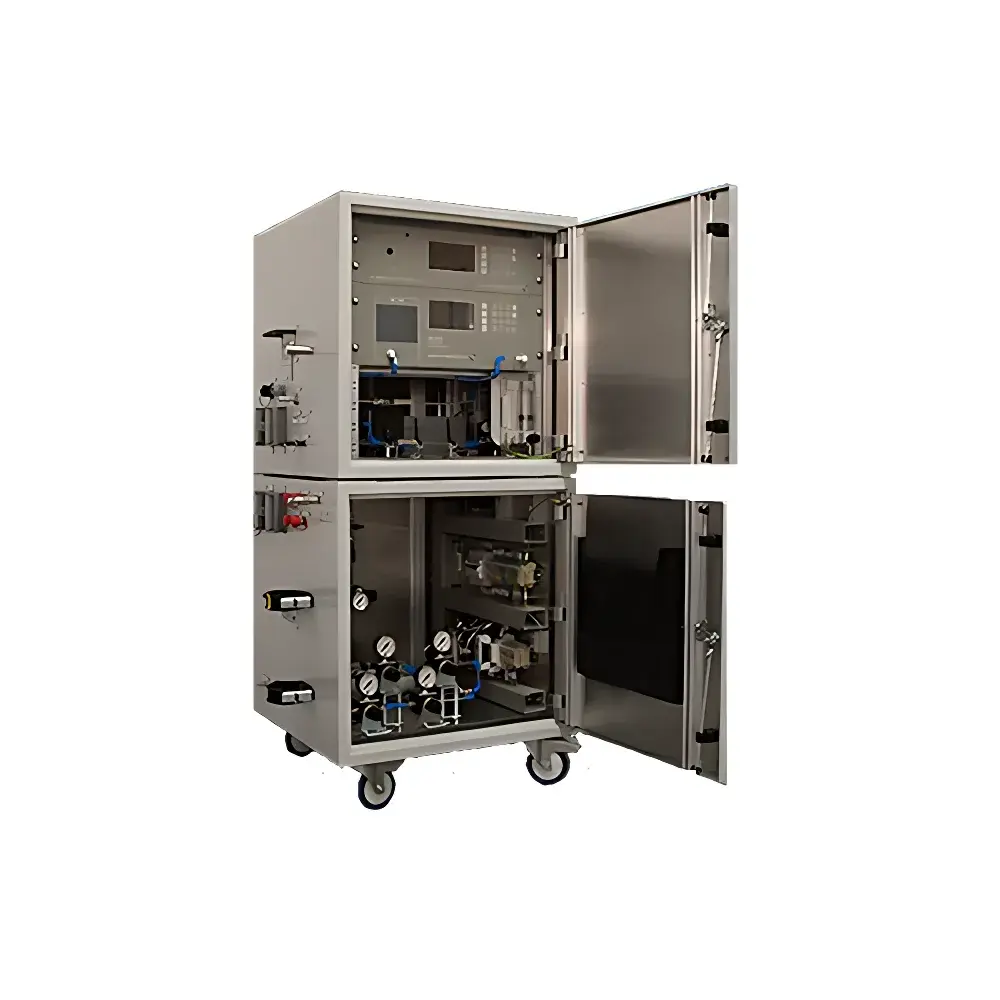
Mercury Instruments SM-4 Mobile Flue Gas Mercury Continuous Emission Monitoring System
| Brand | Mercury Instruments |
|---|---|
| Origin | Germany |
| Model | SM-4 Mobile |
| Measurement Principle | Thermal Catalytic Conversion + Gold Amalgamation Cold Vapor Atomic Fluorescence (CVAFS) |
| Detection Limit | 0.05 µg/m³ |
| Response Time (t₉₀) | ~180 s |
| Sample Line Length | Up to 73 m (240 ft) |
| Dilution Ratio | Adjustable, up to 1:100 |
| Compliance | EU EN 15267-3 certified, US EPA Performance Specification 12A (PS-12A) and RATA validated |
| Calibration Options | Automated Hg⁰ and Hg²⁺ gas generators (NIST-traceable), QAL3-compliant auto-validation module |
| Waste Generation | Zero liquid or solid waste |
| Operating Temperature Range | Probe heated to >180 °C |
| Filter | Heated particulate filter with automatic air-purge cleaning |
Overview
The Mercury Instruments SM-4 Mobile is a fully integrated, transportable flue gas mercury continuous emission monitoring system (CEMS) engineered for regulatory-grade compliance and long-term operational stability in demanding industrial environments. It employs a dry, thermal catalytic conversion process—operating at 650–750 °C—to quantitatively transform all mercury species (elemental Hg⁰, oxidized Hg²⁺, and particulate-bound Hgp) into elemental mercury prior to detection. This conversion occurs within a maintenance-free, in-situ catalyst unit mounted directly inside the stack, eliminating the need for long-distance transport of reactive mercury species and mitigating adsorption losses on sampling lines. Detection is performed via cold vapor atomic fluorescence spectroscopy (CVAFS) coupled with gold amalgamation pre-concentration—a technique recognized for its exceptional selectivity, low interference susceptibility, and sub-ng/m³ sensitivity. The system meets the stringent requirements of EN 15267-3 for CEMS type approval and has undergone successful Relative Accuracy Test Audits (RATA) per U.S. EPA PS-12A, making it suitable for use in legally binding emissions reporting frameworks under EU IED, U.S. MATS, and other national mercury control regulations.
Key Features
- Dry thermal catalytic conversion at 650–750 °C—no consumables, no solvent, no solid catalyst replacement required.
- On-stack, maintenance-free conversion module eliminates Hg⁰ loss during transit and ensures stoichiometric completeness across all mercury species.
- Programmable sample dilution (up to 1:100) to suppress matrix interferences from SO₂, NOₓ, HCl, and water vapor while extending dynamic measurement range.
- Heated probe and sample line (≥180 °C) with automated compressed-air purge for continuous particulate filter cleaning.
- NIST-traceable, dual-mode calibration system: optional Hg⁰ and Hg²⁺ permeation tube-based gas generators for automated QAL2 and QAL3 validation.
- Zero liquid or solid waste generation—fully compliant with hazardous waste minimization mandates.
- Robust architecture designed for unattended operation over 30-day intervals; field-proven uptime >95% in coal-fired power plants and waste incinerators.
Sample Compatibility & Compliance
The SM-4 Mobile is validated for continuous monitoring of total gaseous mercury (TGM) in high-dust, high-acid, and high-moisture flue gases typical of coal combustion, municipal solid waste (MSW) incineration, cement kilns, and metallurgical processes. Its dilution and thermal conditioning strategy ensures stable performance even under transient load conditions and rapid composition shifts. The system conforms to ISO 17025-accredited laboratory practices for method validation and supports full audit trails required under GLP and GMP environments. Data integrity complies with FDA 21 CFR Part 11 when paired with Mercury Instruments’ secure data acquisition software (v5.2+), including electronic signatures, change logging, and immutable storage.
Software & Data Management
The embedded Windows-based control interface provides real-time visualization of raw signal, converted concentration, dilution ratio, catalyst temperature, vacuum pressure, and filter status. All measurements are timestamped and stored locally with redundant SD card backup. Export formats include CSV, XML, and MODBUS TCP for integration into plant DCS/SCADA systems. The software supports automated report generation aligned with EN 14181 QAL3 protocols—including drift assessment, calibration verification logs, and uncertainty calculation per ISO/IEC 17025 Annex A. Remote diagnostics and firmware updates are enabled via encrypted TLS 1.2 VPN connection.
Applications
- Regulatory compliance monitoring for coal-fired power stations subject to EU LCP BREF and U.S. EPA MATS requirements.
- Continuous mercury emission verification at MSW and hazardous waste incinerators operating under strict BAT conclusions.
- Process optimization and sorbent injection control in activated carbon injection (ACI) systems.
- Baseline characterization and long-term trend analysis in cement production and non-ferrous metal smelting facilities.
- Mobile reference monitoring during CEMS commissioning, cross-validation, or third-party audit support.
FAQ
Does the SM-4 Mobile require wet chemical reagents or liquid traps?
No. It operates entirely on dry thermal principles—no acids, oxidants, or absorbent solutions are used at any stage.
Can it measure speciated mercury (Hg⁰ vs. Hg²⁺) directly?
Not natively—but optional Hg²⁺ and Hg⁰ calibration gas generators enable validated speciation inference through differential spiking and reaction kinetics modeling.
Is the system suitable for high-dust applications such as cement kilns?
Yes. The heated probe, ceramic particulate filter, and automatic air-purge mechanism ensure reliable operation at dust loads exceeding 50 g/Nm³.
What is the minimum detectable concentration and how is it verified?
The system achieves a method detection limit (MDL) of 0.05 µg/m³ (at 1 m³/h flow, 10-min averaging), confirmed annually via independent EN 15267-3 accredited testing.
How often does the catalytic converter require servicing?
None—the monolithic catalyst is lifetime-rated for ≥2 years under continuous operation at design temperature and is not user-serviceable.
Related Products







