
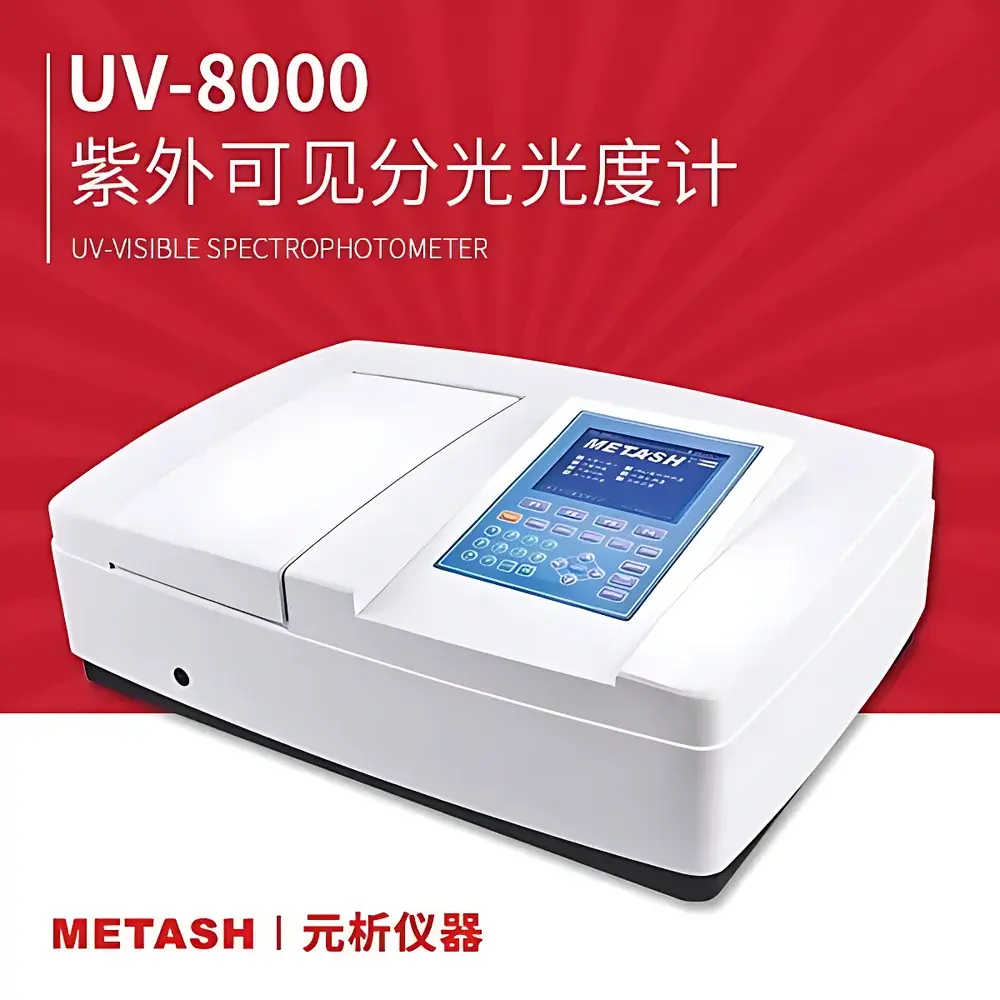
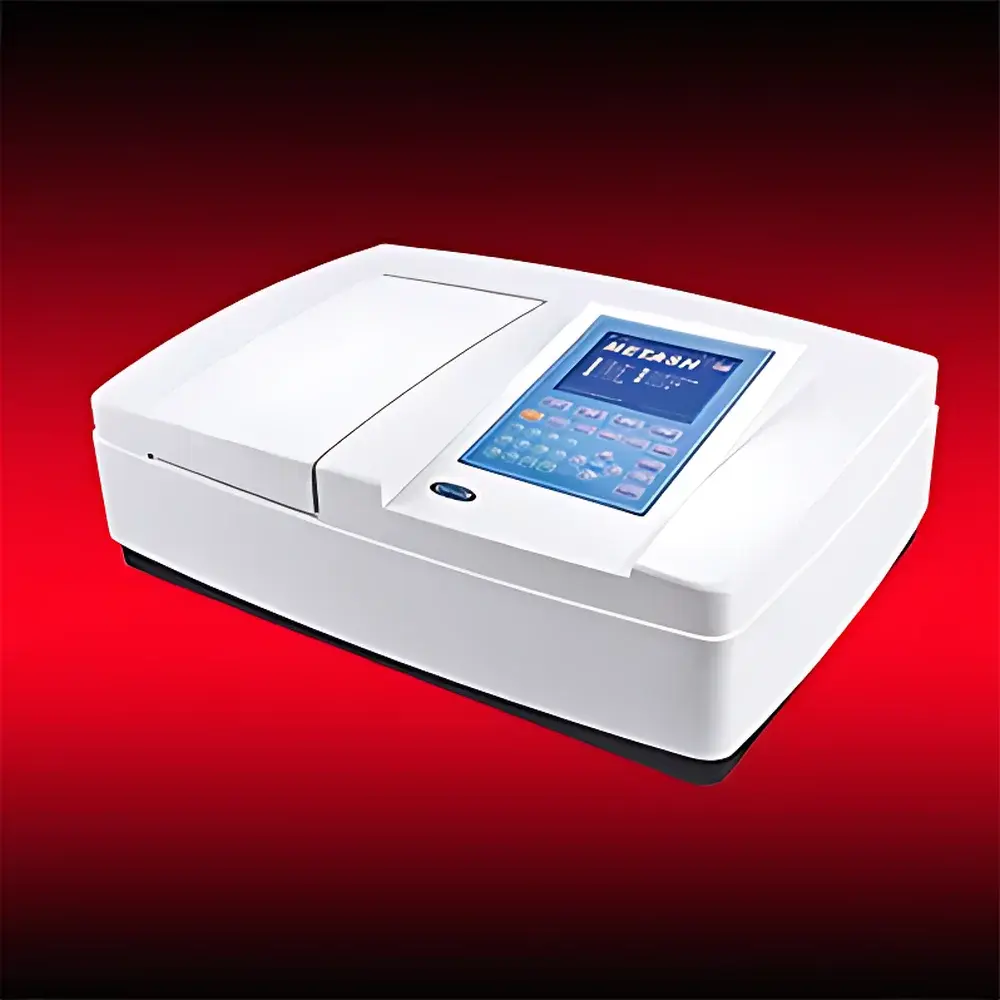
Metash UV-8000 Dual-Beam Ultraviolet-Visible Spectrophotometer
| Brand | Metash Instruments |
|---|---|
| Origin | Shanghai, China |
| Manufacturer Type | Original Equipment Manufacturer (OEM) |
| Model | UV-8000 |
| Optical System | Dual-beam |
| Detector Type | Silicon Photodiode |
| Wavelength Range | 190–1100 nm |
| Spectral Bandwidth | 1.8 nm |
| Wavelength Accuracy | ±0.1 nm at D₂ line (656.1 nm), ±0.3 nm across full range |
| Wavelength Repeatability | ≤0.1 nm |
| Stray Light | ≤0.05% T |
| Display | 6-inch full-color LED touchscreen |
| Data Interface | USB port for PC connectivity |
| Software | GLP/GMP-compliant PC application with audit trail, user management, and report generation |
Overview
The Metash UV-8000 is a dual-beam ultraviolet-visible (UV-Vis) spectrophotometer engineered for high-precision absorbance, transmittance, and reflectance measurements in research laboratories, quality control environments, and pharmaceutical R&D settings. Its optical architecture employs a true split-beam configuration—where the incident light is divided into sample and reference paths before reaching the detector—enabling real-time compensation for source intensity drift, lamp aging, and environmental fluctuations. This design ensures superior photometric stability and long-term baseline reproducibility, critical for kinetic assays, concentration monitoring, and regulatory-compliant testing. The instrument operates across a broad spectral range of 190–1100 nm, covering deep UV (e.g., nucleic acid quantification at 260 nm), visible absorption (e.g., dye analysis), and near-infrared transitions (e.g., polymer characterization). A fixed 1.8 nm spectral bandwidth provides optimal resolution for narrow-band analytes while maintaining sufficient radiant throughput for low-concentration samples.
Key Features
- Dual-beam optical path with independent, vibration-isolated optical base constructed from 16 mm thick aerospace-grade aluminum—minimizing thermal expansion and mechanical perturbation effects on wavelength calibration.
- High-stability light source assembly incorporating imported deuterium and tungsten-halogen lamps, each optimized for UV (190–350 nm) and visible/NIR (350–1100 nm) regions respectively.
- Imported precision holographic grating with enhanced UV diffraction efficiency and reduced stray radiation—contributing to measured stray light performance of ≤0.05% T at 220 nm (NaI) and 340 nm (NaNO₂).
- 6-inch full-color LED touchscreen display enabling standalone operation: direct access to photometric mode, quantitative analysis (single/multi-point calibration), spectral scanning (up to 3200 data points), time-based kinetics, DNA/protein A₂₆₀/A₂₈₀ ratio calculation, and multi-wavelength quantitation.
- Rugged mechanical design supporting optional accessories including automated 8-cell changer, micro-volume cuvette holder (down to 50 µL), Peltier-controlled temperature-regulated cell holder, integrating sphere for diffuse reflectance, and specular reflection stage.
Sample Compatibility & Compliance
The UV-8000 accommodates standard 10 mm square quartz or glass cuvettes (pathlengths 1–100 mm), as well as specialized formats such as capillary cells, flow-through cells, and solid-sample holders. Its optical alignment tolerances and beam geometry conform to ISO 9001 manufacturing controls and are validated per ASTM E275 and ISO/IEC 17025 requirements for spectrophotometric instrumentation. All firmware and PC software comply with GLP and GMP documentation standards—including electronic signature support, role-based user permissions, immutable audit trails, and timestamped data archiving. Instrument qualification packages (IQ/OQ/PQ) are available upon request to support FDA 21 CFR Part 11 compliance in regulated pharmaceutical and biotechnology facilities.
Software & Data Management
The included PC-based analytical software is built on a modular architecture supporting both Windows 10/11 and Windows Server platforms. It features native CSV, TXT, and XML export formats; customizable report templates aligned with internal SOPs; and integrated calibration verification workflows using NIST-traceable reference standards (e.g., holmium oxide, didymium, potassium dichromate). Data integrity safeguards include automatic backup to network drives, encrypted local storage, and configurable retention policies. Software validation documentation—including risk assessment, functional specification, and test protocols—is provided to facilitate laboratory system validation (CSV) under ICH Q9 and Q10 frameworks.
Applications
- Pharmaceutical QC: Assay of active pharmaceutical ingredients (APIs), excipient identification, dissolution testing, and stability-indicating methods per USP and EP 2.2.25.
- Biochemistry: Quantification of nucleic acids and proteins via A₂₆₀/A₂₈₀ ratios; enzyme kinetics (e.g., NADH oxidation at 340 nm); ligand-binding studies.
- Environmental analysis: Detection of nitrate, phosphate, and heavy metal complexes (e.g., Cr(VI) at 350 nm) in wastewater per EPA Method 353.2 and ISO 15681-1.
- Materials science: Bandgap estimation of semiconductors, thin-film thickness calculation via interference fringes, and pigment dispersion analysis.
- Food & beverage: Colorimetric determination of anthocyanins, chlorophyll, and preservatives (e.g., sulfites) using standardized AOAC and ISO methods.
FAQ
What is the recommended calibration frequency for routine use?
For GLP-compliant operation, wavelength calibration should be verified daily using holmium oxide or didymium filters, and photometric accuracy checked weekly with neutral density filters traceable to NIST SRM 930e.
Does the UV-8000 support method transfer between instruments?
Yes—the software exports complete method files (.uvp) containing all acquisition parameters, calibration curves, and processing algorithms, ensuring consistent results across multiple UV-8000 units within a networked lab environment.
Can the instrument be integrated into a LIMS or ELN system?
Through its open XML-based data export protocol and optional OPC UA interface module, the UV-8000 supports bidirectional communication with major LIMS (e.g., LabWare, Thermo Fisher SampleManager) and electronic lab notebook platforms.
Is there an option for remote diagnostics or service support?
All instruments include embedded Ethernet connectivity and remote desktop capability (with customer authorization), enabling secure firmware updates and technician-assisted troubleshooting without on-site visits.
What safety certifications does the UV-8000 hold?
The instrument meets IEC 61010-1:2010 for electrical safety and IEC 60825-1:2014 Class 1 laser product requirements (for internal alignment lasers), with CE marking and RoHS 2011/65/EU compliance documented in the Declaration of Conformity.
Related Products




