
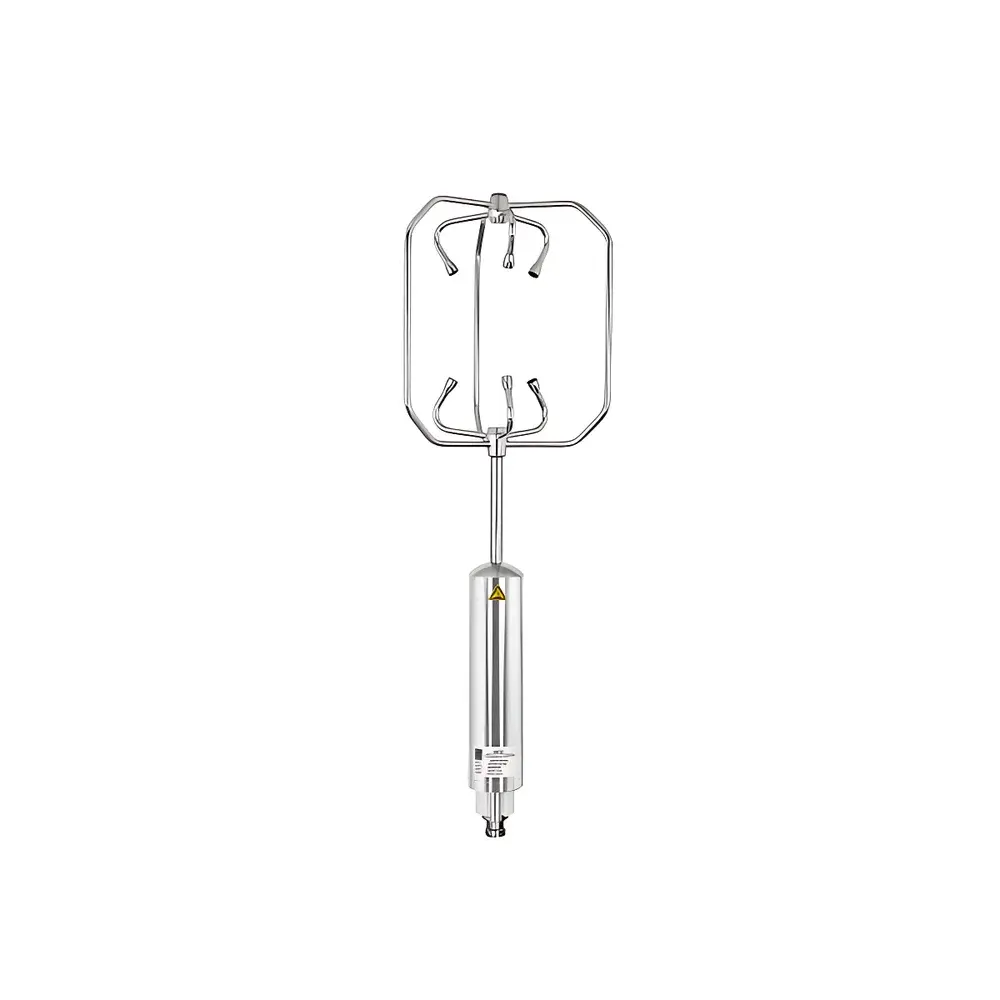
METEK uSonic-3 Cage MP and uSonic-3 Class A MP 3D Ultrasonic Anemometers
| Origin | USA |
|---|---|
| Manufacturer | METEK GmbH (Germany), Distributed in North America |
| Instrument Type | Imported High-Precision Turbulence-Grade 3D Ultrasonic Anemometer |
| Model | uSonic-3 Cage MP / uSonic-3 Class A MP |
| Sampling Rate | Up to 30 Hz per transducer pair (90 Hz total radial data rate) |
| Wind Speed Range | ±40 m/s |
| Operating Temperature | −40 °C to +60 °C |
| Relative Humidity | 5–100 % RH |
| Wind Accuracy | ±0.5–1 % RMS @ 5 m/s (horizontal, 0°–20° sector) |
| Vertical Velocity Resolution | 0.006 m/s |
| Temperature Resolution | 0.01 K |
| Output Data | 9 radial wind components, 9 sonic temperature values, Cartesian (u, v, w), scalar wind speed & direction, turbulence statistics (with optional module) |
| Communication | RS422, RS485 (300–115.2 kbaud), 10/100 Mbit Ethernet (ASCII protocol, NMEA-compliant framing, checksum support) |
| Power | 10–36 VDC, 2.5 W (heating optional: 10–24 VDC, ≤100 W) |
| Mounting Options | Cage-mount (Cage MP) or Class A meteorological mast mount (Class A MP) |
| Compliance | Designed for eddy covariance systems compliant with AmeriFlux, ICOS, and FLUXNET protocols |
Overview
The METEK uSonic-3 Cage MP and uSonic-3 Class A MP are research-grade, turbulence-optimized 3D ultrasonic anemometers engineered for high-fidelity atmospheric boundary layer measurements. Unlike conventional 3-beam or orthogonal 4-beam designs, the uSonic-3 implements a patented Multi-Path (MP) architecture: each of the three ultrasonic transmitters is acoustically coupled to three independent receivers, forming a dense 3×3 acoustic array per sensor head. This configuration yields nine independent radial velocity measurements per sample cycle—enabling spatially resolved reconstruction of the local wind vector field while inherently suppressing flow distortion caused by sensor geometry and thermal wake effects. The system directly resolves all three orthogonal wind components (u, v, w) without coordinate transformation assumptions, and delivers simultaneous sonic temperature from all nine paths—critical for accurate virtual temperature correction and sensible heat flux computation in eddy covariance applications. Both variants operate across the full meteorological temperature range (−40 °C to +60 °C) and meet long-term stability requirements for unattended field deployments in flux towers, wind energy assessment sites, and urban micrometeorology networks.
Key Features
- True 3×3 multi-path ultrasonic measurement principle delivering nine radial wind components and nine independent sonic temperature readings per acquisition cycle
- Direct, distortion-minimized vertical wind velocity measurement—no post-processing tilt correction required for primary output
- Integrated dual-axis inclinometer (optional on Cage MP; standard on Class A MP) with 0.1° resolution and 0.5 Hz update rate for real-time mounting alignment monitoring and automated coordinate rotation
- Configurable sampling: user-selectable averaging intervals (1–3600 s) and sample counts (1–65,365), supporting both high-temporal-resolution turbulence analysis and long-term climatological averaging
- Onboard turbulence processing module (optional firmware upgrade) computes second- and third-order moments—including variances (σu², σv², σw²), covariances (u’w’, v’w’, u’T’), sensible/latent heat fluxes, momentum flux, and Monin–Obukhov length—in real time
- Dual communication interfaces: industrial-grade RS422/RS485 (300–115.2 kbaud) and IEEE 802.3 10/100 Mbit Ethernet, both supporting ASCII-based, NMEA-compliant message framing with CRC checksums for data integrity verification
- Optional heated transducer head (10–24 VDC, ≤100 W) prevents ice accumulation and ensures continuous operation in freezing fog or rime conditions
- Expandable local storage via industrial SD card (optional) enables autonomous data buffering during network outages or remote telemetry interruptions
Sample Compatibility & Compliance
The uSonic-3 series is explicitly designed for integration into internationally standardized eddy covariance infrastructure. Its measurement geometry, temporal synchronization capability (via digital I/O trigger lines), and metadata-rich output format align with AmeriFlux, ICOS, and FLUXNET Level 1 processing guidelines. The instrument’s wind vector uncertainty profile—validated across wind speeds from 0.1 to 40 m/s and directional sectors up to ±170° (Class A MP) or ±180° (Cage MP)—meets the performance thresholds defined in ISO 16622:2021 (Meteorological instruments — Specifications for sonic anemometers) and ASTM D5096-22 (Standard Practice for Determining Turbulent Fluxes). All firmware versions support audit-trail-capable logging of calibration coefficients, operational status flags, and environmental diagnostics—facilitating compliance with GLP and GCP documentation requirements for environmental monitoring programs subject to regulatory review.
Software & Data Management
METEK provides the uSonic Control Center (UCC), a cross-platform desktop application for configuration, real-time monitoring, and firmware updates via Ethernet or serial link. UCC exports time-stamped, column-delimited ASCII files compatible with MATLAB, Python (pandas), R, and commercial flux processing suites such as EddyPro and TK3. For networked deployments, the device supports Modbus TCP mapping of key registers and HTTP GET endpoints for status polling. Raw radial data streams are timestamped using internal high-stability TCXO (±0.5 ppm over −40 °C to +60 °C), and synchronized to external GPS PPS signals via the dedicated digital input—ensuring sub-millisecond inter-sensor alignment in multi-tower experiments. Optional analog outputs (4 × 12-bit, 0–10 VDC or 4–20 mA) enable direct interfacing with legacy SCADA or PLC systems without protocol translation.
Applications
- Eddy covariance flux measurements of CO2, CH4, H2O, and energy exchange in ecosystem-scale carbon monitoring networks
- Atmospheric turbulence characterization for wind resource assessment, turbine wake studies, and siting optimization
- Urban boundary layer research including street canyon ventilation, pollutant dispersion modeling, and heat island dynamics
- Aviation meteorology: low-level wind shear detection and microburst forecasting at airports and helipads
- Industrial stack emission monitoring where tracer gas dilution methods require precise, co-located wind vector data
- Calibration reference for cup-and-vane sensors and Doppler lidar systems in intercomparison campaigns
FAQ
What distinguishes the uSonic-3 Cage MP from the Class A MP variant?
The Cage MP is optimized for cage-mounted installations on open-framework flux towers, featuring a wider ±180° azimuthal acceptance angle and enhanced resistance to mechanical vibration. The Class A MP follows WMO Class A geometric and thermal specifications for mast-mounted meteorological stations, with tighter mechanical tolerances, integrated inclinometry, and extended analog I/O for auxiliary sensor integration.
Can the uSonic-3 operate unattended for extended periods in harsh environments?
Yes—both models are rated IP66 and operate continuously from −40 °C to +60 °C at 5–100 % RH. Optional heater control, SD-card logging, and dual power input redundancy (10–36 VDC) support multi-year deployments in polar, alpine, or desert locations.
Is NIST-traceable calibration available?
METEK provides factory calibration against NIST-traceable wind tunnel standards (NPL, PTB) with documented uncertainty budgets per ISO/IEC 17025. Field recalibration kits and procedures are available for user-performed verification.
Does the system support time synchronization with GPS or IRIG-B?
It accepts 1PPS TTL input for hardware-level timestamp alignment and supports NTP over Ethernet for network-wide clock discipline. IRIG-B compatibility requires external converter hardware.
How is data integrity ensured during transmission?
All ASCII output frames include header, payload, and CRC-16 checksum. Ethernet packets use TCP handshake and retransmission logic; RS422/RS485 links implement configurable retry-on-error and frame validation prior to buffer commit.



