
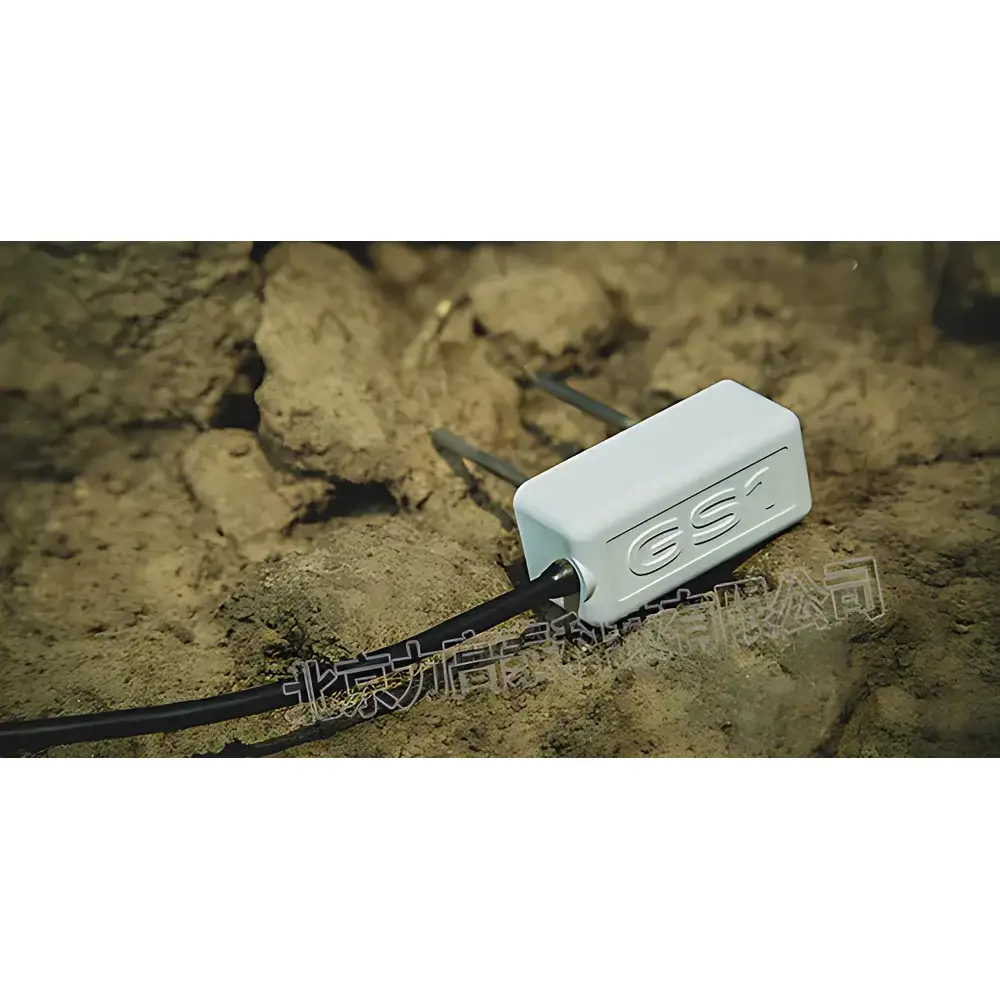
METER GS1 Soil Moisture Sensor
| Brand | METER |
|---|---|
| Origin | USA |
| Manufacturer Type | Authorized Distributor |
| Import Status | Imported |
| Model | GS1 |
| Instrument Type | Volumetric Water Content (VWC) Sensor |
| Measurement Principle | 70 MHz Capacitance-Based Dielectric Permittivity Sensing |
| Operating Temperature | -40 to 50 °C |
| Measurement Range | 0–57% VWC |
| Accuracy | ±0.03 m³/m³ (±3%) for typical soils (EC < 8 dS/m) |
| Resolution | 0.001 m³/m³ (0.1%) |
| Measurement Time | 10 ms |
| Power Supply | 3.0–15 VDC @ ≤15 mA |
| Output Signal | 1000–2500 mV (analog, linear voltage-to-VWC) |
| Sensor Dimensions | 5.1 × 2.4 × 2.1 cm |
| Connector | 3.5 mm stereo jack or tinned 3-wire lead |
| Compatible Data Loggers | METER Em50 series, ProCheck, Campbell Scientific (CSI) loggers |
Overview
The METER GS1 Soil Moisture Sensor is a field-deployable, capacitance-based volumetric water content (VWC) sensor engineered for high reproducibility and broad environmental resilience. It operates on the principle of frequency-domain reflectometry (FDR) at a fixed 70 MHz excitation frequency, measuring the dielectric permittivity of soil or substrate media to derive VWC. This high-frequency approach minimizes sensitivity to electrical conductivity (EC) and structural heterogeneity—critical advantages in saline soils, hydroponic substrates, and engineered growing media where low-frequency sensors exhibit significant drift or bias. Unlike time-domain transmission (TDT) or neutron probe methods, the GS1 requires no radioactive sources, complex calibration curves per installation, or site-specific firmware configuration. Its measurement range spans 0–57% VWC, covering the full spectrum from air-dry conditions to saturation across mineral soils (typical saturation: 40–60% VWC), peat, coco coir, perlite, and rockwool. Designed as the foundational upgrade to the legacy ECH2O basic sensor line, the GS1 maintains backward compatibility while delivering enhanced signal stability and long-term drift resistance under cyclic thermal and moisture stress.
Key Features
- 70 MHz capacitance sensing architecture optimized for minimal EC interference—validated for reliable operation in soils with EC up to 8 dS/m without recalibration
- Ruggedized epoxy-encapsulated housing rated for continuous outdoor exposure across -40 to +50 °C ambient conditions
- Stainless steel probe electrodes ensure mechanical durability, consistent soil contact, and corrosion resistance in aggressive chemical environments
- Fast 10 ms measurement cycle enables high-temporal-resolution monitoring in dynamic irrigation or drought-response studies
- Linear analog output (1000–2500 mV) directly proportional to VWC—no proprietary protocol required; supports universal voltage-to-VWC conversion via simple slope-intercept equation
- Compact form factor (5.1 × 2.4 × 2.1 cm) facilitates multi-depth profiling and dense spatial deployment in lysimeters, root zones, or container nurseries
Sample Compatibility & Compliance
The GS1 is validated for direct insertion into mineral soils, structured aggregates, and inert or organic substrates including vermiculite, expanded clay, pine bark, and soilless horticultural media. Its factory calibration covers generic mineral soils; however, it supports user-defined two-point or multipoint empirical calibration for site-specific accuracy improvement—particularly recommended for high-organic-matter soils (>20% OM) or saline-sodic profiles. While not certified to ISO 11274 or ASTM D5859 as a standalone device, the GS1 meets the functional performance criteria outlined in USDA-ARS guidelines for field VWC instrumentation and is routinely deployed in GLP-compliant agronomic trials, USDA NRCS Soil Climate Analysis Network (SCAN) auxiliary nodes, and NSF-funded ecohydrology research. When integrated with METER Em50-series loggers configured with timestamped metadata logging, the system satisfies audit-trail requirements for data integrity under 21 CFR Part 11 when paired with appropriate electronic signature workflows.
Software & Data Management
The GS1 interfaces natively with METER’s DataTrac 3 software platform, enabling centralized database ingestion, georeferenced visualization, cross-sensor comparison, and export to CSV, Excel, or NetCDF formats. DataTrac 3 supports automated QA/QC flagging—including outlier detection based on physical plausibility thresholds (e.g., VWC > 60% triggers review) and temporal continuity checks. For integration into third-party SCADA or IoT frameworks, the linear voltage output allows seamless ingestion into Campbell Scientific LoggerNet, HOBOware Pro, or custom Python/Node-RED pipelines using standard ADC acquisition modules. All raw voltage readings retain traceability to NIST-traceable calibration standards maintained by METER’s metrology lab in Pullman, WA.
Applications
- Irrigation scheduling and deficit irrigation optimization in precision agriculture and viticulture
- Root-zone moisture profiling in greenhouse substrate management and vertical farming systems
- Soil hydraulic property characterization (e.g., θ(h) curve derivation) when combined with tensiometers or TEROS sensors
- Long-term ecological monitoring in flux towers, eddy covariance sites, and critical zone observatories
- Educational use in undergraduate soil physics and environmental science laboratories due to its plug-and-play simplicity and transparent calibration model
FAQ
Does the GS1 require soil-specific calibration for accurate measurements?
Yes—while the factory calibration provides ±3% accuracy in typical mineral soils (EC < 8 dS/m), optimal accuracy (±1–2%) is achieved through two-point calibration using oven-dry and saturated paste samples from the target medium.
Can the GS1 be used in frozen soils?
No—the sensor is not designed for operation below 0 °C in frozen matrices; ice formation alters dielectric response non-linearly and may cause mechanical stress on the probe.
Is the output signal compatible with non-METER data loggers?
Yes—the 1000–2500 mV analog output is voltage-ratiometric and supported by any data logger with differential analog input channels and configurable scaling (e.g., Campbell Scientific CR1000X, Onset HOBO U30, Delta-T Devices GP2).
What is the expected service life under continuous field deployment?
Field validation indicates >5 years median operational lifespan in temperate climates; epoxy encapsulation and stainless steel electrodes resist degradation from UV, moisture ingress, and moderate chemical exposure.
How does the GS1 compare to TDR-based sensors in terms of installation sensitivity?
The GS1 is less sensitive to air gaps and probe-soil contact quality than traditional TDR probes, owing to its lower spatial resolution and distributed field geometry—making it more robust for rapid deployment in heterogeneous or rocky soils.







