
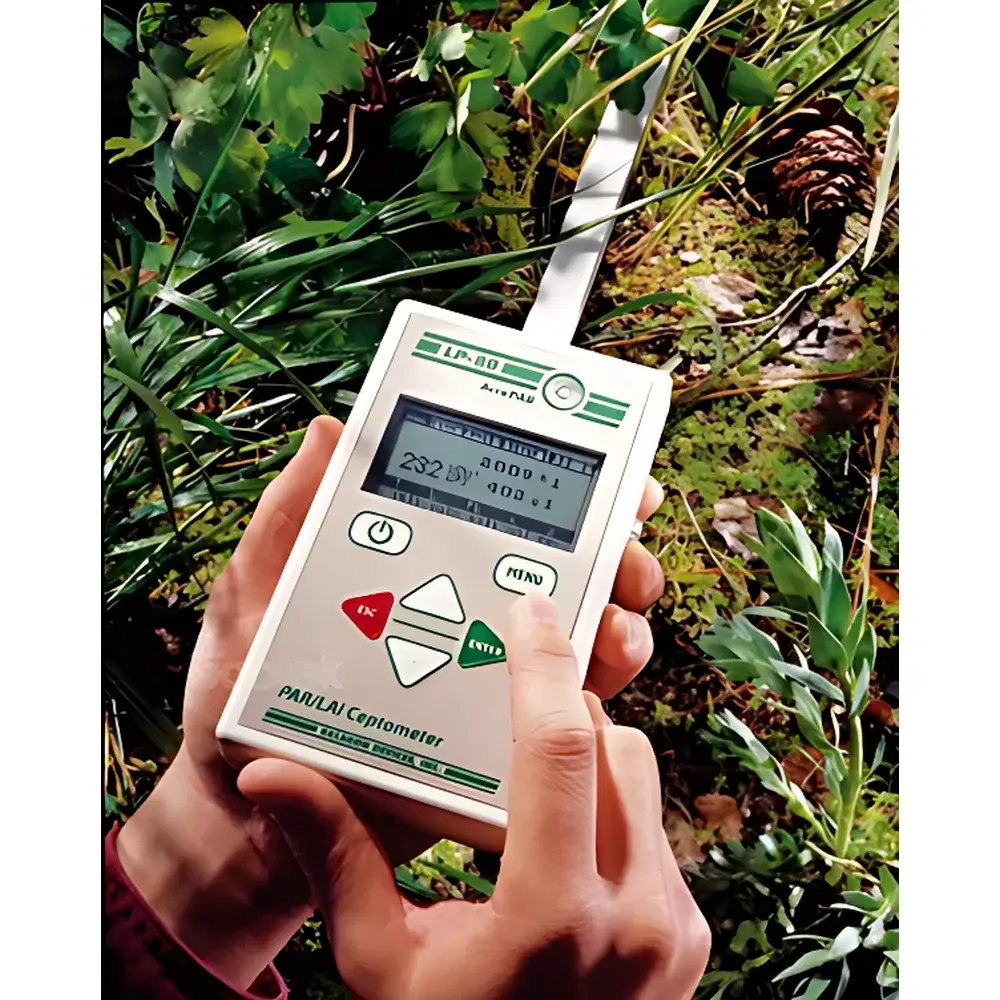
METER LP-80 AccuPAR Canopy Analyzer
| Brand | METER |
|---|---|
| Origin | USA |
| Manufacturer | METER Group, Inc. (formerly Decagon Devices) |
| Model | LP-80 |
| Sensor Count | 80 PAR quantum sensors (1 cm spacing) |
| PAR Measurement Range (Probe) | 0–2500 µmol·m⁻²·s⁻¹ |
| Resolution | 1 µmol·m⁻²·s⁻¹ |
| Accuracy | ±5% |
| External PAR Sensor | Apogee SQ110, 0–4000 µmol·m⁻²·s⁻¹, Ø24 × 27 mm, 5-pin sealed circular connector, 5 m cable |
| Unattended Sampling Interval | 1–60 min |
| Data Storage | 1 MB RAM |
| Power | 4 × AAA alkaline batteries (typical 2-year field life) |
| Operating Environment | 0–50 °C, 0–100% RH |
| Compliance | ISO 9001:2015, ISO/IEC 17050:2010 (CE marked) |
| Dimensions (Probe) | 865 × 19.0 × 9.5 cm |
| Dimensions (Control Unit) | 15.8 × 9.5 × 3.3 cm |
| Weight (Control Unit, w/batteries) | 0.55 kg |
| Interface | 5-pin sealed circular to RS-232 cable included |
Overview
The METER LP-80 AccuPAR Canopy Analyzer is a field-deployable, research-grade instrument engineered for rapid, non-destructive quantification of photosynthetically active radiation (PAR) transmission and leaf area index (LAI) in plant canopies. Based on the Beer–Lambert law and validated gap-fraction inversion algorithms, the LP-80 measures incident and transmitted PAR simultaneously using an 80-sensor linear quantum array spaced at 1 cm intervals. By integrating user-input geographic coordinates and time-of-measurement, the device calculates solar zenith angle and applies user-defined leaf angle distribution parameter (X) to derive LAI from the ratio of above-canopy to below-canopy PAR irradiance. Unlike optical hemispherical photography or destructive sampling methods, the LP-80 delivers repeatable, traceable LAI values without requiring post-processing calibration or image analysis software—making it suitable for longitudinal monitoring under GLP-aligned field protocols.
Key Features
- Integrated 80-element PAR quantum sensor array with factory-traceable calibration stored in non-volatile memory—no field recalibration required
- Dual-point PAR measurement capability: simultaneous acquisition of incident (via external Apogee SQ110 sensor) and transmitted (via linear probe) irradiance
- Onboard calculation engine for LAI, gap fraction, and canopy light extinction coefficient using standard spherical leaf angle distribution assumptions (X = 1 default)
- Intuitive 7-button interface with real-time display of PAR flux, LAI, and battery status; no external power or laptop needed during data collection
- 1 MB internal RAM supports >100,000 timestamped measurements; programmable unattended logging intervals from 1 to 60 minutes
- Low-power architecture: 4 × AAA alkaline batteries sustain >17,500 measurements over typical 2-year deployment cycles
- Ruggedized housing rated for continuous operation across 0–50 °C and 0–100% relative humidity; CE-marked per ISO/IEC 17050:2010
Sample Compatibility & Compliance
The LP-80 is compatible with herbaceous, shrub, and broadleaf forest canopies up to 3 m in height when used with the standard 86.5 cm probe and extendable pole system. It does not require species-specific parameterization but accommodates user adjustment of the leaf angle distribution parameter (X) to improve accuracy in needleleaf or highly clumped canopies. All measurements conform to ASTM E2098–21 (Standard Practice for Measuring Photosynthetically Active Radiation) and support compliance with ISO 11727:2022 (Plant canopy structure—Determination of leaf area index by indirect methods). The instrument’s documented calibration history, firmware versioning, and audit-ready data export facilitate adherence to FDA 21 CFR Part 11 requirements for electronic records in regulated agricultural trials.
Software & Data Management
Data retrieval is supported via native Windows-compatible AccuPAR Desktop Software (v3.x), which enables visualization of diurnal PAR profiles, LAI time-series plots, and statistical summaries (mean, SD, CV%). Raw binary files (.dat) are also readable through terminal emulation (e.g., PuTTY) using standard RS-232 serial protocol, allowing integration into custom Python or R pipelines. Each record includes UTC timestamp, GPS-derived location metadata (if enabled externally), sensor ID, and QA flags for saturated or low-signal readings. Firmware updates preserve backward compatibility with legacy datasets and maintain full traceability under ISO 9001:2015 quality management system documentation.
Applications
- Long-term phenological monitoring of crop canopy development in agronomic field trials (e.g., maize, soybean, wheat)
- Forest structure assessment in ecological inventories and carbon sequestration modeling
- Evaluation of shade-tolerant species performance in agroforestry systems
- Validation of satellite-derived LAI products (e.g., MODIS, Sentinel-2) at ground-truth sites
- Controlled-environment studies of light interception efficiency under variable planting densities
- Supporting FAO AquaCrop and DSSAT crop simulation model parameterization
FAQ
Does the LP-80 require annual recalibration?
No. Factory calibration coefficients are permanently stored in onboard memory and remain stable under normal operating conditions. Users may verify sensor response using the external SQ110 reference sensor prior to critical campaigns.
Can the LP-80 measure LAI in coniferous stands?
Yes—with appropriate selection of the leaf angle distribution parameter (X). For needleleaf canopies, X values between 0.5 and 0.7 are recommended based on published allometric relationships.
Is the data output compatible with GIS platforms?
Yes. Exported CSV files include latitude, longitude, elevation (when paired with external GNSS), and timestamp fields—enabling direct import into ArcGIS, QGIS, or ENVI for spatial interpolation and zonal statistics.
What is the minimum detectable LAI value?
The practical lower limit is ~0.2 LAI, constrained by signal-to-noise ratio at low transmission levels (<5% of incident PAR). Below this threshold, uncertainty increases significantly due to ambient diffuse light contributions.
How is the external SQ110 sensor mounted during measurement?
It is positioned horizontally above the canopy on a leveling tripod or pole-mounted bracket, aligned parallel to the LP-80 probe axis, ensuring co-planar irradiance geometry for accurate ratio computation.





