
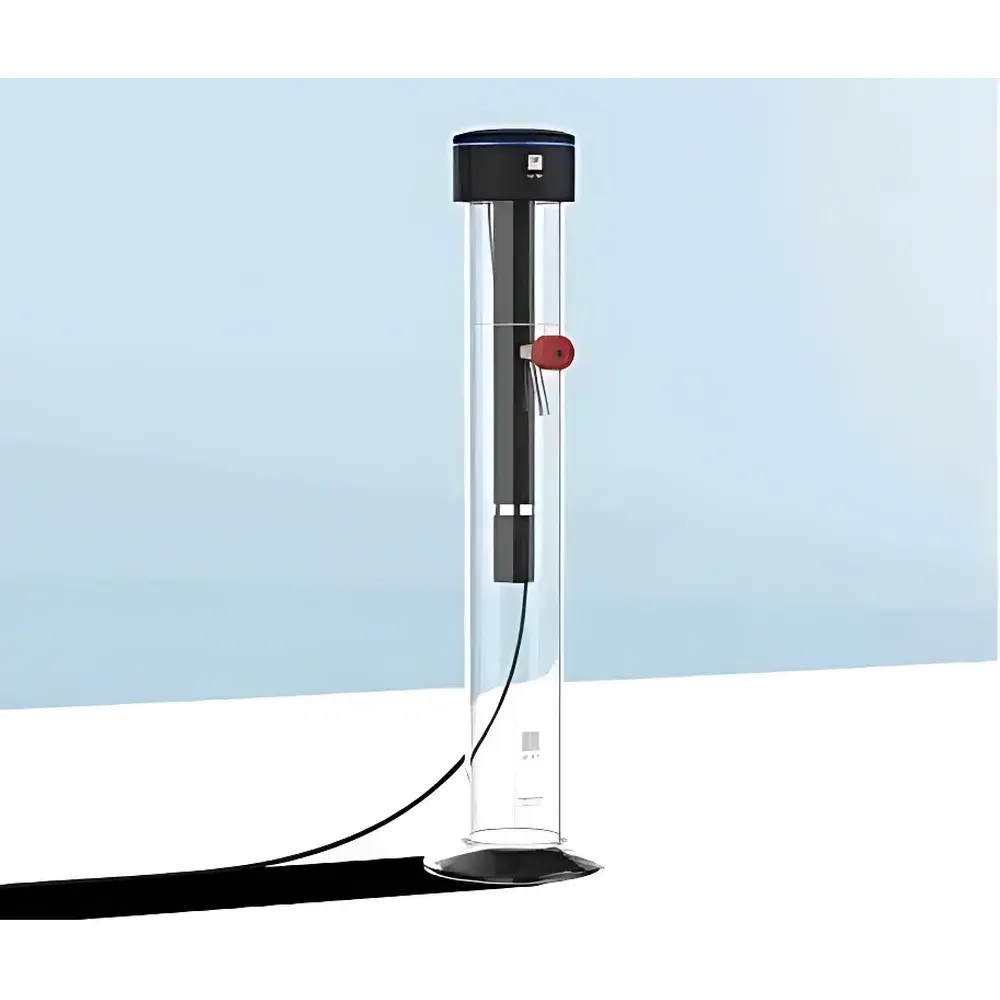
METER PARIO Plus Automated Soil Particle Size Analyzer
| Brand | METER |
|---|---|
| Origin | USA |
| Model | PARIO Plus |
| Instrument Type | Multi-Function Soil Analyzer |
| Particle Size Range | 2–63 µm |
| Measurement Principle | Extended Integrated Suspension Pressure Method (ISP+) based on Stokes’ Law |
| Accuracy (Mass Fraction) | ±1.0% |
| Pressure Sensor Accuracy | ±1.0 Pa, Resolution: ±0.1 Pa |
| Measurement Interval | 10 s |
| Typical Sample Mass | 25–50 g per 1 L suspension |
| Measurement Duration | ~2.5 h |
| Operating Temperature | 15–35 °C (optimal at 20 °C), max ΔT during measurement: ±1.5 °C |
| Suspension Volume | 1000 mL |
| Glass Column Dimensions | H 450 mm, ID 59 mm, OD 67.5 mm, borosilicate glass 3.3 |
| Device Dimensions | H 293 mm, Ø 80 mm, housing material: POM + stainless steel |
| Power Supply | USB 5 V / 100 mA |
| PC Compatibility | Windows 10 |
| Compliance | ISO 9001:2015, ISO/IEC 17050:2010 (CE Mark) |
| Required Ancillary Measurements | Dry mass of subsample, sand content (wet sieving), mass of dispersing salt in suspension |
Overview
The METER PARIO Plus Automated Soil Particle Size Analyzer is an advanced, benchtop instrument engineered for high-precision, fully automated determination of soil particle size distribution (PSD) in the silt and clay fraction (2–63 µm). Unlike laser diffraction or image-based systems, the PARIO Plus applies a physically grounded, hydrodynamic measurement principle rooted in Stokes’ law—ensuring traceability to classical sedimentation theory while eliminating empirical calibration dependencies. Its core innovation lies in the Extended Integrated Suspension Pressure (ISP+) method (Durner et al., 2017), which continuously monitors pressure and temperature gradients at a fixed depth within a vertically oriented, thermostatically stabilized suspension column. By resolving temporal pressure decay with ±0.1 Pa resolution at 10-second intervals over ~2.5 hours, the system reconstructs continuous PSD curves without manual intervention, sampling, or mechanical disturbance—preserving natural settling dynamics and minimizing operator-induced error.
Key Features
- Fully automated operation: Once configured and initiated, the PARIO Plus runs unattended; only a single manual valve actuation is required at measurement completion.
- High metrological fidelity: Achieves ±1.0% mass fraction uncertainty—superior to traditional hydrometer (ASTM D422, ISO 11277) and pipette methods, and significantly more robust than laser diffraction systems requiring extensive soil-specific transfer function corrections.
- Non-invasive, disturbance-free measurement: No insertion of hydrometers, no pipetting, no stirring—eliminating resuspension artifacts and ensuring undisturbed sedimentation kinetics.
- Physically principled calculation: Direct derivation of particle size from measured pressure decay via Stokes’ law—no empirical fitting or matrix-dependent calibration required for clay/silt fractions.
- Integrated environmental compensation: Real-time temperature monitoring enables automatic dynamic viscosity and density correction, critical for accurate Stokes-based sizing across ambient lab conditions (15–35 °C).
- Borosilicate glass suspension column: 1000 mL capacity, precision-machined (ID 59.0 mm), compliant with ISO 11277 geometry requirements for sedimentation analysis.
Sample Compatibility & Compliance
The PARIO Plus is validated for mineral soils with organic matter content ≤10% (organic carbon removal via H2O2 oxidation is recommended per ISO 11277 prior to analysis). It accepts standard 25–50 g dry soil samples dispersed in sodium hexametaphosphate solution. Sand content must be pre-determined by wet sieving (ISO 11277 Annex A), and total dry mass of the analyzed subsample must be recorded for mass balance. The system complies with ISO 9001:2015 quality management standards and bears CE marking per EU Regulation (EC) No 765/2008 and ISO/IEC 17050:2010. While not certified for GLP or 21 CFR Part 11 out-of-the-box, its deterministic algorithm, full audit trail of raw pressure/temperature time series, and exportable CSV/Excel data formats support integration into regulated workflows with appropriate SOP documentation.
Software & Data Management
Controlled via Windows 10–compatible desktop software, the PARIO Plus interface provides real-time visualization of pressure decay, temperature stability, and intermediate PSD reconstructions. All raw sensor data (pressure in Pa, temperature in °C, timestamp) are stored locally in open-format CSV files, enabling third-party reprocessing and long-term archival. The software calculates cumulative and differential PSD curves, reports clay (63 µm) mass fractions, and exports results to Excel-compatible spreadsheets with metadata (sample ID, operator, date/time, dispersion protocol, dry mass). No cloud dependency or proprietary binary formats are used—ensuring full data sovereignty and compatibility with institutional LIMS or statistical analysis pipelines (R, Python, SAS).
Applications
- Soil texture classification (USDA, FAO, WRB systems)
- Hydraulic property estimation (e.g., van Genuchten parameters via pedotransfer functions)
- Clay mineralogy screening in conjunction with XRD or CEC assays
- Quality control in soil remediation and land reclamation projects
- Long-term soil monitoring networks requiring inter-laboratory comparability
- Method validation studies comparing against reference hydrometer or sedimentation protocols
FAQ
Does the PARIO Plus require soil-specific calibration?
No. Unlike laser diffraction or image analysis, the ISP+ method relies solely on first-principles physics (Stokes’ law) and does not require transfer functions or matrix-specific calibration.
Can it measure particles outside the 2–63 µm range?
The system is optimized for silt and clay fractions. Sand (>63 µm) must be removed by wet sieving prior to analysis, as per ISO 11277.
Is temperature control built into the instrument?
The PARIO Plus does not include active temperature regulation but operates within a stable ambient environment (15–35 °C); its software applies real-time thermal corrections using measured temperature data.
What sample preparation steps are mandatory?
Organic matter removal (H2O2), dispersion (sodium hexametaphosphate), wet sieving for sand separation, and precise weighing of the dry subsample are required per ISO 11277 guidelines.
How is data integrity ensured for regulatory submissions?
Raw time-series data (pressure, temperature, timestamps) are stored in human-readable CSV format with no lossy compression, supporting full traceability, independent verification, and audit-ready documentation.
Related Products







