
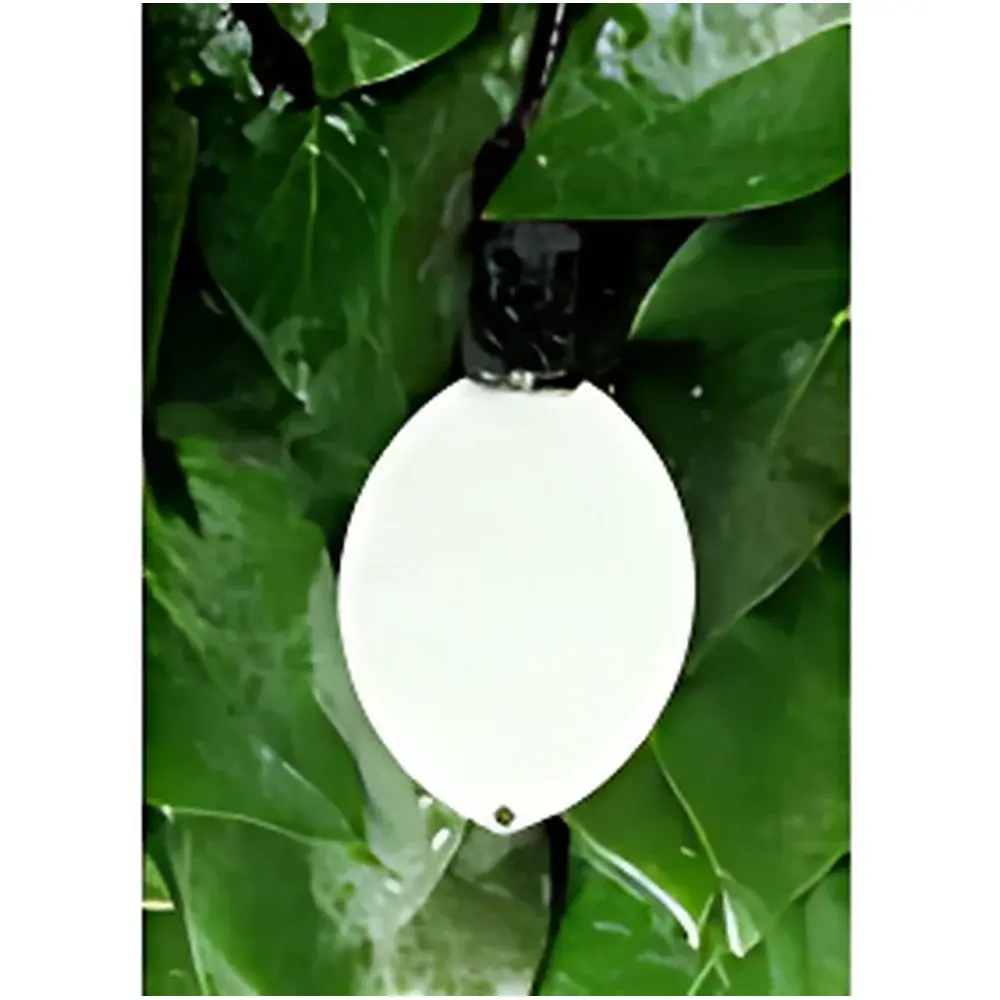
METER PHYTOS 31 Leaf Wetness Sensor
| Brand | METER |
|---|---|
| Origin | USA |
| Model | PHYTOS 31 |
| Dimensions | 12.0 × 5.8 × 0.8 cm |
| Operating Temperature | -40 to +60 °C |
| Cable Length | Standard 5 m (customizable up to 40 m) |
| Interface | 3.5 mm stereo jack or bare wire |
| Supply Voltage | 2.5–5.0 VDC |
| Measurement Time | 10 ms |
| Output Signal | 300–1250 mV (proportional to excitation voltage) |
| Sensor Type | Frequency-Domain Dielectric Sensor |
| Output Resolution Compatibility | ≥12-bit single-ended voltage input |
| Certified Standards | ISO 9001:2015, CE (EMC per ISO/IEC 17050:2010) |
Overview
The METER PHYTOS 31 Leaf Wetness Sensor is a frequency-domain dielectric sensor engineered for ecologically valid, long-term monitoring of leaf surface moisture status in natural and managed plant canopies. Unlike resistive leaf wetness sensors—which rely on conductive bridging across electrodes and are prone to drift, contamination, and false positives—the PHYTOS 31 measures the dielectric permittivity of the thin water film or ice layer directly adjacent to its polymer surface. This physical principle enables detection of micro-scale condensation, dew formation, frost deposition, and light interception events with high temporal fidelity and minimal hysteresis. Its thermally matched substrate mimics the thermal mass and evaporative dynamics of real leaves, ensuring realistic response kinetics to ambient humidity, radiation, and convective cooling. Designed for deployment in unattended field stations, the sensor operates reliably across extreme climatic conditions—from arctic tundra to subtropical orchards—without requiring recalibration or routine maintenance.
Key Features
- Dielectric sensing principle eliminates dependence on surface conductivity, enabling robust detection of dew, frost, and light rain without false triggers from dust, salt, or organic residue.
- Thermally inert polymer substrate replicates leaf thermal inertia, ensuring physiologically relevant wetness dynamics—including evaporation-driven drying and radiative cooling-induced condensation.
- Low-power operation (typical current draw <1 mA at 3.3 VDC) supports multi-year deployments on solar-recharged data loggers.
- Fast 10 ms measurement cycle allows sub-minute temporal resolution for process-level studies of dew duration, frost onset, or canopy interception efficiency.
- Standard SDI-12 compatibility enables plug-and-play integration with METER ZL6, EM50/60 series, and third-party loggers supporting 2.5–5.0 VDC excitation and ≥12-bit single-ended analog input.
- Factory-calibrated traceable to NIST-traceable reference standards; no user calibration required under normal operating conditions.
Sample Compatibility & Compliance
The PHYTOS 31 is compatible with all terrestrial vascular plant species and non-vascular bryophytes where surface microclimate interaction is relevant. It does not require species-specific configuration and functions identically across broadleaf, needleleaf, and grass canopies. The sensor complies with ISO 9001:2015 quality management requirements for design and manufacturing. Electromagnetic compatibility is certified to ISO/IEC 17050:2010 (CE marking), ensuring stable operation in mixed-signal field environments with RF transceivers, solar chargers, and wireless telemetry modules. While not explicitly validated against ASTM E2277 (Standard Guide for Measuring Leaf Wetness), its dielectric methodology aligns with best practices outlined in FAO Irrigation and Drainage Paper No. 56 for phenological modeling inputs.
Software & Data Management
Raw voltage outputs (300–1250 mV) are linearly proportional to excitation voltage and can be converted to dimensionless wetness indices or calibrated to dew duration thresholds using site-specific empirical relationships. When paired with METER’s ZL6 data logger, PHYTOS 31 data is automatically time-stamped, stored with metadata (battery voltage, temperature, GPS if enabled), and exportable via USB or cellular uplink in CSV or JSON format. All firmware and configuration tools adhere to FDA 21 CFR Part 11 principles for audit trail integrity when used in GLP-compliant agricultural research. Third-party platforms including Campbell Scientific LoggerNet, HOBOware Pro, and Python-based PyCampbellCR1000 support direct ingestion via analog channel mapping and custom scaling equations.
Applications
- Precision agriculture: Quantifying dew duration to refine irrigation scheduling and optimize fungicide application windows in vineyards and orchards.
- Plant pathology: Supporting early-warning models for foliar diseases (e.g., powdery mildew, citrus greening) that require >6 h continuous leaf wetness for spore germination.
- Ecohydrology: Estimating canopy interception loss during low-intensity rainfall events (<2 mm/h) where traditional tipping-bucket gauges lack resolution.
- Climate change research: Monitoring shifts in nocturnal dew formation frequency and duration across elevation gradients or land-use transitions.
- Frost risk assessment: Detecting surface ice nucleation onset in perennial crops prior to air temperature minima, enabling targeted frost mitigation strategies.
FAQ
How does the PHYTOS 31 differ from resistive leaf wetness sensors?
It uses frequency-domain dielectric measurement instead of electrical resistance, eliminating sensitivity to electrolyte concentration, surface contamination, and electrode corrosion.
Is field calibration required?
No—each unit is factory calibrated against traceable dielectric standards; zero-point and span stability are verified over the full -40 to +60 °C operating range.
Can it detect frost as well as dew?
Yes—the dielectric contrast between liquid water and ice is sufficiently distinct to resolve phase transitions; output hysteresis during freeze-thaw cycles is <2% of full scale.
What data logger specifications are mandatory for reliable operation?
A minimum 12-bit analog-to-digital converter, stable 2.5–5.0 VDC excitation source, and ≥10 kΩ input impedance are required to maintain specified measurement repeatability.
Does cable length affect measurement accuracy?
Signal attenuation is negligible up to 40 m with standard twisted-pair wiring; no active signal conditioning is needed within this range.




