
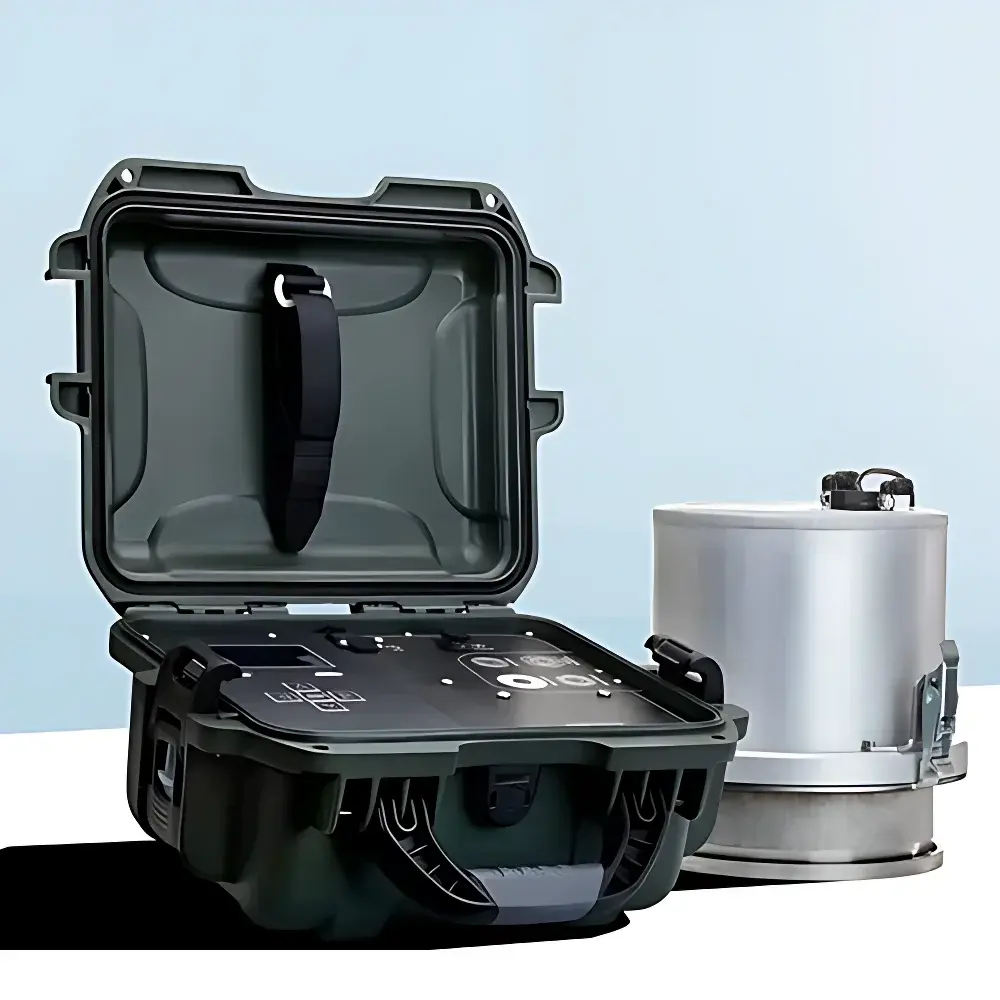
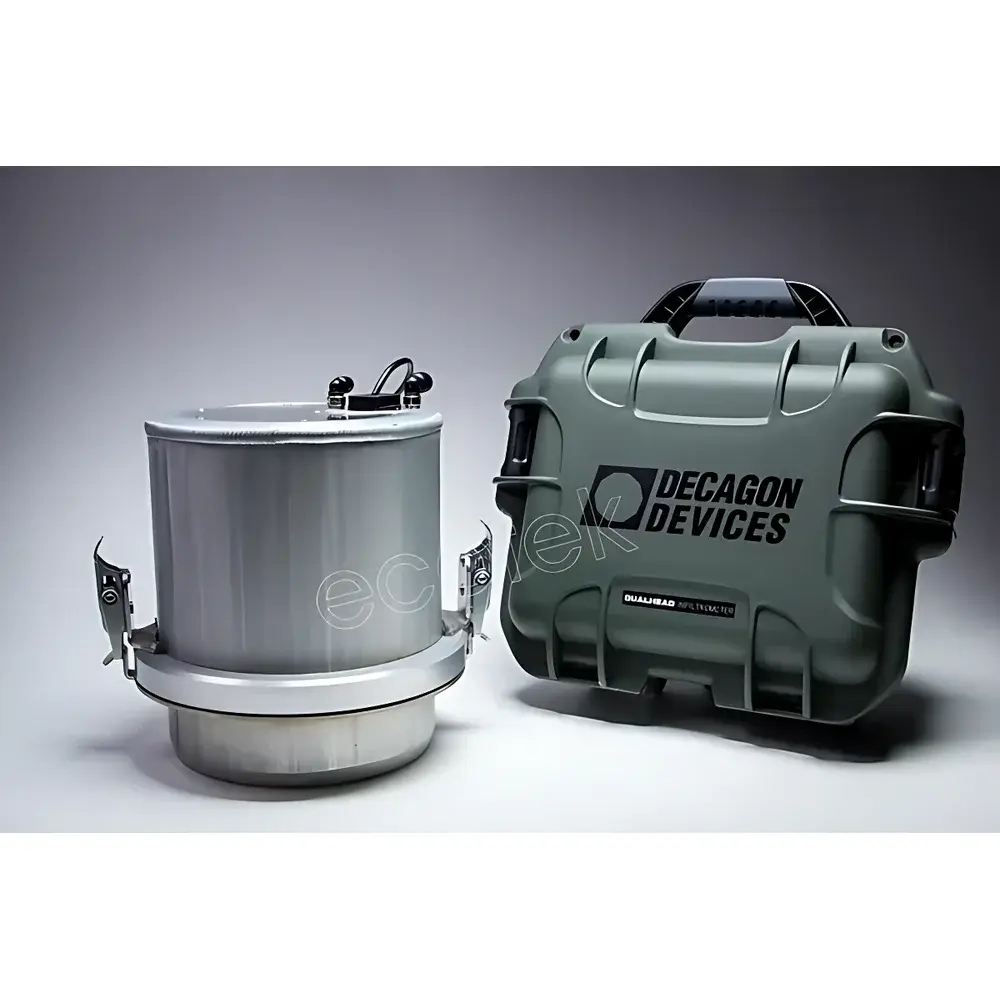
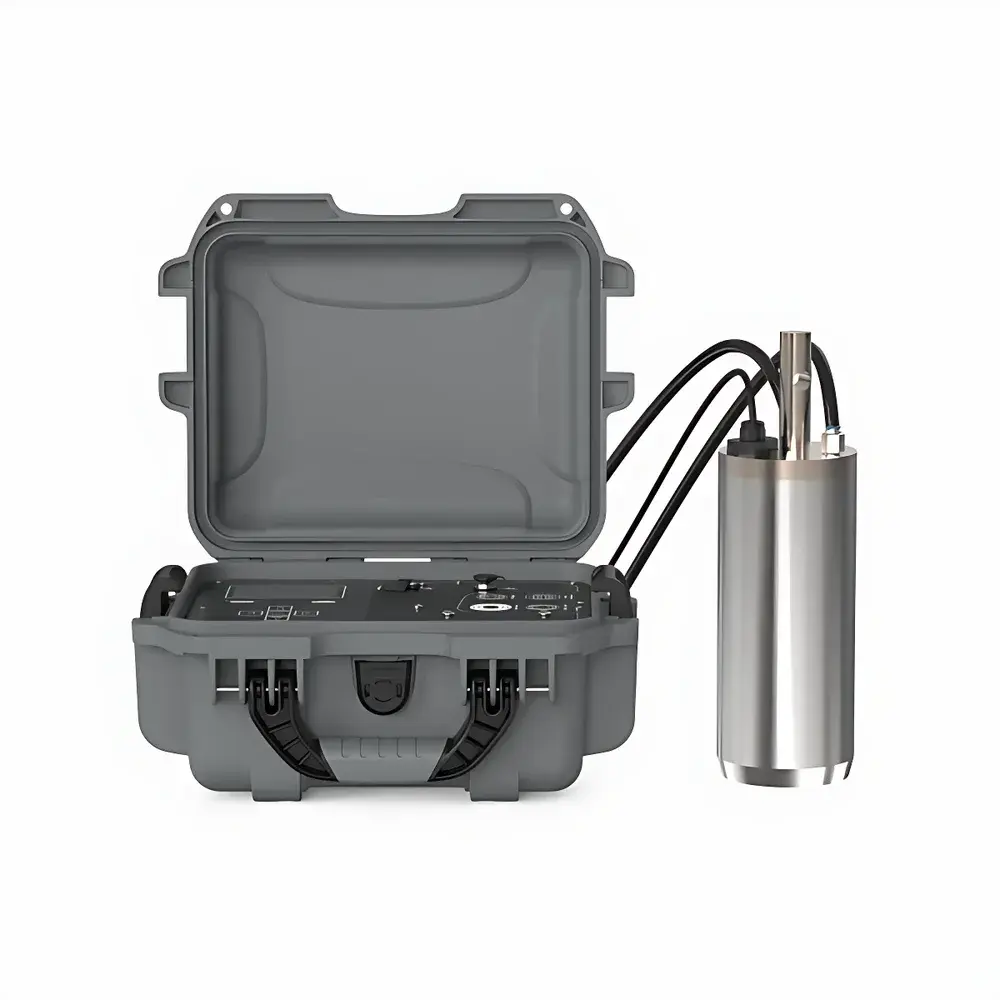
METER SATURO Dual-Head Infiltrometer
| Brand | METER |
|---|---|
| Origin | USA |
| Model | SATURO |
| Instrument Type | Automated Dual-Head Infiltration Analyzer for Saturated Hydraulic Conductivity (Kfs) Measurement |
| Infiltration Rate Range | 0.0038–115 cm/hr |
| Resolution | 0.0038 cm/hr |
| Accuracy | ±5% of reading |
| Pressure Head Range | 0–40 cm |
| Water Level Control | Maintained at 5 cm |
| Operating Temperature | 0–50 °C |
| Power Input | 18 V DC, 2.2 A (18–24 V DC supported) |
| Output Interface | USB |
| Standard Head Dimensions | Total Height 18.3 cm, Internal Diameter 17.2 cm |
| Borehole Head Dimensions | Total Height 28.78 cm, Internal Diameter 8.26 cm |
| Embedded Ring ID | 14.4 cm, Insertion Depth: 5 or 10 cm |
Overview
The METER SATURO Dual-Head Infiltrometer is an automated, field-deployable instrument engineered for the direct, assumption-free determination of saturated hydraulic conductivity (Kfs) in unsaturated and near-saturated soils. It operates on the dual-head infiltration principle rooted in the Reynolds and Elrick (1990) analytical solution to the three-dimensional Richards equation. Unlike single-ring or single-head devices—which require prior estimation or calibration of the soil macroscopic capillary length (α)—the SATURO applies two distinct, precisely regulated pressure heads simultaneously via pneumatic control. This enables closed-form numerical inversion of the infiltration equation, yielding Kfs, sorptivity (S), and α as independent, experimentally derived parameters—not modeled approximations. The system eliminates lateral flow artifacts through controlled head differentials and real-time volumetric flux monitoring, ensuring high reproducibility across heterogeneous field sites.
Key Features
- Fully automated dual-head pressure regulation using integrated air-driven diaphragm pumps—no manual water-level adjustment or siphon maintenance required.
- Real-time data acquisition and on-board calculation of Kfs, S, and α without post-processing or external software dependency.
- Low water consumption design: pressure heads are sustained pneumatically; only minimal reservoir replenishment is needed per test cycle.
- Modular hardware architecture supporting both surface-mounted standard heads and borehole-integrated measurement heads for subsurface profiling down to 2 m depth.
- Field-portable configuration: total system weight under 12 kg; full setup and operation achievable by a single technician in under 15 minutes.
- Robust environmental rating: operational integrity maintained across 0–50 °C ambient temperature range and variable soil textures—from coarse sands to structured clays.
- Compliance-ready data logging: time-stamped, audit-trail-capable output with USB export compatible with GLP/GMP-aligned laboratory information management systems (LIMS).
Sample Compatibility & Compliance
The SATURO is validated for use in mineral soils, organic-rich topsoils, and compacted anthropogenic substrates. Its dual-head methodology satisfies the theoretical requirements of ASTM D3385 (Standard Test Method for Infiltration Rate of Soils in Field Using Double-Ring Infiltrometer) while extending beyond its limitations via explicit 3D flow correction. The instrument’s calculation engine implements the exact analytical form described in Reynolds & Elrick (1990), cited in USDA-NRCS TR-55 and ISO 11274:2020 (Soil quality — Determination of saturated hydraulic conductivity). All firmware and data outputs conform to FDA 21 CFR Part 11 electronic record requirements when used with validated LIMS integration protocols. No calibration standards or reference materials are required—system accuracy is traceable to NIST-traceable pressure transducers and volumetric flow sensors.
Software & Data Management
Data acquisition and analysis are performed internally by the SATURO control unit running embedded firmware v3.2+. Raw pressure, flow rate, and time-series infiltration data are logged at 1 Hz resolution and stored in non-volatile memory. USB export generates CSV files containing timestamped columns for applied head (cm), cumulative infiltration (cm), calculated flux (cm/hr), and derived parameters (Kfs, S, α). Optional cloud synchronization via METER ZENTRA platform supports multi-site spatial heterogeneity mapping, with geotagged metadata and automated QA/QC flagging for outlier detection (e.g., air entrapment, ring leakage). All data exports include full traceability: firmware version, sensor serial numbers, operator ID, and environmental context (ambient T, RH).
Applications
- Quantification of Kfs for vadose zone modeling in hydrological and contaminant transport simulations (e.g., HYDRUS-1D, STANMOD).
- Pre- and post-remediation assessment of infiltration capacity in brownfield redevelopment and landfill cover design.
- Validation of pedotransfer functions (PTFs) and soil hydraulic property databases (e.g., ROSETTA, UNSODA).
- In situ characterization of bioinfiltration basins, permeable pavements, and stormwater green infrastructure performance.
- Long-term monitoring of soil structural degradation or improvement under conservation tillage and cover cropping regimes.
- Regulatory compliance reporting for EPA Region-specific stormwater permits (e.g., NPDES Phase II) and EU Soil Thematic Strategy indicators.
FAQ
How does the SATURO eliminate the need to assume or estimate α?
It solves the infiltration equation simultaneously using two independently controlled pressure heads—generating two unique infiltration curves. This overdetermined system allows algebraic isolation of α without empirical correlation or texture-based estimation.
Can the SATURO be used in rocky or gravelly soils?
Yes—provided the measurement ring achieves full contact with undisturbed soil matrix. For highly heterogeneous profiles, the borehole head option minimizes surface disturbance and improves representativeness at depth.
Is external power required during measurement?
The control unit operates on internal rechargeable Li-ion batteries (rated for ≥8 hours continuous use). AC adapter (18–24 V DC) is optional for extended deployments or rapid recharging between tests.
What is the minimum recommended sample area for reliable Kfs measurement?
For standard head deployment, a 30 × 30 cm undisturbed plot is advised. For borehole measurements, a 15-cm-diameter access hole with intact sidewalls ensures representative sampling volume.
Does the SATURO comply with ISO/IEC 17025 testing laboratory requirements?
When operated per METER’s documented SOPs (SOP-INF-01 Rev. 4) and maintained with annual transducer calibration certificates, the SATURO meets method validation criteria for accredited soil physics laboratories.







