
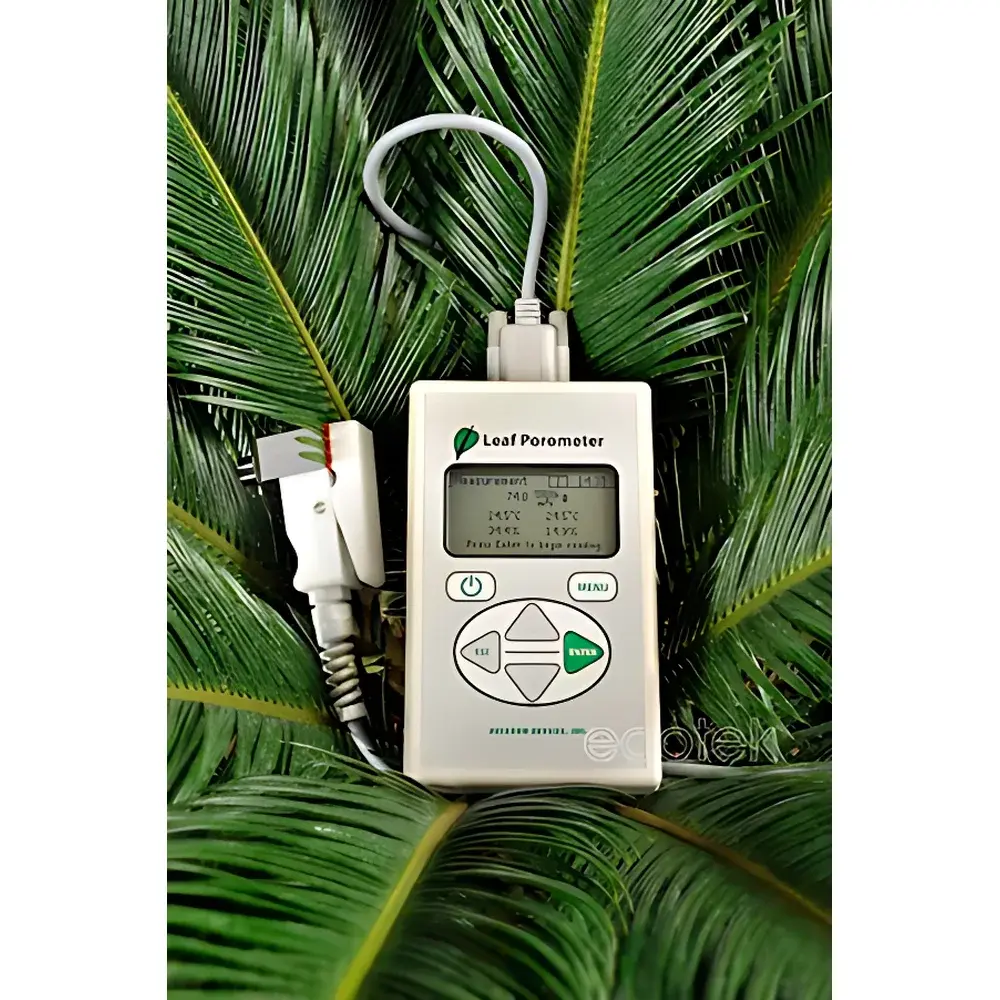
METER SC-1 Steady-State Porometer
| Brand | METER |
|---|---|
| Origin | USA |
| Manufacturer Type | Authorized Distributor |
| Origin Category | Imported |
| Model | SC-1 |
| Pricing | Upon Request |
Overview
The METER SC-1 Steady-State Porometer is a field-deployable, battery-powered instrument engineered for direct, non-destructive measurement of leaf stomatal conductance (gs) in situ. It operates on the principle of steady-state diffusion, where a precisely defined aperture (6.35 mm diameter) is sealed against the leaf surface using a calibrated diffusion pathway. The device measures the water vapor flux across this known resistive channel by quantifying the vapor pressure gradient between the leaf boundary layer and the internal reference chamber—enabled by integrated humidity and temperature sensors. Stomatal conductance is then derived via Fick’s first law of diffusion: gs = J / Δe, where J is the calculated water vapor flux (mol·m−2·s−1) and Δe is the vapor pressure deficit (kPa) across the leaf surface. This physics-based approach ensures traceable, repeatable results without reliance on airflow generation or external pumps—eliminating turbulence-induced artifacts common in dynamic porometers.
Key Features
- True steady-state measurement architecture—no fan, pump, or forced-air components; eliminates boundary-layer disturbance and flow calibration drift
- Dual-mode operation: fully automated 30-second acquisition (removes operator-dependent endpoint selection) and manual mode for real-time sensor monitoring and ad-hoc data logging
- Integrated desiccant cartridge (10–20 mesh silica gel) maintains internal dry reference conditions under high ambient RH (up to 100 % RH when active), ensuring stable baseline performance in humid tropical or greenhouse environments
- Ultra-low power design: 3 years of typical field use (based on 10 measurements/day)
- Compact, ergonomic form factor (15.8 × 9.5 × 3.3 cm; ~320 g) optimized for one-handed operation and extended canopy access
- Onboard memory stores up to 4,095 complete measurement records—including gs, vapor pressure deficit, leaf temperature, ambient RH, and timestamp—with RS-232 serial interface (9-pin D-sub) for PC-based data retrieval and batch export
Sample Compatibility & Compliance
The SC-1 accommodates intact, turgid leaves with smooth to moderately textured surfaces (e.g., maize, wheat, soybean, Arabidopsis rosettes, grapevine, and broadleaf ornamentals). Its fixed 6.35 mm measurement aperture requires minimal leaf area and avoids tissue compression artifacts associated with larger chambers. The instrument conforms to standardized physiological measurement protocols referenced in ASTM E1980 (Standard Guide for Conducting Plant Stress Experiments) and supports GLP-aligned data integrity through time-stamped, non-editable measurement logs. While not FDA 21 CFR Part 11 certified (as it is a research-grade field instrument), its deterministic steady-state algorithm and hardware-based calibration traceability align with ISO/IEC 17025 requirements for measurement uncertainty management in plant phenotyping labs.
Software & Data Management
Data extraction is performed via terminal emulation software (e.g., Tera Term or PuTTY) using ASCII protocol over RS-232. Each record includes six fields: date/time stamp, stomatal conductance (mmol·m−2·s−1), reciprocal conductance (m2·s·mol−1), resistance (s·m−1), leaf-to-air vapor pressure deficit (kPa), and sensor head temperature (°C). No proprietary software installation is required. Exported .csv files are directly compatible with R, Python (pandas), MATLAB, and statistical platforms such as JMP or SAS for longitudinal analysis, QTL mapping, or drought-response modeling. Firmware updates (if issued) are delivered via simple ASCII command sequence—no USB adapter or driver dependencies.
Applications
- Field-based drought tolerance screening in breeding programs (e.g., identifying genotypes with conservative stomatal behavior under water deficit)
- Diurnal stomatal kinetics studies—tracking gs response to light intensity, VPD, and CO2 gradients without chamber acclimation delay
- Validation of thermal infrared or hyperspectral proxies for stomatal conductance in remote sensing workflows
- Teaching laboratories: hands-on demonstration of plant water relations, Fickian diffusion, and environmental physiology principles
- Ecophysiological monitoring across gradients—elevation, soil moisture, or urban heat island effects—where portability and rapid throughput are critical
FAQ
How does the SC-1 differ from dynamic (open-system) porometers?
Unlike dynamic porometers that rely on regulated airflow and feedback-controlled humidity, the SC-1 uses passive diffusion equilibrium—making it insensitive to leaf boundary-layer thickness, wind speed, or chamber leakage. This yields higher reproducibility under variable field conditions.
Is calibration required before each use?
No routine recalibration is needed. The instrument ships with factory-applied diffusion-path calibration constants stored in non-volatile memory. Users perform only a quick zero-check using the included desiccant cap prior to field deployment.
Can the SC-1 measure transpiration rate directly?
No—it measures stomatal conductance exclusively. Transpiration rate (E) must be calculated externally using concurrent measurements of vapor pressure deficit and leaf area.
What is the minimum leaf thickness the chamber can seal against?
The spring-loaded gasket accommodates leaves from 0.1 mm (e.g., young spinach) to 3.5 mm (e.g., mature rubber tree), provided the surface is continuous and non-waxy.
Does the RS-232 interface support modern laptops without serial ports?
Yes—standard USB-to-RS-232 adapters (FTDI chipset recommended) enable plug-and-play connectivity with Windows, macOS, and Linux systems.





