
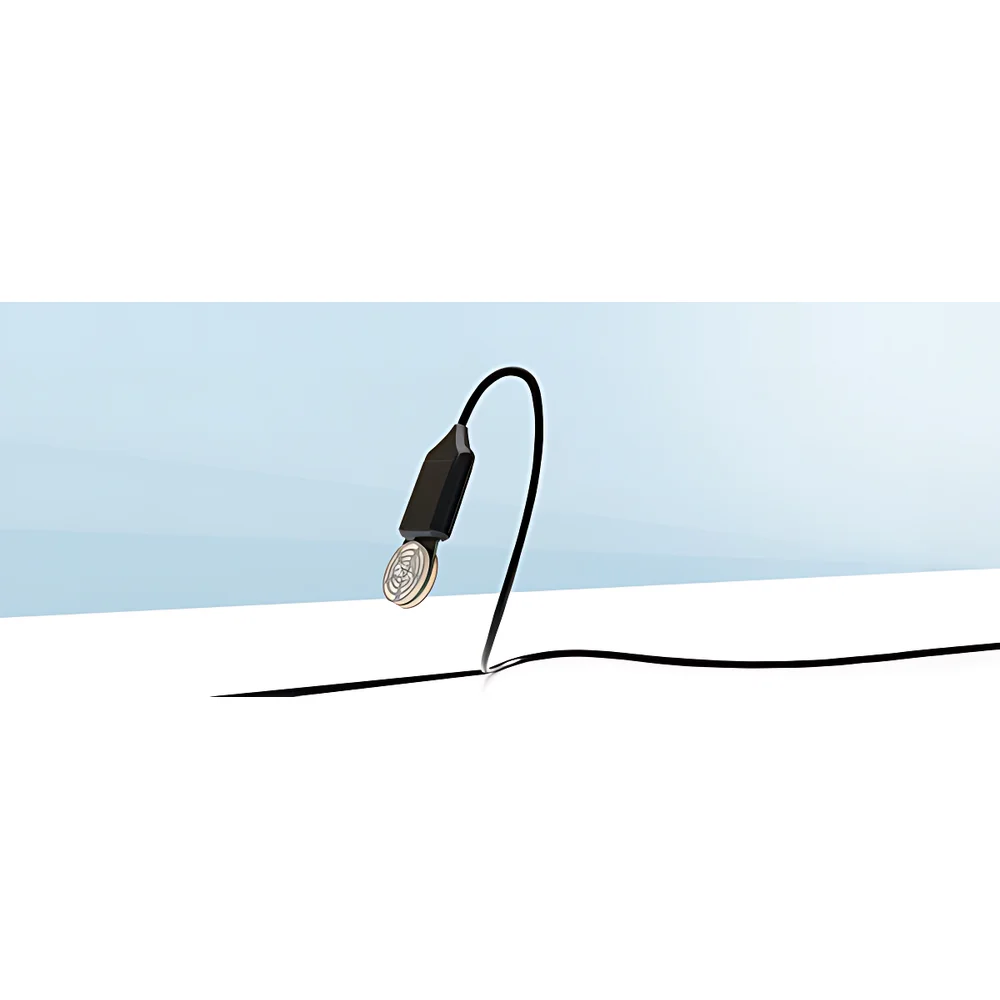
METER TEROS 21 Soil Water Potential Sensor
| Brand | METER |
|---|---|
| Origin | USA |
| Model | TEROS 21 |
| Measurement Range | 0 to –100,000 kPa |
| Temperature Range | –40 to +60 °C |
| Resolution | 0.1 kPa / 0.1 °C |
| Accuracy | ±(10% of reading + 2 kPa) from –5 to –100 kPa / ±1 °C |
| Sensor Type | Frequency-domain ceramic matrix with calibrated thermistor |
| Output | SDI-12 or DDI serial interface |
| Power Supply | 3.6–15 VDC |
| Dimensions | 9.6 × 3.5 × 1.5 cm (L×W×D) |
| sensing head diameter | 3.2 cm |
| Cable Length | 5 m (customizable up to 75 m) |
| Compliance | ISO 9001:2015, ISO/IEC 17050:2010 (CE) |
Overview
The METER TEROS 21 Soil Water Potential Sensor is a field-deployable, ceramic-matrix-based instrument engineered for continuous, high-fidelity measurement of soil water potential (ψ) across the full biophysically relevant range—from saturation (0 kPa) to extreme drought conditions (–100,000 kPa, equivalent to ~6.0 pF). Unlike tensiometric or thermal dissipation methods limited to wetter ranges, the TEROS 21 employs a rigorously characterized porous ceramic matrix in thermodynamic equilibrium with surrounding soil. A high-stability capacitive humidity sensor embedded within the matrix measures relative humidity at the ceramic–air interface; this value is converted to matric potential via a factory-determined, temperature-compensated water release curve (WRP) derived from independent gravimetric and psychrometric validation. This physical principle—based on the fundamental relationship between water activity and chemical potential—ensures traceability to primary standards and eliminates reliance on empirical fitting or site-specific calibration.
Key Features
- Full-range measurement capability: Covers 0 to –100,000 kPa, enabling unified monitoring from flooded to xeric conditions without sensor swapping or method discontinuity.
- Zero-drift ceramic matrix: Utilizes sintered silica-based ceramic with inert, non-hydrolyzable pore structure—immune to aging, organic degradation, or irreversible hysteresis common in polymer or gypsum-based sensors.
- Integrated temperature compensation: Onboard thermistor (±1 °C accuracy) provides concurrent soil temperature data critical for vapor pressure deficit modeling and WRP correction.
- Low-maintenance design: No electrolyte refilling, no membrane replacement, and operational integrity preserved under freeze–thaw cycles (–40 °C to +60 °C housing rating).
- SDI-12 & DDI dual protocol support: Ensures interoperability with widely deployed environmental data loggers including METER ZL6, EM50/60 series, Campbell Scientific CR1000X, and other SDI-12–compliant systems.
- Factory individual calibration: Each unit undergoes per-sensor WRP characterization against NIST-traceable psychrometric reference standards, guaranteeing inter-unit comparability and cross-method consistency (e.g., vs. WP4C or dewpoint hygrometry).
Sample Compatibility & Compliance
The TEROS 21 is validated for use in mineral soils, volcanic ash, peat, and structured agricultural substrates—including saline and sodic profiles where electrical conductivity exceeds 10 dS/m. Its ceramic matrix exhibits negligible sensitivity to ionic strength variation, eliminating systematic bias in coastal, irrigated, or reclaimed soils. The sensor complies with ISO 9001:2015 quality management requirements and bears CE marking per ISO/IEC 17050:2010. While not inherently GLP/GMP-certified, its stable calibration history, audit-ready output metadata (including timestamp, raw RH%, temperature, and diagnostic flags), and compatibility with 21 CFR Part 11–enabled logging platforms (e.g., ZL6 with secure user authentication and electronic signature) support regulated environmental monitoring workflows.
Software & Data Management
Data acquisition requires an external SDI-12 or DDI-compatible logger (e.g., METER ZL6, Campbell CR6, or Onset HOBO RX3000). The TEROS 21 outputs discrete numeric values for water potential (kPa) and temperature (°C) as ASCII strings per command cycle. When paired with the ZL6 system, measurements are automatically time-stamped, stored with CRC error-checking, and accessible remotely via cellular or LoRaWAN telemetry. Raw data exports adhere to CF Standard Names (e.g., “soil_water_potential” and “soil_temperature”) and can be ingested into MATLAB, Python (via PySDI12), R (sdi12 package), or commercial platforms such as Aqua4D or CropX. No proprietary software installation is required—configuration occurs via simple ASCII commands over UART or SDI-12 bus.
Applications
- Long-term eddy covariance and lysimeter studies requiring continuous ψ–θ coupling
- Irrigation scheduling in viticulture, orchards, and precision row crops
- Root zone drought stress phenotyping in controlled-environment growth chambers and field trials
- Soil hydraulic property estimation (e.g., van Genuchten α and n parameters) via inverse modeling
- Validation of satellite-derived soil moisture products (e.g., SMAP, Sentinel-1) at in situ scales
- Ecological research on plant–soil–atmosphere continuum dynamics in arid and semi-arid ecosystems
FAQ
Does the TEROS 21 require field recalibration?
No. The sintered silica ceramic matrix exhibits no measurable drift over time; factory calibration remains valid for the sensor’s operational lifetime under normal environmental exposure.
Can it measure water potential below 0 °C?
Water potential readings below 0 °C are physically meaningful only if unfrozen water is present; however, accuracy degrades below freezing due to ice formation in pores. For cryogenic applications, supplemental dielectric or neutron probe data is recommended.
Is cable length extension supported?
Yes—standard 5 m cables may be extended up to 75 m using shielded, twisted-pair 22 AWG cable with proper grounding to maintain SDI-12 signal integrity.
How does it compare to traditional tensiometers?
Tensiometers fail above –85 kPa due to cavitation; the TEROS 21 maintains accuracy across the entire range, including dry, low-water-activity regimes where root water uptake ceases.
What power supply specifications must the data logger meet?
The sensor operates on 3.6–15 VDC, draws ≤16 mA during measurement (≤0.03 mA in standby), and requires logic-level voltage compliance: high ≥2.8 V, low ≤0.8 V.
Related Products





