
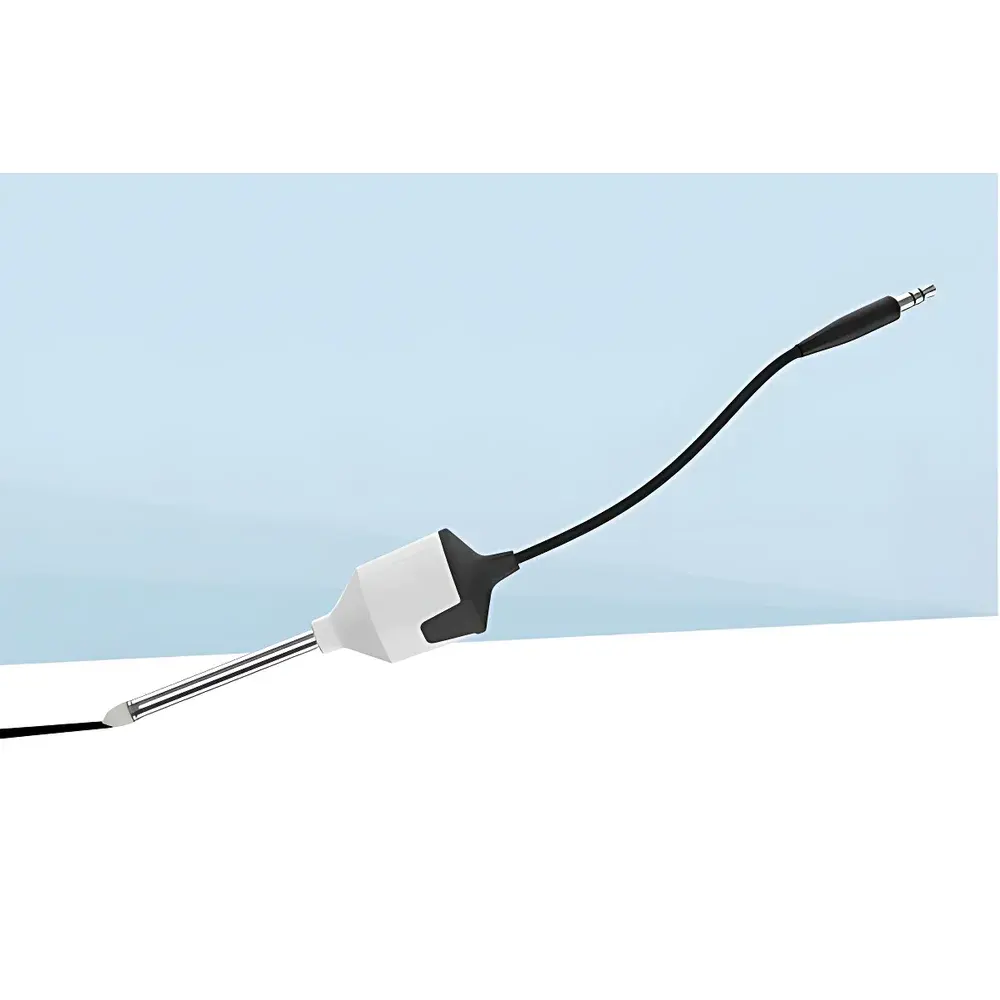
METER TEROS 31 Laboratory Soil Water Potential Sensor
| Brand | METER |
|---|---|
| Origin | USA |
| Model | TEROS 31 |
| Measurement Range | –150 to +50 kPa (standard range: –85 to +50 kPa) |
| Temperature Range | –30 to 60 °C |
| Resolution | ±0.0012 kPa / ±0.01 °C |
| Accuracy | ±0.15 kPa / ±0.5 °C |
| Output Protocols | SDI-12, Modbus RTU, TensioLink, DDI Serial |
| Power Supply | 3.6–28.0 VDC |
| Dimensions | 23.5 × 17.5 × 49.0 mm |
| Ceramic Tip Area | 0.5 cm² |
| Rod Diameter | 5 mm |
| Cable Length | 1.5 m |
| Connector | 3.5 mm 4-pole stereo plug |
| Operating Temperature | 0–50 °C |
| Certifications | ISO 9001:2015, CE (EN ISO/IEC 17050:2010) |
Overview
The METER TEROS 31 Laboratory Soil Water Potential Sensor is a high-precision, miniaturized tensiometric instrument engineered for controlled-environment measurement of soil matric potential in laboratory settings. It operates on the fundamental principle of ceramic tensiometry: water movement across a porous ceramic cup (Al₂O₃, bubble point 500 kPa) establishes hydraulic equilibrium between the soil matrix and an internal water column; changes in soil water potential induce proportional pressure variations within the sealed sensor chamber, which are transduced by a calibrated piezoresistive pressure transducer. The resulting analog signal is digitized and output via industry-standard protocols. Designed specifically for low-disturbance, high-spatial-resolution profiling in intact soil columns, core samples, and ring-core specimens, the TEROS 31 delivers sub-second response (≤5 s typical equilibration), enabling dynamic tracking of transient water redistribution events—such as infiltration fronts, drying fronts, or root water uptake gradients—under reproducible experimental conditions.
Key Features
- Ultra-compact ceramic sensing tip (0.5 cm² surface area) minimizes soil structural disruption during insertion and enables dense spatial sampling in confined geometries—including small-diameter soil columns and thin-layered substrates.
- Multi-protocol digital interface (SDI-12, Modbus RTU, TensioLink, DDI serial) ensures seamless integration with METER’s ZL6 and EM60 data loggers, as well as third-party systems supporting ≥3.6 VDC excitation and at least one compatible protocol.
- Robust mechanical design: PMMA body with TPE encapsulation provides chemical resistance and thermal stability across 0–50 °C operational range; 5 mm diameter rod allows precise placement at any orientation—horizontal, vertical, or oblique—without gravitational bias.
- Extended measurement capability: Under optimized vacuum-degassed conditions and controlled temperature, the effective range extends to –150 kPa by delaying vapor cavitation onset—critical for characterizing drier soils relevant to drought physiology and unsaturated zone hydrology.
- Low-power operation: Typical current draw of 25 mA during measurement and only 0.05 mA in standby enables extended battery-powered deployments when paired with compatible loggers.
- Transparent PMMA rod facilitates visual verification of internal water column integrity and meniscus position—a practical diagnostic feature for routine QA/QC in regulated environments.
Sample Compatibility & Compliance
The TEROS 31 is validated for use with undisturbed soil monoliths, repacked cores, and field-collected ring-core samples (e.g., 5 cm diameter × 5 cm height). Its minimal insertion footprint (5 mm pilot hole) preserves pore structure continuity and avoids compaction artifacts common with larger probes. The sensor meets ISO 9001:2015 manufacturing requirements and carries CE marking per EN ISO/IEC 17050:2010. While not intrinsically GLP- or GMP-certified, its traceable calibration, audit-ready digital outputs (including timestamped raw pressure and temperature values), and compatibility with ZENTRA Cloud’s secure, encrypted data pipeline support compliance with FDA 21 CFR Part 11 (electronic records/signatures) when deployed within validated laboratory workflows. It is routinely applied in studies aligned with ASTM D4318 (liquid limit), ISO 11277 (soil physical analysis), and USDA NRCS soil moisture monitoring guidelines.
Software & Data Management
Data acquisition is supported natively through METER’s ZENTRA Cloud platform, which provides real-time visualization, automated calibration application, and export in CSV/JSON formats compliant with FAIR data principles. Raw sensor outputs—including uncorrected pressure (kPa), thermistor-resolved temperature (°C), and protocol-specific metadata—are stored with full versioned provenance. ZENTRA Cloud integrates with MATLAB, Python (via REST API), and R for advanced statistical modeling (e.g., van Genuchten parameter fitting, Richards’ equation inversion). For offline analysis, METER’s Decagon Connect software enables local configuration, firmware updates, and batch processing of SDI-12 or Modbus archives. All communication layers implement CRC error checking and timeout-retry logic to ensure data integrity under variable power or electromagnetic conditions.
Applications
- Controlled-stress plant physiology experiments: Quantifying root-zone water availability during drought imposition or recovery cycles in growth chambers and phytotrons.
- Soil hydraulic property characterization: Supporting inverse modeling of soil water retention curves (SWRC) and hydraulic conductivity functions using multi-depth TEROS 31 arrays in tension infiltrometers or evaporation pans.
- Validation of pedotransfer functions (PTFs): Benchmarking empirical models against direct tensiometric measurements across texture gradients (sand to clay loam).
- Microcosm and rhizobox studies: Mapping 2D/3D water potential gradients around roots or mycorrhizal networks with sub-centimeter spatial resolution.
- Calibration transfer between lab and field: Cross-validating TEROS 31 lab measurements against co-located TEROS 21 field sensors to refine site-specific scaling relationships.
FAQ
What is the recommended installation method for minimal soil disturbance?
Use the included micro-auger to drill a 5 mm pilot hole to the desired depth; gently insert the TEROS 31 until the ceramic tip is fully embedded and the rod is flush with the soil surface. Pre-wetting the ceramic tip with deionized water improves initial contact.
Can the TEROS 31 measure above +50 kPa (e.g., saturated or flooded conditions)?
No. As a tensiometer, it measures matric (negative) potential only. Positive pressures require a separate piezometer or pressure transducer system.
How often does the sensor require refilling or maintenance?
The TEROS 31 is sealed and maintenance-free for typical lab use. Refilling is unnecessary unless long-term storage (>6 months) causes internal water loss—verified via visual inspection of the meniscus through the transparent rod.
Is temperature compensation applied automatically in the firmware?
Yes. Internal thermistor readings are used in real time to correct pressure transducer drift per NIST-traceable coefficients embedded in the sensor’s EEPROM.
Does ZENTRA Cloud support role-based access control for multi-user labs?
Yes. Administrators can assign granular permissions (view-only, edit, delete, share) per project, device group, or individual sensor—enabling audit-compliant collaboration across research teams.



