
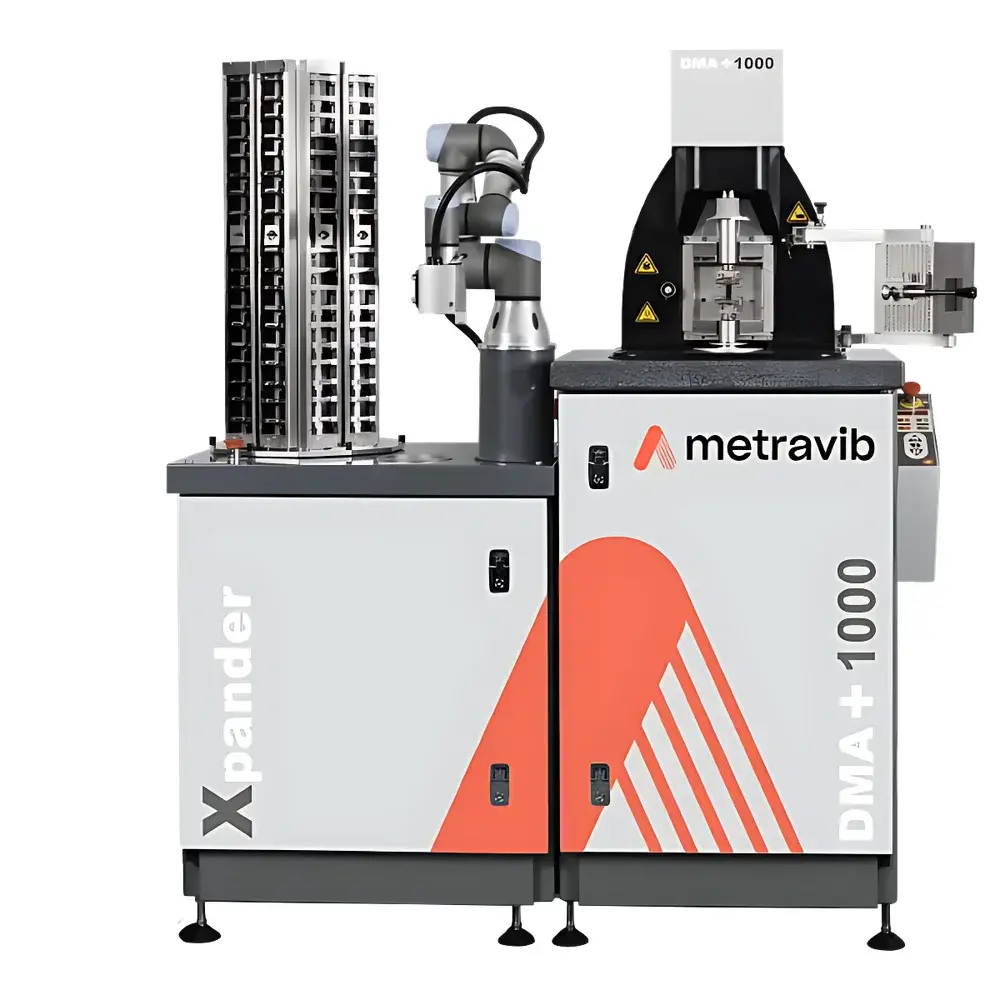
Metravib DMA+1000/2000 Series with Xpander Automated Dynamic Mechanical Analyzer
| Brand | Metravib |
|---|---|
| Origin | France |
| Model | DMA+1000 / DMA+2000 + Xpander |
| Instrument Type | Dynamic Mechanical Analyzer (DMA/DMTA) |
| Automation Level | Fully Automated Robotic System |
| Compliance | Designed for ISO 6721, ASTM D4065, ASTM D7028, ISO 11359-2, and USP <1031> compliant testing environments |
| Operating Modes | Tension, Compression, Dual Cantilever, Single Cantilever, Shear |
| Sample Capacity | Up to 120 specimens per rack (configurable) |
| Footprint | < 1.2 m² |
| Control Interface | Touchscreen HMI + Ethernet-connected PC workstation |
Overview
The Metravib DMA+1000/2000 Series with Xpander represents a paradigm shift in high-throughput dynamic mechanical analysis—integrating precision viscoelastic characterization with industrial-grade robotic automation. Unlike conventional DMA systems requiring manual sample loading, thermal equilibration, and mode reconfiguration, this platform employs a fully integrated collaborative robot (cobots) architecture engineered for continuous, unattended operation under controlled environmental conditions. At its core, the system applies small-amplitude oscillatory stress or strain to polymeric, composite, elastomeric, or biomedical materials across programmable temperature ramps (−150 °C to 600 °C, depending on furnace configuration), while measuring the resulting complex modulus (E*, G*), damping factor (tan δ), and transition temperatures (Tg, Tm, Tβ). The measurement principle adheres strictly to the fundamentals of linear viscoelasticity, where material response is decomposed into storage (elastic) and loss (viscous) components via Fourier-transformed force-displacement data. This enables quantitative assessment of time–temperature superposition, creep compliance, stress relaxation, and frequency-dependent behavior—critical for formulation development, quality control, and regulatory submissions.
Key Features
- Collaborative robotic arm (Xpander) certified to ISO/TS 15066 safety standards—operates alongside lab personnel without physical barriers or interlocked enclosures.
- Modular test head design supporting rapid tool-change between tension, compression, dual/single cantilever, and shear fixtures—mechanical reconfiguration completed in < 90 seconds without recalibration.
- Automated sample identification via integrated 2D barcode scanning; each specimen rack includes temperature-stable RFID tags for full traceability across thermal cycles.
- Dual-stage thermal control system: liquid nitrogen cooling (LN2) coupled with resistive heating furnaces ensures ±0.1 °C temperature stability and ramp rates from 0.1 to 20 °C/min.
- Real-time force feedback loop with active load cell compensation minimizes drift during extended low-frequency measurements (0.01–100 Hz).
- Self-diagnostics engine monitors actuator health, thermal uniformity, fixture alignment, and sensor linearity—generates automated calibration alerts and audit-ready logs.
Sample Compatibility & Compliance
The system accommodates diverse geometries—including films (10–500 µm thick), rods (0.5–10 mm diameter), molded plaques (up to 50 × 50 mm), and irregular biomedical scaffolds—via adjustable clamping jaws with pneumatic pressure regulation (0.1–1.2 MPa). All hardware and software modules are validated against ISO/IEC 17025 requirements for testing laboratories. Data acquisition and reporting comply with FDA 21 CFR Part 11 for electronic records and signatures, including role-based access control, immutable audit trails, and electronic signature capture. Test protocols may be preconfigured to meet ASTM D4065 (standard practice for DMA), ISO 6721-1 (general principles), and ISO 11359-2 (thermomechanical analysis of polymers), ensuring direct alignment with GLP and GMP documentation frameworks.
Software & Data Management
Metravib’s proprietary ThermoLab Suite v5.x provides unified control of both instrument hardware and robotic subsystems through a single graphical interface. The software supports method templating, batch scheduling, real-time spectral visualization (loss modulus vs. temperature/frequency), and automated report generation in PDF/A-2 or Excel-compatible XML formats. Raw time-series data (force, displacement, temperature, phase angle) are stored in HDF5 format with embedded metadata (user ID, instrument serial, calibration certificate hash, environmental log). Integration with LIMS platforms (e.g., LabVantage, Thermo Fisher SampleManager) is achieved via RESTful API or OPC UA protocol, enabling bidirectional specimen tracking and result ingestion. All software updates undergo regression testing per IEC 62304 Class B medical device software standards.
Applications
- Accelerated aging studies of aerospace composites under thermo-mechanical cycling (per ASTM D3410).
- Viscoelastic mapping of hydrogels and tissue-engineered constructs for FDA IDE submissions.
- Quality assurance of thermoplastic elastomer batches across production lines using tan δ peak width as a process consistency metric.
- Development of shape-memory polymer formulations via multi-frequency master curve construction.
- Failure analysis of solder joints and underfill materials in electronics packaging subjected to thermal shock profiles.
FAQ
Is the Xpander robot compatible with existing Metravib DMA+1000/2000 base units?
Yes—retrofit kits are available for DMA+1000 and DMA+2000 systems manufactured from 2018 onward, requiring only firmware update and mechanical mounting bracket installation.
Does the system support non-standard test geometries such as torsion or biaxial stretching?
Custom fixture integration is supported through Metravib’s OEM partnership program; torsional DMA modules and biaxial grips are available as validated add-ons.
How is data integrity maintained during unattended overnight runs?
Each test cycle generates SHA-256 checksums for raw datasets, and all intermediate processing steps are logged with timestamps, user context, and system state flags—enabling full forensic reconstruction.
Can thermal calibration be performed automatically?
Yes—the system executes NIST-traceable indium and zinc melt point verifications at user-defined intervals, with results archived alongside instrument calibration certificates.
What network security protocols are implemented for remote monitoring?
TLS 1.3 encryption, IEEE 802.1X port-based authentication, and configurable firewall rules ensure secure access via corporate VPN or zero-trust architecture deployments.



