
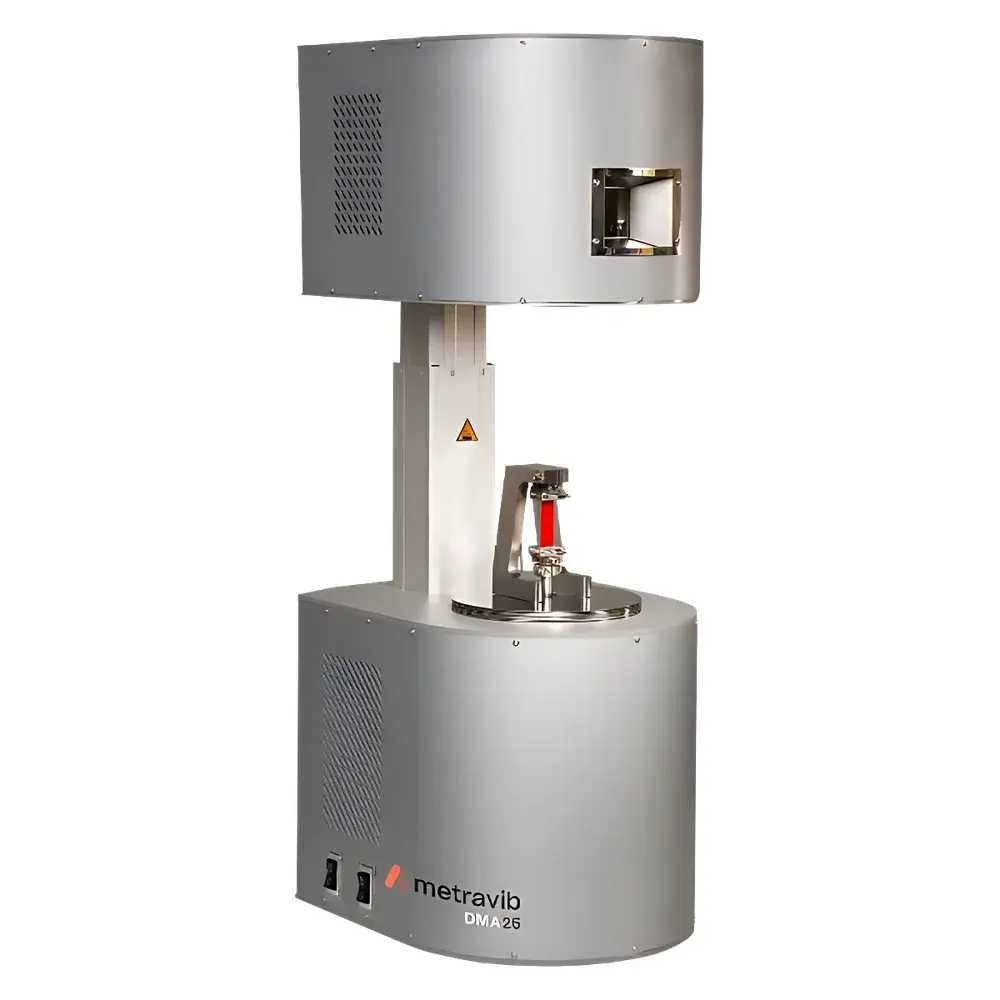
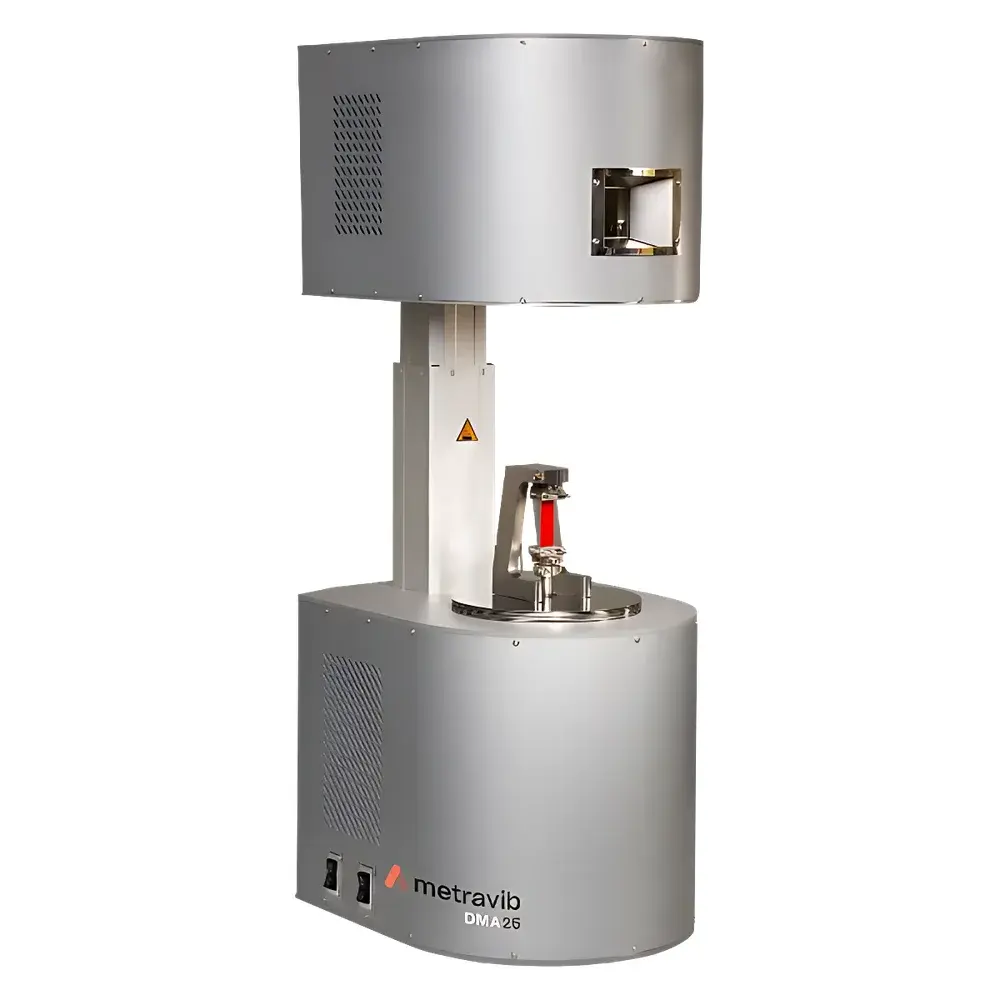
Metravib DMA25/50 Dynamic Mechanical Analyzer
| Brand | Metravib |
|---|---|
| Origin | France |
| Model | DMA25/50 |
| Instrument Type | Dynamic Mechanical Analyzer (DMA/DMTA) |
| Temperature Range | −150 °C to 500 °C (upgradable to 600 °C) |
| Temperature Accuracy | ±0.1 °C |
| Temperature Ramp Rate | ±0.1 to ±10 °C/min |
| Dynamic Force Range | ±25/±50 N (peak-to-peak: 50/100 N) |
| Displacement Range | ±3/±6 mm |
| Frequency Range | 1×10⁻⁵ to 200 Hz |
| Modulus Range | 10⁵ to 10¹¹ Pa |
| Compliance | ASTM D4065, ISO 6721, ISO 11357-2, USP <1031>, FDA 21 CFR Part 11 (software-enabled) |
Overview
The Metravib DMA25/50 Dynamic Mechanical Analyzer is a high-precision, dual-range instrumentation platform engineered for rigorous viscoelastic characterization of polymeric, composite, biological, and elastomeric materials across extreme thermal and mechanical conditions. Operating on the fundamental principle of forced oscillatory deformation—where a sinusoidal stress or strain is applied to a sample while simultaneously measuring the resulting in-phase (storage) and out-of-phase (loss) response—the system quantifies complex modulus (E* or G*), damping factor (tan δ), and transition temperatures with metrological traceability. Its inverted frame architecture, integrated environmental control, and modular transduction design enable seamless operation in air, inert gas, vacuum, or liquid immersion environments—making it uniquely suited for R&D labs requiring reproducible, standards-compliant thermo-mechanical data under GLP/GMP-aligned workflows.
Key Features
- Inverted mechanical frame: Enables direct immersion testing without fixture reconfiguration; all standard夹具 (tension, compression, 3-point bending, dual-cantilever, shear) are fully compatible with liquid media.
- Wide operational envelope: −150 °C to 500 °C temperature range (upgradeable to 600 °C); frequency sweep from 10⁻⁵ Hz (quasi-static creep/stress relaxation) to 200 Hz (high-rate dynamic response).
- High-fidelity force-displacement coupling: Dual-force-range capability (±25 N / ±50 N) with peak-to-peak resolution up to 100 N; displacement sensing with ±6 mm full-scale range and sub-micron resolution.
- Integrated control cabinet: Consolidates power conditioning, real-time data acquisition (16-bit ADC, 10 kHz sampling), temperature chamber regulation, dynamic actuation control, and cryogenic/hot gas cooling interface into a single plug-and-play unit.
- Optical access port: Allows real-time visual monitoring of sample deformation, phase separation, or gelation during test execution—critical for curing kinetics or failure mechanism studies.
- DYNATEST software suite: Fully compliant with ASTM D4065 and ISO 6721 protocols; supports synchronized DMA/TMA hybrid experiments, multi-frequency temperature sweeps, automatic amplitude optimization, and audit-trail-enabled user management per FDA 21 CFR Part 11.
Sample Compatibility & Compliance
The DMA25/50 accommodates diverse material classes—including thermoplastics, thermosets, elastomers, fiber-reinforced composites, hydrogels, food matrices, and pharmaceutical excipients—across geometry formats (films, rods, fibers, bulk specimens, pastes). Its modular fixture system supports tension, compression, shear, three-point bending, and single/dual cantilever configurations, each validated for use under ambient, controlled humidity (2–85% RH, optional module), or submerged conditions. Regulatory alignment includes full support for ISO 11357-2 (plastics—dynamic mechanical properties), ASTM D4065 (standard practice for DMA), and USP (viscoelasticity of pharmaceutical solids). Data integrity is ensured via electronic signatures, time-stamped audit logs, and role-based access controls embedded in DYNATEST.
Software & Data Management
DYNATEST provides an intuitive, workflow-driven interface for experiment design, real-time monitoring, and post-processing. It natively exports ASCII, CSV, and universal .tdms formats compatible with MATLAB, Python (NumPy/Pandas), and industry-standard statistical packages. Advanced features include automated glass transition detection (Tg onset, midpoint, inflection), master curve construction using Time-Temperature Superposition (WLF/Arrhenius), and simultaneous multi-channel acquisition (temperature, humidity, O2 partial pressure, purge gas flow). All raw and processed datasets retain full metadata provenance—including instrument calibration history, environmental setpoints, and operator credentials—ensuring full traceability for internal QA reviews or external regulatory audits.
Applications
- Determination of α-, β-, and γ-relaxations linked to molecular mobility and secondary transitions.
- Quantification of crosslink density and network formation kinetics in thermosets and elastomers.
- Evaluation of thermal stability, fatigue resistance, and service-temperature limits for structural composites.
- Characterization of viscoelastic behavior in biodegradable polymers and tissue-engineered scaffolds under physiological conditions.
- Correlation of processing parameters (e.g., injection molding, extrusion) with final-part modulus and damping performance.
- Accelerated aging studies via isothermal frequency sweeps at elevated temperatures.
- Combined DMA/TMA experiments to decouple dimensional changes from mechanical response during thermal cycling.
FAQ
Can the DMA25 be upgraded to DMA50 functionality?
Yes—the DMA25 platform is field-upgradeable to full DMA50 specifications (±50 N dynamic force, ±6 mm displacement) via hardware retrofit and software license activation.
Is liquid nitrogen cooling included as standard?
The base configuration supports mechanical refrigeration down to −70 °C; cryogenic operation to −150 °C requires optional LN2 delivery system and cold trap integration.
Does the system meet FDA 21 CFR Part 11 requirements?
DYNATEST v5.2+ provides full electronic signature, audit trail, and user access control capabilities validated for regulated pharmaceutical and medical device development environments.
What is the minimum sample thickness measurable in shear mode?
For thin films or gels, shear clamp configurations accommodate specimens as thin as 25 µm with calibrated gap control and normal force compensation.
Are third-party humidity or gas atmosphere modules supported?
Yes—optional RH control (2–85% RH) and multi-gas mixing units (N2/O2/CO2) integrate seamlessly via standardized I/O and protocol mapping within DYNATEST.



