
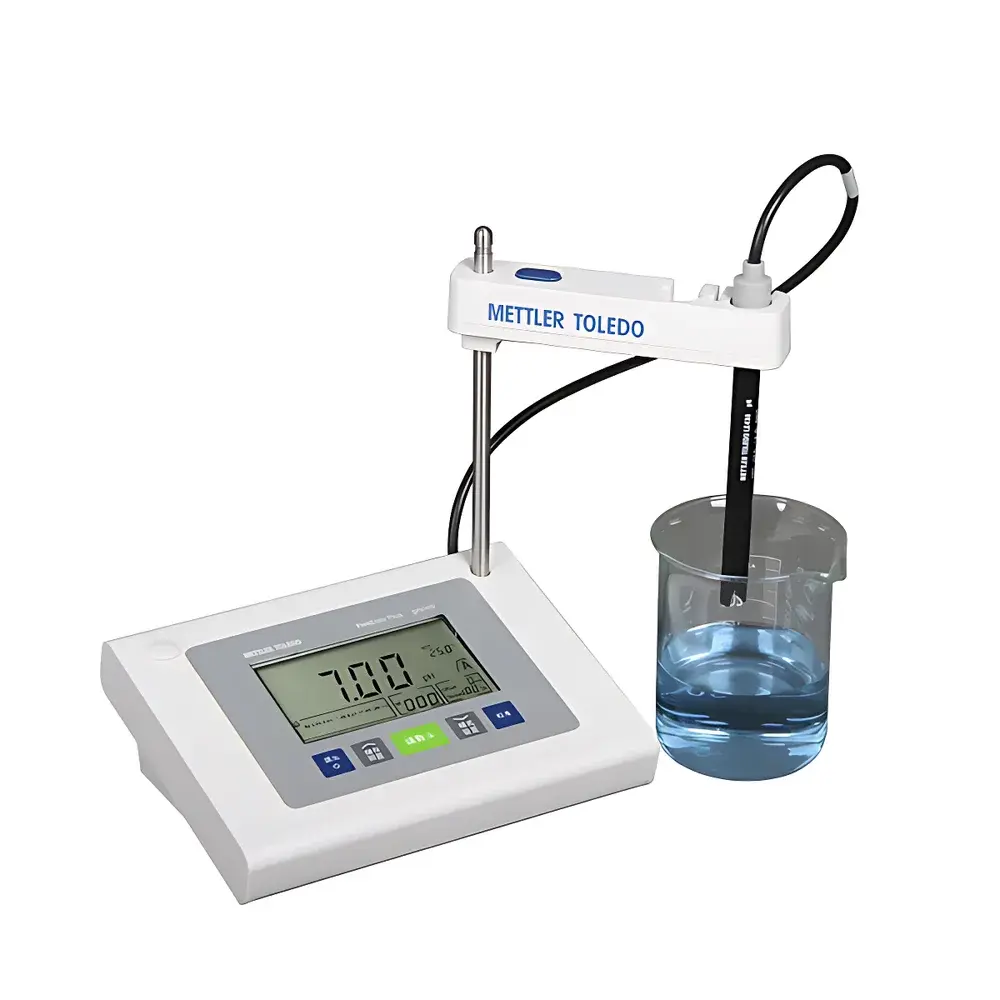
METTLER TOLEDO FE28-Standard Benchtop pH Meter
| Brand | METTLER TOLEDO |
|---|---|
| Origin | Italy |
| Model | FE28 |
| Instrument Type | Benchtop |
| Parameter Types | pH and mV (single-channel) |
| pH Measurement Range | -2 to 16 |
| pH Resolution | 0.01 / 0.1 |
| pH Accuracy | ±0.01 |
| mV Measurement Range | 0 mV |
| mV Resolution | 1 mV |
| mV Accuracy | ±1 |
| Temperature Range | -5 °C to 105 °C |
| Temperature Resolution | 0.1 °C |
| Temperature Accuracy | ±0.3 °C |
| Data Storage Capacity | 200 measurements |
| Connectivity | RS232 and USB |
| Electrode Included | LE438 pH electrode |
| ISM Support | Not supported |
| Calibration Solution Compatibility | China-specific calibration buffers |
| Compliance | Designed for GLP-compliant routine lab use |
Overview
The METTLER TOLEDO FE28-Standard is a single-channel benchtop pH meter engineered for precision, repeatability, and operational simplicity in routine quality control, educational laboratories, and industrial process support environments. It operates on the fundamental principle of potentiometric measurement: detecting the potential difference between a pH-sensitive glass electrode (LE438) and a stable reference electrode, converting this voltage into a logarithmic pH value based on the Nernst equation. The instrument supports simultaneous pH and mV (ORP) measurements with automatic temperature compensation (ATC), ensuring thermally corrected readings across a wide operational range from –5 °C to 105 °C. Its compact, space-efficient footprint—designed with an integrated sensor holder that folds flush against the unit’s side—minimizes benchtop real estate without compromising ergonomics or stability. Built and assembled in Italy under METTLER TOLEDO’s global manufacturing standards, the FE28-Standard delivers metrological traceability aligned with ISO/IEC 17025 laboratory practices and supports basic GLP documentation requirements through timestamped data logging.
Key Features
- High-resolution dual-display interface showing pH/mV and temperature simultaneously, with intuitive button navigation and context-sensitive soft keys
- Auto-read function ensures measurement stability confirmation before recording, reducing operator-dependent variability
- Two-point pH calibration with slope and offset verification, supporting standard buffer sets (including China-specific pH 4.01, 7.00, and 10.01 buffers)
- Manual or automatic temperature compensation using either built-in sensor or external Pt1000 probe input
- Robust ABS housing rated for general laboratory environments; no moving parts or consumable internal mechanisms
- RS232 and USB-B ports enable direct connection to thermal printers or Windows/macOS computers for raw data export in CSV format
Sample Compatibility & Compliance
The FE28-Standard is optimized for aqueous and mildly buffered solutions typical in QC testing of pharmaceutical excipients, food extracts, water treatment effluents, and chemical intermediates. It is not intended for non-aqueous solvents, highly viscous slurries, or aggressive HF-containing media. While the LE438 electrode features a low-resistance glass membrane and ceramic junction suitable for general-purpose use, users handling proteins, sulfides, or silver ions should consider alternative electrode configurations to prevent junction clogging or poisoning. The instrument complies with IEC 61010-1 (safety) and IEC 61326-1 (EMC) standards. Though it does not implement full FDA 21 CFR Part 11 electronic signature functionality or audit trail generation, its timestamped data storage (200 entries, including date/time, pH, mV, temperature, and calibration status) meets minimum GLP record-keeping expectations for non-regulated or internally audited workflows.
Software & Data Management
No proprietary software installation is required. Data export occurs via ASCII-based serial or USB CDC protocols, generating plain-text files compatible with Excel, LabArchives, or LIMS ingestion pipelines. Each logged entry includes measurement ID, date/time stamp (real-time clock), measured pH/mV value, temperature reading, electrode condition flag (if applicable), and last calibration date. No encryption, user role management, or electronic signature capability is embedded. For labs requiring enhanced data integrity, METTLER TOLEDO recommends pairing the FE28-Standard with their free LabX Lite software (via USB-to-serial adapter) for centralized instrument configuration backup and batch report generation—though advanced features like method locking or multi-user permissions require upgrade to FiveEasy Plus or SevenCompact platforms.
Applications
- Routine pH verification of purified water (PW) and water-for-injection (WFI) in pharmaceutical manufacturing support labs
- pH monitoring during titration endpoint confirmation in undergraduate chemistry teaching labs
- Batch release testing of cleaning agents, disinfectants, and cosmetic emulsions per internal SOPs
- Environmental water sampling analysis where portability is unnecessary but regulatory-grade documentation is expected
- Calibration verification of inline pH sensors used in bioreactor or fermentation systems
FAQ
Does the FE28-Standard support ISM (Intelligent Sensor Management)?
No. ISM functionality—including plug-and-play electrode recognition, lifetime tracking, and calibration history storage—is exclusive to METTLER TOLEDO’s FiveGo, SevenCompact, and Excellence series instruments.
Can I use non-METTLER electrodes with this meter?
Yes, provided the electrode has a BNC connector and complies with standard pH electrode output specifications (–1999 to +1999 mV, high-impedance signal). However, automatic recognition, temperature compensation via integrated sensor, and error diagnostics are not guaranteed.
Is the FE28-Standard compliant with USP or ASTM E70?
It satisfies the instrumental performance criteria outlined in ASTM E70 (Standard Test Method for pH of Aqueous Solutions) when operated with traceable calibration standards and validated electrodes. USP compliance depends on procedural execution—not device certification—and requires documented calibration, system suitability checks, and environmental controls beyond the instrument’s scope.
What is the recommended recalibration frequency?
Per ISO 8655-5 and common lab practice, recalibrate before each analytical session or at least every 2 hours during continuous use. Recalibration is mandatory after electrode cleaning, temperature shifts >5 °C, or when measuring samples outside pH 2–12.
Does the unit include a certificate of conformance or factory calibration report?
A Declaration of Conformity (DoC) is supplied with shipment. Traceable factory calibration certificates are available upon request at time of order (additional lead time and fee apply).
Related Products






