
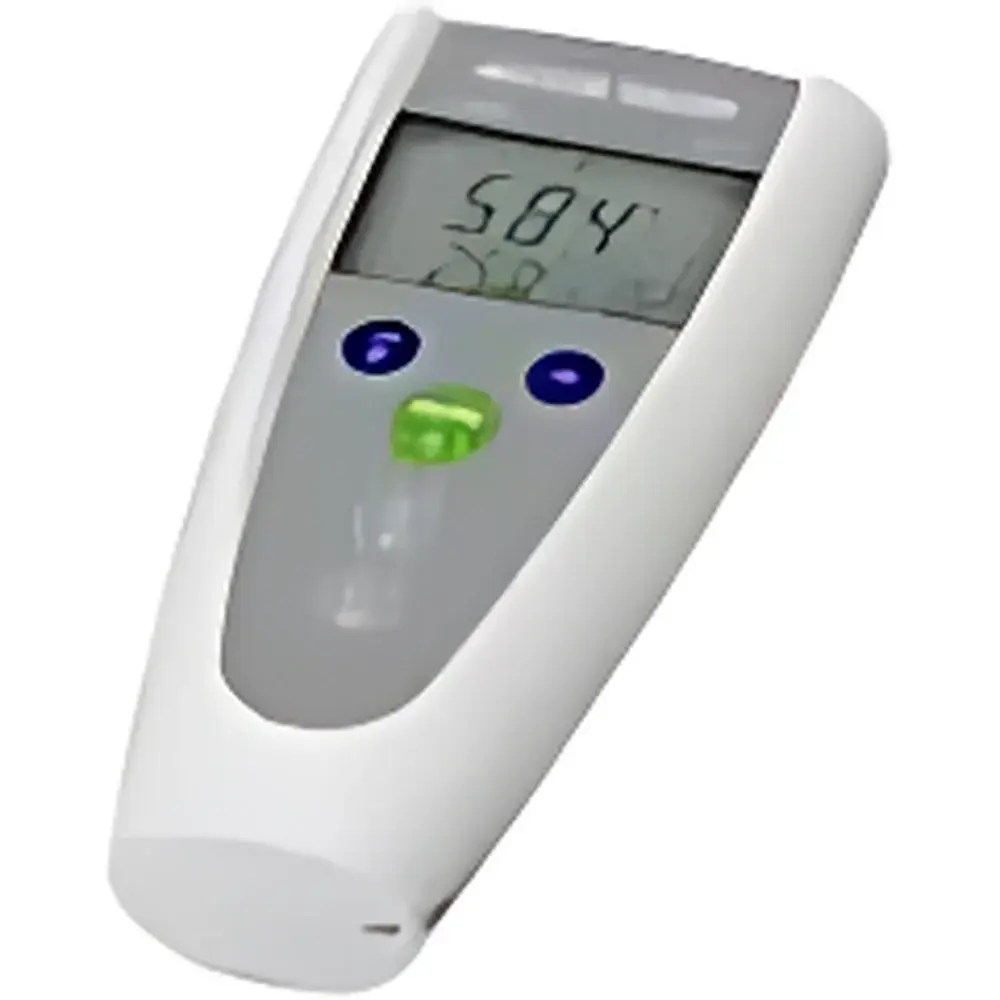
METTLER TOLEDO FG4 FiveGo™ Dissolved Oxygen Meter
| Brand | METTLER TOLEDO |
|---|---|
| Origin | Switzerland |
| Model | FG4 |
| Measurement Principle | Galvanic Cell (Zero-Polarization) |
| Temperature Range | 0.0–50.0 °C |
| Temp. Resolution | 0.1 °C |
| Temp. Accuracy | ±0.3 °C |
| DO Range (%) | 0.00–199.9% (extended to 400%) |
| DO Range (mg/L & ppm) | 0.0–45.0 mg/L (ppm) |
| DO Resolution | 0.1% / 0.01 mg/L / 0.01 ppm |
| DO Accuracy | ±1% of reading or ±1 mg/L (whichever is greater) |
| Salt Range | 0.0–50.0 ppt (0.1 ppt resolution) |
| Atmospheric Pressure Range | 375–825 mmHg / 500–1100 mbar / 500–1100 hPa |
| Pressure Resolution | 1 unit |
| Calibration Points | 2-point (0% and 100% O₂) |
| Data Storage | 30 measurements |
| Display | Backlit LCD with simultaneous readout of DO value, temperature, endpoint status, and compensation indicators |
| Enclosure Rating | IP54 |
| Power Supply | 4 × 1.5 V AAA batteries |
| Operating Environment | 0–40 °C, 5–80% RH (non-condensing) |
Overview
The METTLER TOLEDO FG4 FiveGo™ Dissolved Oxygen Meter is a field-deployable, galvanic-cell-based portable instrument engineered for rapid, reliable, and operator-independent measurement of dissolved oxygen (DO) in aqueous samples. Unlike polarographic sensors requiring polarization time, the FG4’s galvanic cell electrode—such as the LE611—generates a stable current immediately upon connection, eliminating warm-up delays and enabling true “measure-on-arrival” operation. This principle relies on spontaneous electrochemical reduction of molecular oxygen at a noble metal cathode (e.g., gold or platinum), paired with oxidation of a consumable anode (typically lead or zinc), producing a current linearly proportional to oxygen partial pressure. The FG4 integrates automatic temperature compensation (ATC) via an integrated NTC 30 kΩ sensor, real-time barometric pressure correction (500–1100 hPa), and salinity compensation (0.0–50.0 ppt), ensuring traceable accuracy across diverse environmental and process conditions—from freshwater streams and wastewater effluents to food processing rinse waters and bioreactor monitoring points.
Key Features
- Galvanic DO sensor compatibility (e.g., LE611 or LE612 electrodes) with zero-polarization startup—no pre-conditioning required.
- Triple-unit display: simultaneous readout in % saturation, mg/L, and ppm—user-selectable per measurement session.
- Automatic endpoint detection with visual and audible confirmation, reducing subjectivity and improving inter-operator reproducibility.
- Integrated environmental compensation: automatic correction for temperature (0.0–50.0 °C), atmospheric pressure (375–825 mmHg), and salinity (0.0–50.0 ppt).
- Robust IP54-rated housing suitable for outdoor use in rain, dust, or high-humidity environments typical of wastewater plants and field sampling campaigns.
- Intuitive five-button interface: dedicated keys for start/stop, calibration access, data recall, unit toggle, and menu navigation—minimizing training overhead.
- Backlit LCD with contextual icons indicating calibration status, endpoint mode, ATC activation, and battery level—optimized for low-light field conditions.
- Onboard storage for up to 30 measurement records, each timestamped and annotated with temperature, pressure, and salinity values at time of acquisition.
Sample Compatibility & Compliance
The FG4 supports direct immersion measurement in liquid samples ranging from deionized water to brackish estuaries (up to 50.0 ppt salinity) and industrial process streams. Its galvanic sensor design ensures stable performance in low-flow or stagnant conditions where membrane fouling risks are elevated. While not intended for continuous online monitoring, the FG4 meets core requirements for grab-sample compliance testing under EPA Method 360.1, ISO 5814:2012 (electrochemical determination of dissolved oxygen), and ASTM D888-12 (standard test methods for dissolved oxygen in water). When used with documented calibration procedures—including zero-oxygen calibration using sodium sulfite tablets (included in field kits) and air-saturation calibration—the FG4 supports GLP-aligned data integrity for environmental reporting and internal QA/QC protocols.
Software & Data Management
Data retrieval is performed manually via the LCD interface; the FG4 does not feature USB, Bluetooth, or PC connectivity. However, its structured 30-entry memory enables consistent field logging without external devices. Each stored record includes DO value, temperature, pressure, salinity, date/time stamp (set manually), and calibration reference points used. For laboratories requiring electronic data capture, METTLER TOLEDO recommends pairing the FG4 with validated paper-based logbooks or integrating readings into LIMS via manual entry—consistent with FDA 21 CFR Part 11 guidance for non-connected instruments where audit trails are maintained through procedural controls and signed documentation.
Applications
- Environmental field surveys: river, lake, and coastal water quality assessment per national monitoring programs.
- Wastewater treatment: aeration basin optimization, effluent compliance verification, and sludge respiration rate estimation.
- Drinking water distribution: residual DO profiling in storage tanks and post-disinfection lines.
- Food & beverage production: monitoring DO in CIP rinse cycles, carbonated beverage fill lines, and fermentation broth aeration control points.
- Educational laboratories: teaching fundamental principles of aquatic chemistry, redox reactions, and sensor electrochemistry.
- Aquaculture management: routine pond and tank DO screening to prevent hypoxic stress in sensitive species.
FAQ
Does the FG4 require electrode polarization before first use?
No. The galvanic cell design (e.g., LE611) delivers immediate response without polarization time—ideal for intermittent field use.
Can the FG4 measure dissolved oxygen in seawater?
Yes, with full salinity compensation up to 50.0 ppt. Ensure the LE611 electrode is rinsed thoroughly after seawater exposure to prevent chloride-induced drift.
What calibration standards are required?
Two-point calibration: zero-oxygen solution (prepared using included sodium sulfite tablets) and air-saturated water (at known temperature, pressure, and salinity).
Is the FG4 compliant with ISO/IEC 17025 or GLP requirements?
The instrument itself is not certified, but its documented calibration, environmental compensation, and traceable measurement chain support adherence to ISO/IEC 17025 clause 6.4.1 and GLP principles when operated within defined SOPs.
How often should the LE611 electrode be replaced?
Typical service life is 12–18 months under regular field use. Replacement is indicated by sluggish response (>60 s to 95% endpoint), unstable zero signal, or failure to achieve calibrated slope during verification.
Related Products







