
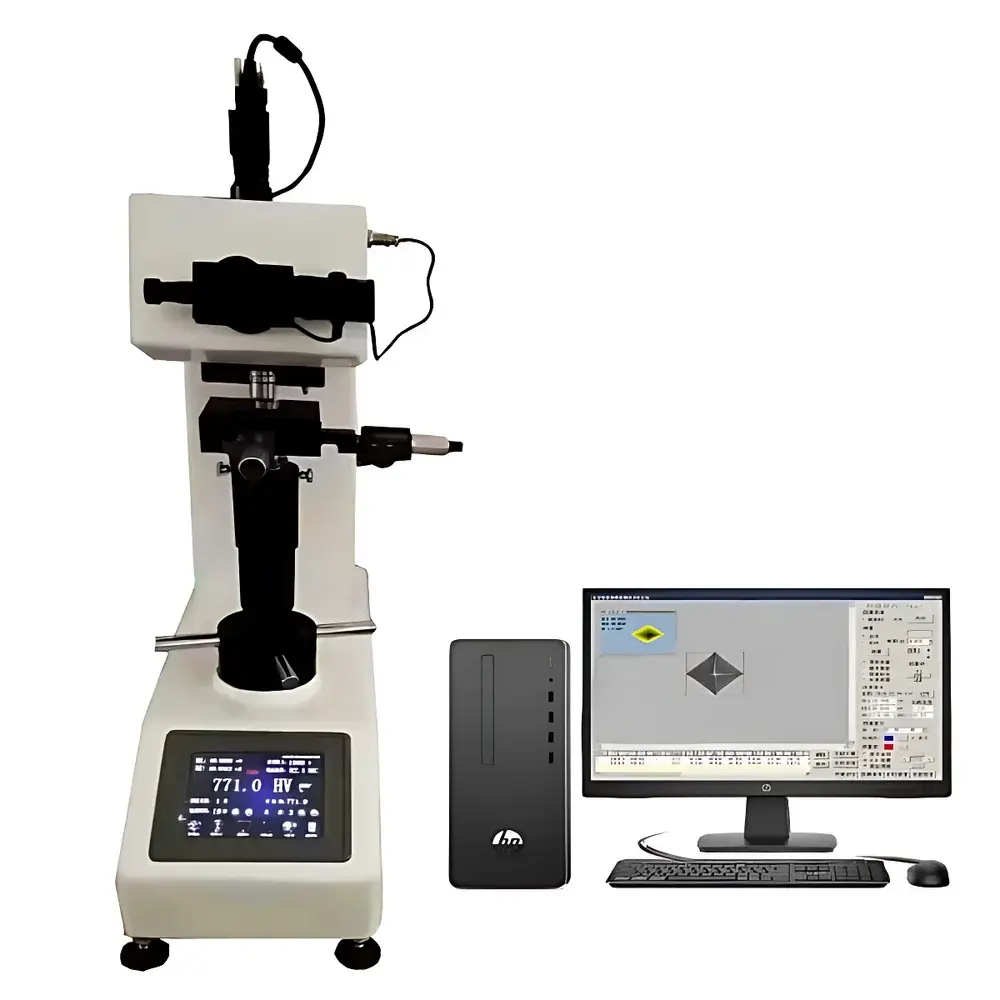
YANRUN HMAS-D10SMZ Automated Vickers Hardness Testing & Analysis System
| Brand | YANRUN |
|---|---|
| Origin | Shanghai, China |
| Manufacturer Type | Direct Manufacturer |
| Instrument Type | Vickers Hardness Tester |
| Model | HMAS-D10SMZ |
| Measurement Range | 0–3000 HV |
| Test Forces (6 Levels) | 0.3, 0.5, 1, 3, 5, 10 kgf |
| Standards Compliance | GB/T 4340 |
| Automatic Turret | Yes |
| Loading Mechanism | Gear-Driven Force Application |
| Z-Axis Drive | Precision Lead Screw |
| XY Manual Stage | 100 × 100 mm platform, 25 × 25 mm travel, 0.01 mm mechanical resolution |
| Objective Lenses | 10×, 20× (optional: 40×, 50×, 100×) |
| Total Optical Magnification | 100×, 200× (dual-scale measurement) |
| Digital Image Magnification (via CCD + PC) | ~400×–800× |
| Indentation Imaging | High-Resolution CCD + Real-Time Image Acquisition Processor |
| Software | YANRUN HMAS Hardness Analysis Suite (v5.x) with Auto-Indent Recognition, SPC, 3D Indent Modeling, Simulated Focus, 12-Color Backgrounds, ASTM/GB Hardness Conversion, PDF/Word/Excel Reporting, GLP-Compliant Audit Trail |
Overview
The YANRUN HMAS-D10SMZ Automated Vickers Hardness Testing & Analysis System is a fully integrated metrology platform engineered for high-precision micro- and macro-Vickers hardness evaluation in R&D laboratories, quality control departments, and materials certification facilities. It operates on the fundamental principle of Vickers indentation—applying a precisely calibrated diamond pyramid indenter (136° apex angle) under controlled static load to produce a geometrically reproducible square impression on the specimen surface. The diagonal lengths of the residual indent are measured optically, and hardness values (HV) are calculated per ISO 6507-1 and GB/T 4340.1, ensuring traceable, standardized results across metallic alloys, heat-treated steels, case-hardened layers, thin films, ceramics, and composite substrates. Unlike conventional analog hardness testers, the HMAS-D10SMZ embeds real-time digital imaging, closed-loop motion control, and algorithm-driven image analysis into a single architecture—eliminating operator-dependent parallax error, manual caliper reading, and subjective focus judgment.
Key Features
- Automated turret with motorized objective and indenter switching—enabling rapid transition between magnifications and test forces without manual intervention.
- Gear-driven mechanical loading system delivering six selectable test forces (0.3–10 kgf) with ±0.5% force accuracy and programmable dwell time (1–60 s, 1 s increments).
- Dual-path optical viewing: simultaneous observation via 10× digital eyepiece and high-resolution CCD camera feeding live video to the HMAS software interface.
- Precision-machined aluminum alloy frame with vibration-damped base and rigid column—ensuring long-term mechanical stability and thermal drift resistance.
- Integrated 100 × 100 mm manual XY stage with 25 × 25 mm travel range and 0.01 mm vernier scale—optimized for localized hardness mapping of heterogeneous microstructures.
- Real-time simulated focus algorithm: proprietary image enhancement engine that digitally refines edge contrast and depth-of-field perception—mimicking optical focus adjustment without physical lens movement.
- 3D indent reconstruction module: generates topographic surface models from dual-diagonal measurements and empirical material displacement coefficients—supporting quantitative depth profiling of carburized or nitrided case layers.
Sample Compatibility & Compliance
The HMAS-D10SMZ accommodates specimens up to 200 mm in height and 130 mm from column centerline, supporting standard metallurgical mounts, as-received forgings, machined coupons, and coated components. Its 12-selectable background color palette mitigates contrast ambiguity when testing reflective non-ferrous surfaces (e.g., Cu, Al, Ti alloys), oxidized steel, or matte-finished castings. All hardness calculations conform to GB/T 4340 and ASTM E384 for microhardness and E92 for macrohardness. The system supports full traceability per ISO/IEC 17025 requirements: each test record includes timestamp, operator ID, environmental temperature/humidity metadata (when externally logged), force calibration certificate reference, and indenter serial number. Optional X-Y motorized stage enables automated grid-based hardness mapping compliant with ASTM E384 Annex A3 for gradient analysis.
Software & Data Management
The YANRUN HMAS v5.x software suite is a validated Windows-based application designed for regulated environments. It features role-based user access control, electronic signatures, and immutable audit trails meeting FDA 21 CFR Part 11 and EU Annex 11 expectations. Core capabilities include: auto-indent detection with sub-pixel edge localization (10,000 test records with SQL-based search and filter functions.
Applications
This system is routinely deployed for: evaluating case depth and hardness gradient in carburized and nitrided gears; quantifying decarburization in hot-rolled bar stock; validating heat treatment uniformity in aerospace titanium alloys; assessing coating adhesion integrity via microindentation fracture analysis; measuring thin-film hardness (e.g., PVD TiN, DLC) using low-load HV0.3 testing; and performing failure analysis on fractured weld zones. Its ability to generate 3D indent morphology supports research into plastic deformation mechanisms, strain hardening exponents, and size effects in nanocrystalline metals.
FAQ
Does the HMAS-D10SMZ comply with ISO/IEC 17025 accreditation requirements?
Yes—the system provides full measurement traceability, calibration documentation, environmental logging interfaces, and audit-trail-enabled software operation suitable for accredited testing laboratories.
Can the software perform statistical analysis on multi-point hardness arrays?
Yes—HMAS supports batch processing of grid-based measurements, generating histograms, box plots, ANOVA reports, and spatial correlation maps for homogeneity assessment.
Is external calibration verification supported?
Yes—users may import NIST-traceable hardness reference block certificates and apply correction offsets per GB/T 4340.3 and ISO 6507-3 protocols.
What file formats does the system use for long-term archival?
Raw images: uncompressed TIFF with embedded calibration metadata; reports: PDF/A-2b, .xlsx, and .docx with embedded fonts and digital signatures.
How is measurement uncertainty estimated in the HMAS software?
Uncertainty is calculated per GUM (JCGM 100:2008) using combined contributions from force accuracy, optical magnification error, diagonal measurement repeatability, and indenter geometry tolerance—displayed alongside each HV result.



