
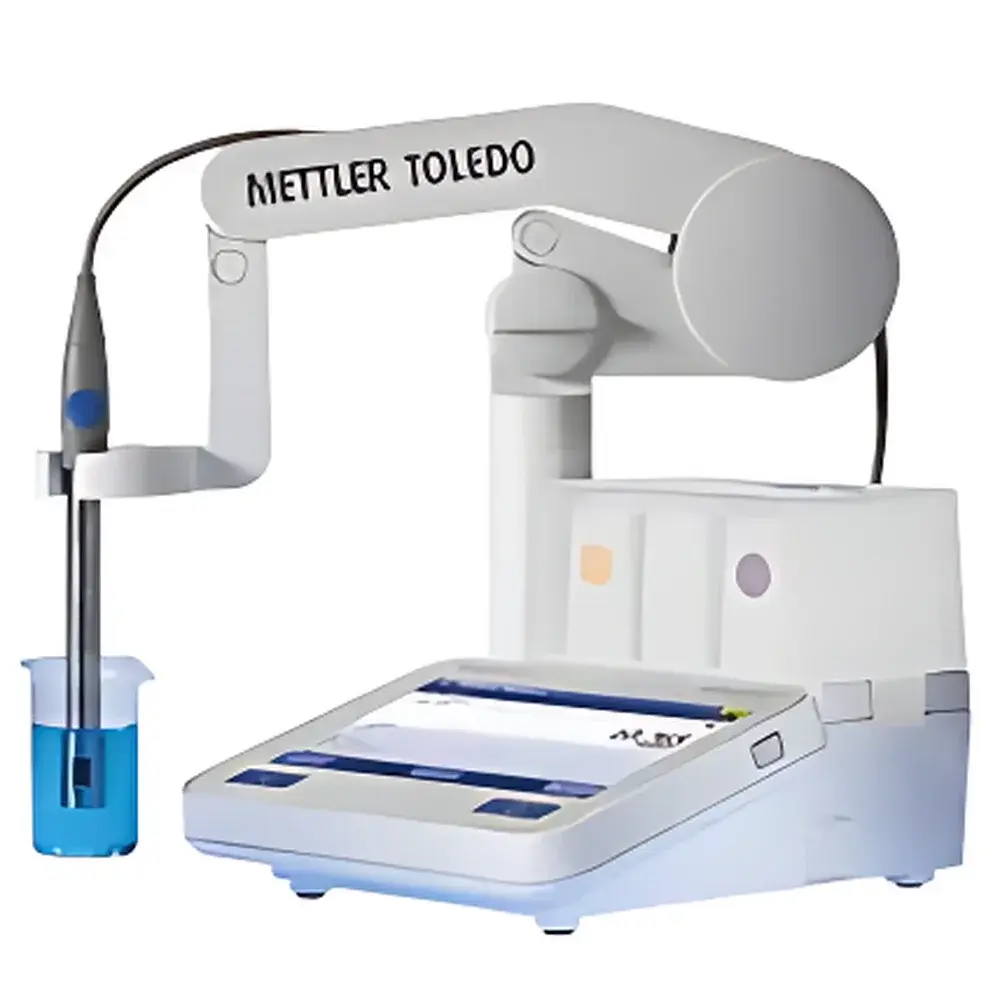
METTLER TOLEDO SevenExcellence S700-B Conductivity Meter
| Brand | METTLER TOLEDO |
|---|---|
| Origin | Switzerland |
| Instrument Type | Benchtop |
| Conductivity Range | 0.001–2000 µS/cm |
| Resistivity Range | 0.001–2000 MΩ·cm |
| Temperature Range | −30 to +130 °C |
| Accuracy | ±0.5% of reading |
| Minimum Resolution | 0.001 µS/cm |
| Channel Configuration | Single-channel, modularly expandable |
Overview
The METTLER TOLEDO SevenExcellence S700-B Conductivity Meter is a high-precision benchtop electrochemical instrument engineered for rigorous laboratory and quality control environments. It operates on the principle of two- or four-electrode AC conductivity measurement, minimizing polarization effects and enabling accurate, stable readings across ultra-low to high-conductivity samples—from ultrapure water (e.g., pharmaceutical grade WFI) to concentrated brines and industrial process streams. Designed in accordance with ISO/IEC 17025 and aligned with FDA 21 CFR Part 11 requirements, the S700-B delivers traceable, auditable measurements while supporting full data integrity workflows. Its core architecture integrates temperature-compensated conductivity calculation using either linear (α = 2.0 %/°C default) or non-linear (e.g., ASTM D1125, USP ) compensation models—ensuring compliance with pharmacopeial and regulatory standards.
Key Features
- High-resolution 7-inch capacitive touchscreen with intuitive, icon-driven navigation and multilingual UI support (English, German, French, Chinese, Japanese, etc.)
- Modular platform architecture: The S700-B base unit supports seamless integration of additional measurement modules—including pH, ion concentration, dissolved oxygen, and redox—without hardware replacement or recalibration
- Intelligent electrode recognition via RFID-enabled SmartCal™ probes, automatically loading calibration history, tolerance limits, and sensor-specific parameters
- Real-time temperature monitoring with Pt1000 or NTC thermistor compatibility; built-in temperature sensor accuracy ±0.1 °C
- Automatic range switching and dynamic resolution adjustment ensure optimal signal-to-noise ratio across the full 0.001–2000 µS/cm span
- Robust data security framework: user-level access control (up to 100 configurable roles), electronic signatures, audit trail with immutable timestamps, and encrypted local storage
Sample Compatibility & Compliance
The S700-B accommodates standard DIN/ISO-compliant conductivity cells (e.g., 2-cell, 4-cell, or toroidal sensors) with cell constants from 0.01 to 10 cm⁻¹. It is validated for use with aqueous matrices including purified water (PW), water for injection (WFI), clean-in-place (CIP) rinse solutions, boiler feedwater, wastewater effluents, and electrolyte formulations. Regulatory alignment includes adherence to USP for conductivity testing of purified water and water for injection, EP 2.2.39, JP 2.05, and ASTM D1125–22 for electrical conductivity of water. All firmware and software updates follow METTLER TOLEDO’s GxP-compliant change control process, ensuring continuous compliance during instrument lifecycle.
Software & Data Management
The integrated LabX® Lite software (embedded) enables method-driven operation, customizable report templates (PDF/CSV export), and automated pass/fail evaluation against user-defined specification limits. For enterprise-scale deployment, optional LabX® PC software provides centralized instrument management, remote monitoring, advanced statistical process control (SPC), and full 21 CFR Part 11 compliance—including role-based e-signatures, biometric authentication readiness, and ALCOA+ compliant audit trails. Raw data, metadata (operator ID, timestamp, environmental conditions), and calibration records are stored in a relational database with SHA-256 hashing for tamper evidence.
Applications
- Pharmaceutical QC laboratories performing routine conductivity testing per USP and EU GMP Annex 1
- Power generation facilities monitoring condensate purity and steam cycle chemistry
- Microelectronics manufacturing controlling ultrapure water resistivity in wafer cleaning processes
- Academic research labs conducting ion transport studies, electrolyte characterization, or membrane conductivity validation
- Environmental testing centers analyzing surface water, groundwater, and leachate conductivity as an indicator of ionic contamination
- Food & beverage R&D assessing salt content, brine strength, and cleaning solution efficacy
FAQ
Does the S700-B support automatic temperature compensation (ATC) with non-linear algorithms?
Yes—it supports both fixed α-factor linear compensation and non-linear models per USP , ASTM D1125, and EP 2.2.39.
Can calibration data be transferred between instruments within a lab network?
Yes, via LabX® software synchronization or encrypted USB import/export with full metadata retention.
Is the instrument suitable for measuring conductivity in viscous or particulate-laden samples?
For such applications, METTLER TOLEDO recommends pairing the S700-B with a four-electrode or toroidal sensor to minimize fouling and polarization errors.
What documentation is provided to support IQ/OQ/PQ validation?
METTLER TOLEDO supplies a comprehensive Validation Support Package, including URS, FRS, test protocols, and completed reports compliant with ISO 13485 and GAMP 5 guidelines.
How often does the system require recalibration under GLP conditions?
Calibration frequency is risk-based and sample-dependent; typical intervals range from daily (critical QC) to weekly (routine monitoring), with automatic alerts triggered by user-defined stability thresholds.




