
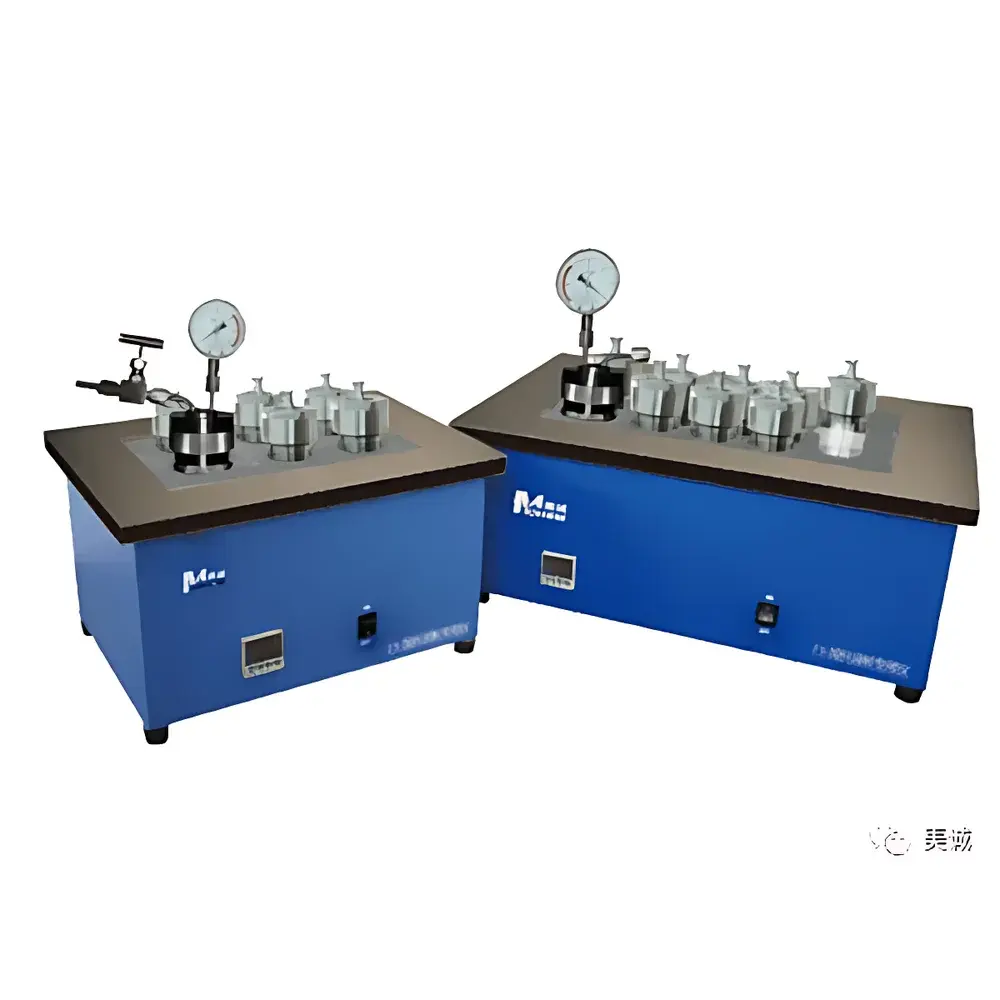
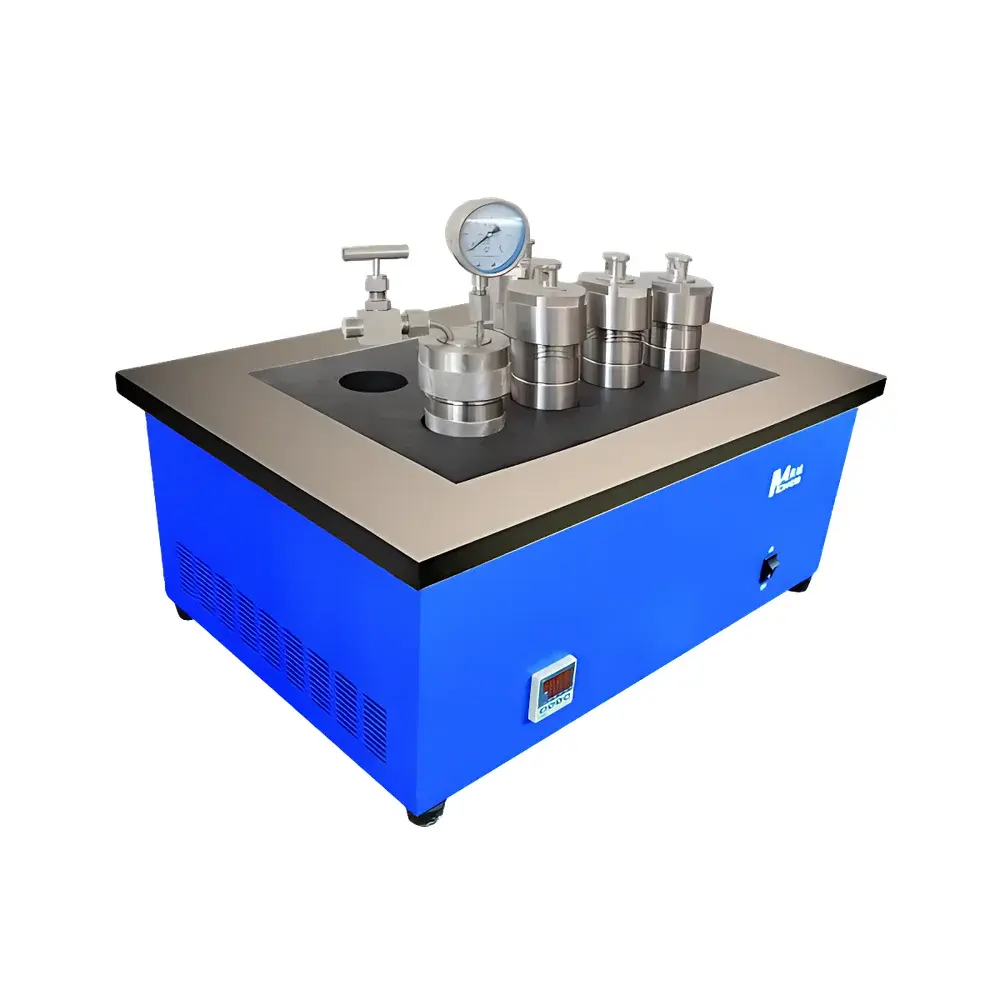
MICHEM DR-6G & DR-8G Graphite Block Digestion System for High-Pressure Reaction Vessels
| Brand | MICHEM |
|---|---|
| Origin | Beijing, China |
| Model | DR-6G |
| Digestion Type | Graphite-block Electric Heating |
| Automation Level | Semi-Automatic |
| Digestion Positions | 6 or 8 |
| Max Temperature | 260 °C |
| Temperature Accuracy | ±1.0 °C |
| Heating Mechanism | Electric heating plate + graphite thermal conduction block + infrared auxiliary heating |
| Surface Coating | PTFE (Teflon®)-coated graphite |
| Rated Power | 1200 W (DR-6G) |
| Input Voltage | AC 220 V, 16 A |
| Dimensions (L×W×H) | 470×350×270 mm (DR-6G) |
| Sample Vessel Capacity | 100 mL × 6 or × 8 |
| Pressure Vessel Compatibility | Dual-layer sealed reaction vessels rated to 10 MPa |
| Compliance | Meets GB/T 150 (China National Standard for Pressure Vessels) |
Overview
The MICHEM DR-6G and DR-8G Graphite Block Digestion Systems are engineered for reproducible, high-temperature sample preparation in demanding analytical workflows involving pressurized reaction vessels. Designed specifically to support digestion protocols requiring controlled thermal input prior to or following microwave-assisted digestion (MWD), these semi-automatic instruments operate on a robust graphite-block architecture with integrated electric and infrared heating elements. The core principle relies on uniform conductive heat transfer through high-purity, PTFE-coated graphite—ensuring minimal inter-well temperature deviation (< ±2.0 °C) across all digestion positions. This thermal homogeneity is critical for trace metal analysis where inconsistent acid decomposition or incomplete volatilization of matrix components can introduce systematic bias in downstream quantification by ICP-OES, ICP-MS, AAS, or HG-AFS. Unlike open-vessel hot plates or ceramic heaters, the DR series incorporates structural compatibility with certified 10 MPa dual-layer pressure reactors, enabling closed-system digestion that retains volatile analytes (e.g., As, Se, Hg, Sb) and prevents cross-contamination during acid evaporation or “ashing” steps.
Key Features
- PTFE-coated graphite heating block: Provides exceptional corrosion resistance against concentrated HNO₃, HF, HCl, H₂SO₄, and aqua regia—even under prolonged exposure at 260 °C.
- PID digital temperature control system: Delivers ±1.0 °C accuracy across the full operating range (room temperature to 260 °C); includes programmable ramp-hold profiles, over-temperature cutoff, and auto-shutdown after cycle completion.
- Optimized thermal mass design: Minimizes temperature overshoot and improves recovery time between cycles; validated for stable operation over continuous 8-hour runs under GLP-compliant laboratory conditions.
- Dual-platform configuration: DR-6G accommodates six 100 mL high-pressure vessels; DR-8G supports eight—both sized to match standard quartz or PFA-lined reactor assemblies meeting GB/T 150 and ASME BPVC Section VIII requirements.
- Integrated safety architecture: Includes grounded chassis, thermal fuses, and moisture-resistant PCBs treated with conformal coating (IPC-CC-830B Class 3) to withstand humid, acidic lab environments.
Sample Compatibility & Compliance
The DR series is validated for use with borosilicate glass, quartz, PFA, and ETFE-lined pressure vessels rated to ≥10 MPa. It supports EPA Methods 3050B, 3051A, and 3052; ISO 11466 (soil/ sediment digestion); and USP heavy metals testing. All units undergo factory calibration traceable to NIM (National Institute of Metrology, China) standards. The PTFE surface finish complies with FDA 21 CFR 177.1550 for food-contact polymer coatings. Instrument firmware logs all temperature setpoints, actual readings, and runtime events—enabling audit-ready records per GLP and GMP Annex 11 requirements when paired with compliant LIMS integration.
Software & Data Management
While hardware-based operation requires no PC connection, optional RS-232/USB interface enables serial logging of real-time temperature data (sampled at 1 Hz) into third-party SCADA or ELN platforms. Internal memory stores up to 20 user-defined digestion programs with timestamped execution history. Data export follows CSV format compatible with Microsoft Excel, LabArchives, and Benchling. All temperature logs include metadata fields: operator ID, vessel ID, method name, start/end timestamps, and deviation alerts—supporting 21 CFR Part 11–compliant electronic signatures when deployed with validated authentication modules.
Applications
- Pre-digestion conditioning of solid samples (soils, sediments, sludges, polymers) prior to microwave-assisted acid digestion.
- Controlled post-MWD acid removal (“赶酸”) and volume stabilization under inert atmosphere to prevent analyte loss or re-precipitation.
- Standardized reflux digestion for regulatory compliance testing in environmental monitoring labs (e.g., wastewater, fly ash, industrial effluents).
- Method development for speciation analysis requiring sequential leaching or selective dissolution steps.
- QC/QA batch processing in pharmaceutical manufacturing for residual catalyst screening (e.g., Pd, Pt, Rh in APIs).
FAQ
Can the DR-6G/DR-8G be used without pressure vessels?
Yes—the graphite block functions as a precision heating platform for open-vessel digestion, evaporation, or drying applications; however, maximum temperature stability and corrosion protection are optimized for closed-vessel operation.
Is HF acid compatible with the PTFE coating?
The PTFE layer resists short-term exposure to ≤5% v/v HF at ≤200 °C; extended use with >2% HF requires validation per ASTM D7293 and periodic visual inspection of coating integrity.
Does the system meet international pressure vessel certification requirements?
The instrument itself is not a pressure vessel; it is designed to thermally support externally certified reactors compliant with ASME BPVC Section VIII Div. 1 or PED 2014/68/EU.
What maintenance is required for long-term accuracy?
Annual recalibration of the PT100 sensor and verification of PID controller linearity using NIST-traceable dry-block calibrators is recommended; graphite block surface cleaning with 10% NaOH followed by deionized water rinse preserves coating longevity.
How does the DR series compare to microwave digestion systems in throughput?
It is complementary—not competitive: DR units provide scalable, low-cost thermal conditioning for large-batch prep or post-MWD finishing, whereas microwave systems prioritize rapid, high-pressure digestion of individual samples.



