
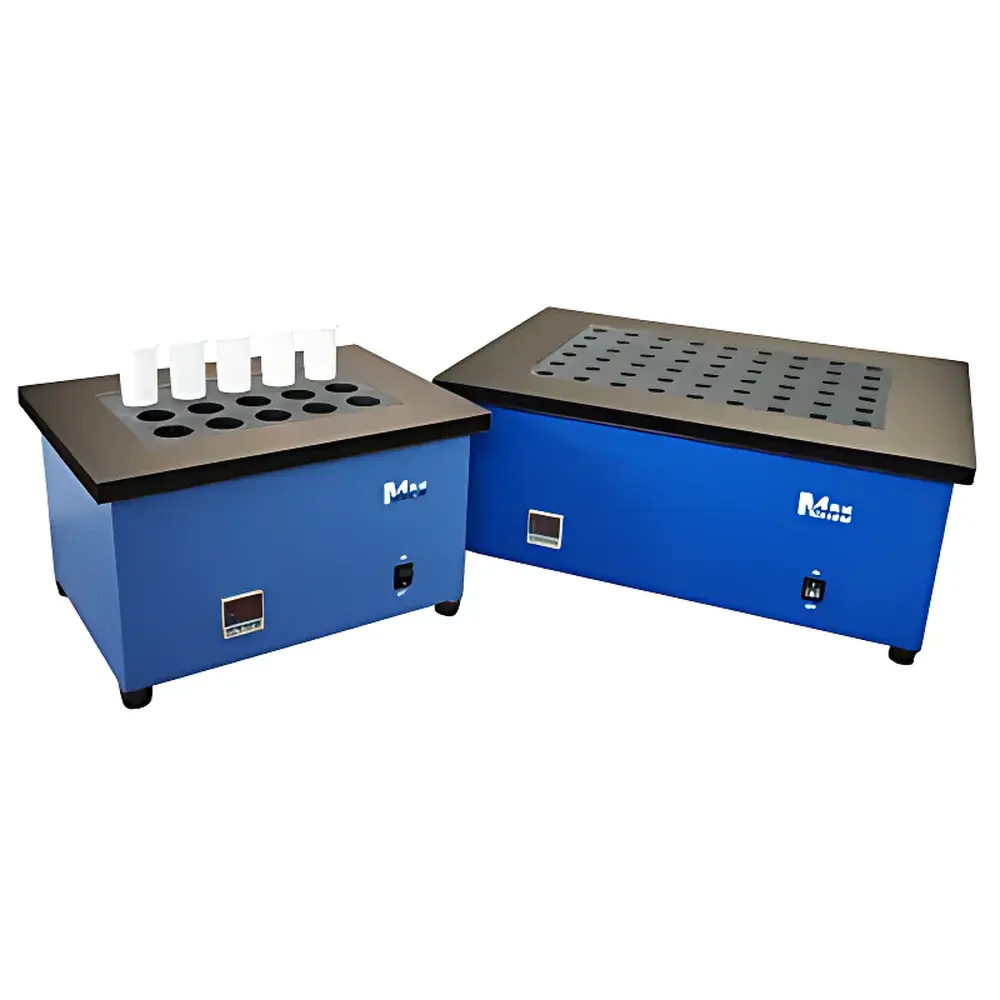
MICHEM DR Series Graphite Block Digestion System
| Brand | MICHEM |
|---|---|
| Origin | Beijing, China |
| Model | DR Series |
| Digestion Positions | 15 / 24 / 40 / 54 / 77 |
| Temperature Range | Ambient to 260 °C |
| Temperature Control Accuracy | ±1.0 °C |
| Heating Principle | Infrared Radiant Heating |
| Heating Block Material | High-Purity Graphite with PTFE Coating |
| Control System | PID Digital Controller (30-Step Programmable Ramp/Soak) |
| Max Power | 1200 W (DR-15/DR-24), 3000 W (DR-54) |
| Sample Vessel Compatibility | Standard digestion tubes (e.g., 50 mL or 100 mL borosilicate or quartz) |
| Compliance | Designed for GLP-compliant sample preparation workflows |
Overview
The MICHEM DR Series Graphite Block Digestion System is a precision-engineered, semi-automated benchtop instrument designed for open-vessel, atmospheric-pressure acid digestion of solid and semi-solid samples prior to elemental analysis. Unlike microwave-assisted digestion systems, the DR Series operates under ambient pressure using infrared radiant heating directed through a monolithic, high-density graphite block — a configuration that ensures uniform thermal mass distribution and eliminates hot-spot formation. This architecture delivers consistent conductive heat transfer across all digestion positions, enabling reproducible decomposition of organic matrices in HNO₃, HCl, HF, H₂O₂, and aqua regia mixtures. The system serves as both a standalone digestion platform for routine environmental, food, pharmaceutical, and geochemical sample preparation and as a complementary post-microwave unit for efficient acid removal (i.e., “acid evaporation” or “赶酸”) and final volume adjustment prior to instrumental analysis by AAS, AFS, ICP-OES, or ICP-MS.
Key Features
- Monolithic graphite heating block with electropolished PTFE coating: Provides exceptional corrosion resistance against concentrated mineral acids (including HF) and alkaline media, while ensuring non-stick surface properties for rapid cleaning and long-term dimensional stability.
- PID-controlled digital temperature regulation: Supports up to 30 programmable ramp-and-soak steps, enabling precise thermal profiles tailored to matrix-specific digestion kinetics — e.g., gradual ramping to prevent violent effervescence in carbon-rich samples.
- Uniform thermal distribution: Inter-hole temperature deviation ≤2.0 °C at setpoint, verified per ASTM E220 calibration methodology; eliminates inter-sample variability inherent in ceramic or aluminum plate heaters.
- Modular capacity configurations: Available in five standard formats (15-, 24-, 40-, 54-, and 77-position blocks), each engineered with optimized well geometry (diameter × depth: φ23–42 mm × 45 mm) to accommodate common digestion tube sizes (e.g., 50 mL or 100 mL) without compromising heat transfer efficiency.
- Energy-efficient infrared heating architecture: Delivers faster thermal response and lower standby power consumption compared to resistive coil-based systems; typical stabilization time from ambient to 200 °C is <15 minutes for the DR-54 model.
Sample Compatibility & Compliance
The DR Series accommodates a broad spectrum of sample types including soils, sediments, biological tissues, foodstuffs, polymers, and pharmaceutical excipients. Its open-vessel design permits real-time visual monitoring of digestion progress and safe handling of volatile or foaming matrices. All models meet structural and electrical safety requirements per IEC 61010-1:2010 and are routinely deployed in laboratories operating under GLP (Good Laboratory Practice) and GMP (Good Manufacturing Practice) frameworks. The system supports full traceability when integrated with LIMS or electronic lab notebooks: temperature logs, run timestamps, and operator IDs can be exported via RS-232 or optional USB interface. It complies with key regulatory digestion methods including EPA 3050B (acid digestion of sediments and soils), EPA 3051A (microwave-assisted extraction followed by open-vessel evaporation), ISO 11466 (heavy metals in soils), and USP (limit test for heavy metals in drug substances).
Software & Data Management
While the base DR Series utilizes an embedded digital controller with LED display and membrane keypad, optional firmware upgrades enable data logging to external storage devices. Time-stamped temperature profiles (recorded at 10-second intervals) are exportable in CSV format for audit-ready documentation. When used in regulated environments, the system supports 21 CFR Part 11-compliant workflows through integration with validated third-party laboratory software platforms that provide electronic signatures, audit trails, and user access controls. No proprietary cloud service or vendor-hosted infrastructure is required — all data remains on-site and under full institutional control.
Applications
- Routine acid digestion of environmental samples (soils, sludges, airborne particulates) for multi-element analysis by ICP-OES.
- Post-microwave acid evaporation (“赶酸”) and final volume adjustment of digests prior to hydride generation AFS or cold vapor AAS.
- Controlled thermal decomposition of organic-rich matrices (e.g., plant tissues, animal feed) to prevent analyte loss via volatilization.
- Standardized sample preparation for certified reference material (CRM) validation studies requiring high inter-laboratory reproducibility.
- Method development for novel digestion protocols involving mixed acid systems or low-temperature chelation-assisted dissolution.
FAQ
Can the DR Series be used with hydrofluoric acid (HF)?
Yes — the PTFE-coated graphite block and optional PTFE or quartz digestion tubes are chemically resistant to HF at concentrations up to 40% v/v under controlled temperature conditions (≤180 °C).
Is method validation support available for regulatory submissions?
MICHEM provides application notes aligned with EPA, ISO, and USP digestion protocols; users retain full responsibility for in-house method validation per their QA/QC requirements.
What maintenance is required for long-term accuracy?
Annual verification of temperature uniformity using calibrated PT100 probes per ASTM E220 is recommended; no routine calibration of the PID controller is needed due to factory-trimmed sensor compensation.
Are custom well dimensions supported?
Yes — MICHEM offers OEM engineering services for non-standard well diameters and depths to match proprietary vessel geometries, subject to minimum order quantities.
Does the system include safety interlocks for overtemperature or dry-run conditions?
All DR Series units feature dual independent thermal cutoffs: a primary PID-controlled relay and a redundant mechanical high-limit switch rated at 280 °C, compliant with IEC 61010-1 Clause 11.3.



