
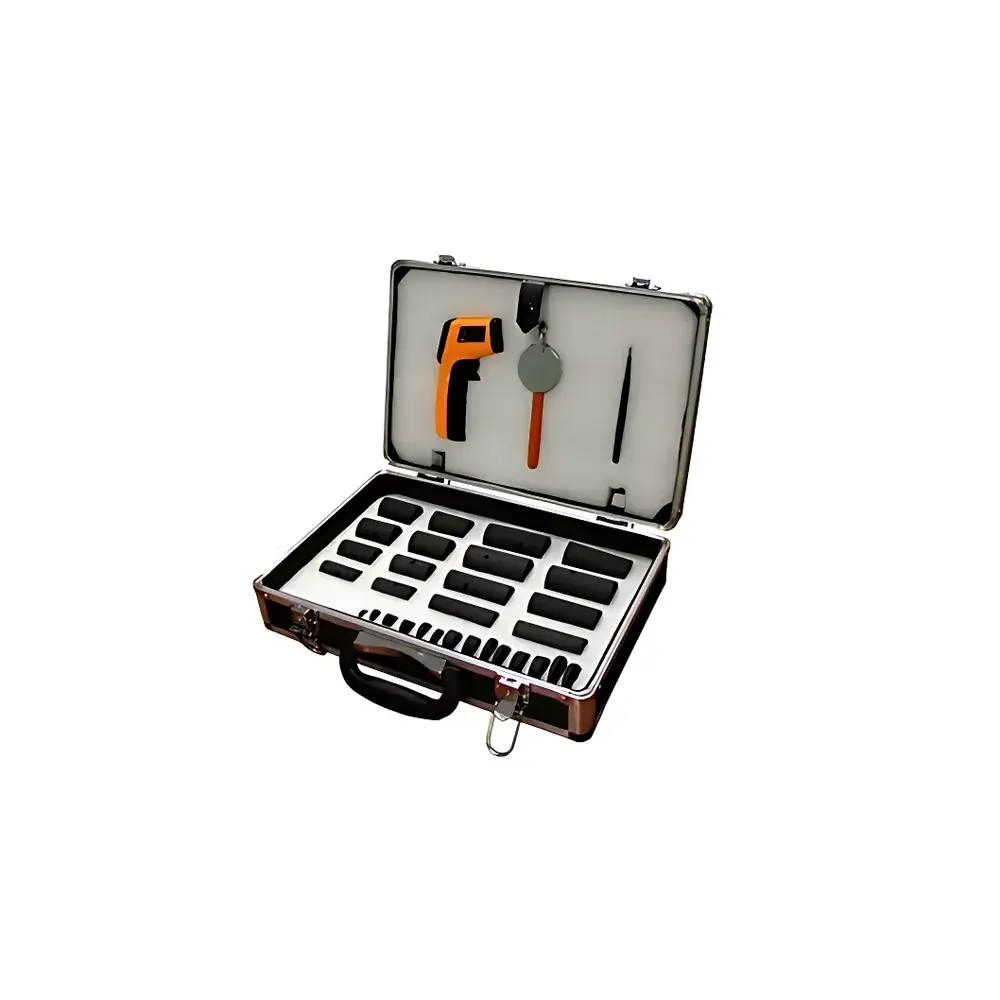
MICHEM Graphite Digestion Assistant
| Brand | MICHEM |
|---|---|
| Origin | Beijing, China |
| Model | Graphite Digestion Assistant |
| Instrument Type | Graphite Digestion Accessory |
| Sample Vessel Compatibility | Universal (Customizable for Domestic & Imported Graphite Block Digesters) |
| Material | High-Purity Isostatically Pressed Fine-Grain Graphite with DuPont™ Teflon® Coating |
| Surface Treatment | High-Pressure Air Atomization Spray Process |
| Thermal Stability | Up to 330 °C |
| Corrosion Resistance | Certified for prolonged exposure to concentrated HNO₃, HCl, HF, H₂SO₄, and aqua regia |
| Included Accessories | Portable Carrying Case with Phenolic Foam Liner, Non-Contact Infrared Thermometer (–50 °C to 330 °C), Telescopic Acid-Resistant Inspection Mirror (16–52 cm extension, 360° axial/radial rotation), Stainless Steel Non-Magnetic Sample Handling Tools |
| Standard Configuration | 15 Custom-Fit Conversion Components per Set |
| Customization | Available for non-standard vessel geometries and OEM integration |
Overview
The MICHEM Graphite Digestion Assistant is a purpose-engineered modular accessory system designed exclusively for integration with stationary graphite block digestion platforms. Unlike standalone digestion instruments, this system operates on the principle of functional augmentation—leveraging the thermal mass and uniform heating profile of existing graphite blocks while extending their operational scope beyond conventional acid digestion. It implements passive thermal conduction enhancement via high-density isostatically pressed graphite components, engineered to maintain dimensional stability under repeated thermal cycling between ambient and 330 °C. The assistant does not generate heat itself; rather, it modifies heat transfer pathways, vessel interface geometry, and vapor management dynamics—enabling precise control over reflux suppression, condensate redirection, and localized thermal gradient minimization. This architecture supports method flexibility across sample preparation workflows governed by EPA Method 3050B, ISO 11466, ASTM D3682, and USP , particularly where multi-step protocols (digestion → evaporation → carbonization → ashing) must be executed sequentially within a single platform.
Key Features
- Modular conversion components fabricated from ultra-fine-grain, high-purity graphite (purity ≥99.997%, ash content <5 ppm), ensuring minimal trace metal leaching and long-term structural integrity under aggressive thermal and chemical stress.
- DuPont™ Teflon® PTFE coating applied via high-pressure air atomization spray—achieving uniform 25–35 µm film thickness with verified adhesion strength (ASTM D3359 Class 4B) and resistance to pitting or delamination in boiling hydrofluoric acid environments.
- Universal fit design validated across 24-, 48-, and 60-position domestic and international graphite digesters (e.g., MICHEM DR-24, SCP Science DigiPREP MS, LabTech HP-300), with optional custom cavity machining available for non-standard vessel diameters and depths.
- Integrated thermal management architecture that eliminates cold-spot-induced condensation and suppresses uncontrolled reflux—critical for maintaining stoichiometric acid ratios during closed-vessel digestion and preventing analyte loss during volatile element analysis (e.g., As, Se, Hg).
- Multi-mode operational capability: transforms standard graphite digesters into configurable platforms supporting digestion, open-vessel evaporation, crystallization, charring, and low-temperature drying—without hardware modification or recalibration.
Sample Compatibility & Compliance
The Graphite Digestion Assistant accommodates borosilicate glass, quartz, PFA, and quartz-lined TFM vessels ranging from 15 mL to 100 mL capacity. Its surface chemistry and inert thermal mass comply with GLP and GMP requirements for trace metal analysis, satisfying ICH Q2(R2) guidelines for equipment suitability. All graphite components are certified free of detectable Cr, Ni, Cu, Zn, Pb, and Cd contamination (ICP-MS detection limit ≤0.05 ng/g). The Teflon® coating meets FDA 21 CFR §177.1550 for food-contact applications and passes ISO 10993-5 cytotoxicity testing. Documentation includes full material traceability certificates, RoHS/REACH declarations, and corrosion resistance validation reports per ASTM G31 immersion testing in 48% HF at 120 °C for 96 hours.
Software & Data Management
As a hardware-only accessory, the Graphite Digestion Assistant requires no embedded firmware or proprietary software. Temperature monitoring is performed externally using the included IR thermometer (calibrated to NIST-traceable standards), with data exportable via USB or Bluetooth to LIMS-compatible platforms (e.g., Thermo Fisher SampleManager, LabWare LIMS). Audit trails for calibration events, usage logs, and maintenance records can be maintained in accordance with FDA 21 CFR Part 11 when integrated with compliant electronic lab notebook (ELN) systems. All accessories—including the telescopic inspection mirror and stainless steel tools—are serialized for asset tracking and preventive maintenance scheduling.
Applications
- Environmental analysis: Soil, sediment, and sludge digestion per EPA 3050B and 3051A, with simultaneous acid recovery and residue concentration.
- Clinical and biological matrices: Tissue homogenate digestion for ICP-MS multi-element quantification (Ca, Mg, Fe, Zn, Cu), minimizing chloride interference through controlled HNO₃/H₂O₂ ramping.
- Geological samples: Silicate rock dissolution using HF-HNO₃ mixtures, where component geometry prevents fluorosilicic acid accumulation in vessel necks.
- Pharmaceutical excipients: Residual catalyst screening (Pd, Pt, Rh) in APIs via microwave-assisted pre-digestion followed by open-beaker carbonization on the converted graphite hotplate mode.
- Materials science: Controlled pyrolysis of polymer composites for ash content determination (ISO 3451-1) and filler dispersion analysis.
FAQ
Is the Graphite Digestion Assistant compatible with microwave digestion systems?
No—it is mechanically and thermally optimized for conductive-heating graphite blocks only. Microwave cavities require RF-transparent materials and distinct thermal management strategies.
Can the Teflon®-coated components be autoclaved?
Autoclaving is not recommended. The coating is rated for continuous use up to 260 °C; steam sterilization cycles exceed this limit and may compromise interfacial adhesion.
Does the assistant alter the original temperature calibration of my digester?
No. It introduces no active heating or sensing elements. Users must verify block temperature uniformity post-installation using calibrated reference thermocouples per ASTM E220.
What is the expected service life under routine daily use?
With proper handling and avoidance of mechanical impact, graphite components retain functional integrity for ≥5 years (≥2,000 digestion cycles) based on accelerated aging studies per ISO 14644-1 Class 5 cleanroom handling protocols.
Are replacement conversion components available as consumables?
Yes. Individual components are orderable by cavity ID number. Lead time is 10–14 business days; batch certification reports accompany each shipment.



