
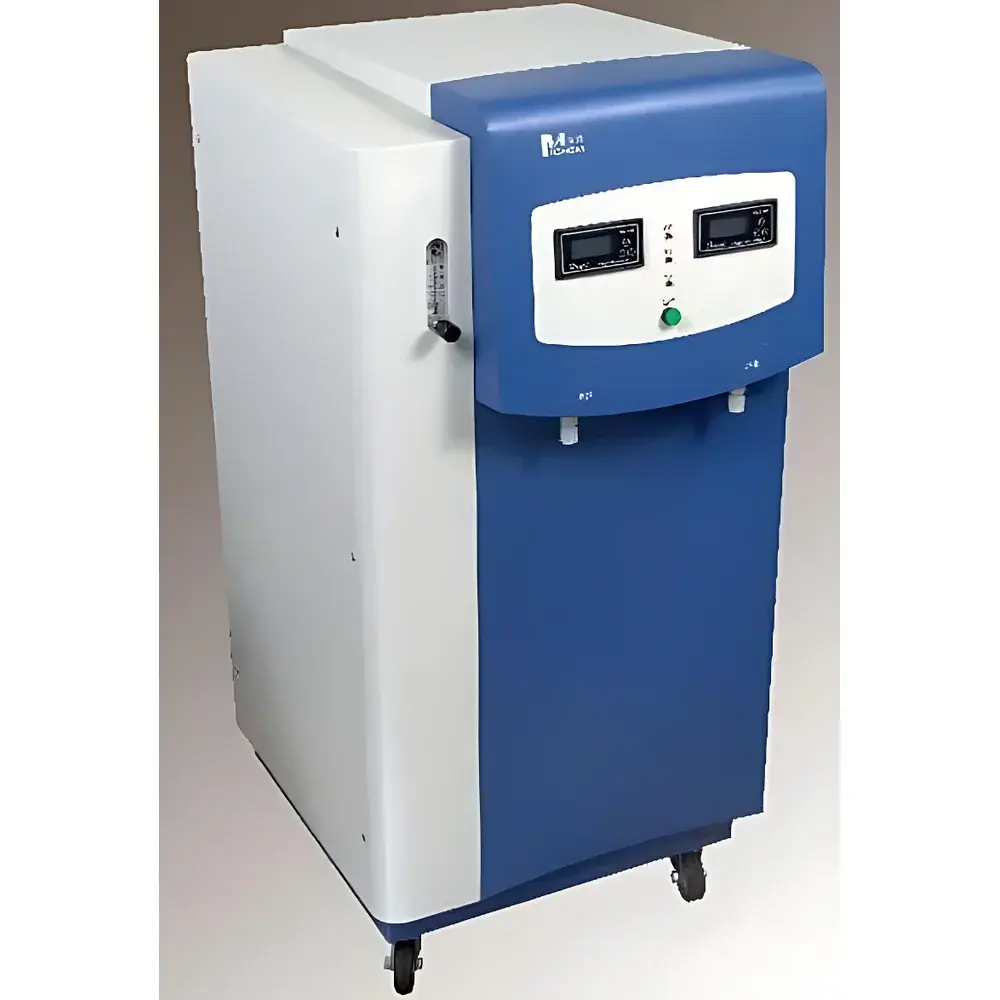
MICHEM MW-D50 Ultra Pure Water System
| Brand | MICHEM |
|---|---|
| Origin | Beijing, China |
| Model | MW-D50 |
| Output Flow Rate | 50 L/h |
| Pure Water Resistivity | 1–5 µS/cm |
| Ultra-Pure Water Resistivity | 18.25 MΩ·cm @ 25 °C |
| Heavy Metals & Soluble Silica | < 0.1 ppb |
| Total Organic Carbon (TOC) | ≤ 10 ppb |
| Endotoxin | < 0.001 EU/mL |
| Particles (>0.1 µm) | < 1 particle/mL |
| Microbial Count | ≤ 1 CFU/mL |
| Feed Water Requirement | Municipal tap water, TDS < 360 ppm, pressure > 0.2 MPa |
| Power Supply | AC 220 V / 50 Hz / 5 A |
| Dimensions (W×D×H) | 560 × 680 × 1105 mm |
| Resin Cycle Yield | 16 tons |
| Pump Noise Level | < 20 dB(A) |
| Conductivity Sensor | 0.01 cm⁻¹ stainless steel electrode, temperature compensation ±0.1 °C |
| Optional Terminal Filtration | Sartorius 0.22 µm filter |
Overview
The MICHEM MW-D50 Ultra Pure Water System is a dual-stream, laboratory-grade water purification platform engineered for consistent production of Type I ultrapure water per GB/T 6682–2008, ASTM D1193–2020, CLSI EP21-A, and CAP/NCCLS guidelines. It employs a six-stage integrated purification architecture—including pre-filtration, reverse osmosis (RO), dual-stage deionization (EDI + mixed-bed ion exchange), 185/254 nm dual-wavelength UV oxidation, and optional 0.22 µm terminal filtration—to remove ions, organic compounds, microorganisms, endotoxins, colloids, and particulates from municipal tap feed water. The system delivers ultra-pure water at 50 L/h with resistivity stabilized at 18.25 MΩ·cm @ 25 °C, TOC ≤ 10 ppb, endotoxin < 0.001 EU/mL, and bacterial count ≤ 1 CFU/mL—meeting stringent requirements for trace elemental analysis, high-sensitivity chromatography, and cell culture applications.
Key Features
- Simultaneous dual-output design: independent pure water (1–5 µS/cm) and ultra-pure water (18.25 MΩ·cm) streams, enabling concurrent use in preparative and analytical workflows.
- Stainless-steel powder-coated cabinet with compact footprint (560 × 680 × 1105 mm), optimized for benchtop or under-bench installation without dedicated plumbing.
- Integrated 185/254 nm UV lamp system for continuous photo-oxidation of organics and microbial inactivation—validated to maintain TOC ≤ 10 ppb over extended operation.
- Real-time digital monitoring via backlit LCD interface: displays resistivity/conductivity, water temperature, system status, consumable life, and alarm conditions (e.g., low feed pressure, full reservoir, sensor drift).
- Intelligent control logic: automatic shutdown on reservoir overflow or feed water interruption; scheduled maintenance alerts based on resin cycle yield (16 tons) and UV lamp operational hours.
- Low-noise (90% compared to conventional distillation units.
- NSF-certified components: Dow Filmtec RO membranes, DuPont Ionac mixed-bed resins, and Sartorius-certified 0.22 µm terminal filters compliant with USP and ISO 8573-1 Class 1 particulate standards.
Sample Compatibility & Compliance
The MW-D50 accepts municipal tap water as feedstock (TDS ≤ 360 ppm, pressure ≥ 0.2 MPa), eliminating dependency on pretreated feed sources. Its closed-loop distribution path and sanitary-grade wetted materials (316L stainless steel, PTFE, and EPDM seals) prevent post-purification contamination. All critical parameters—including resistivity, TOC, endotoxin, and particle counts—are traceable to NIST-traceable calibration standards. The system supports GLP/GMP-aligned documentation through optional audit trail logging (compatible with 21 CFR Part 11–compliant software extensions). Output water meets or exceeds Type I specifications in GB/T 6682–2008, ASTM D1193–2020 Grade I, CLSI EP21-A, and ISO 3696:1987 Class 1.
Software & Data Management
While the base MW-D50 operates via embedded firmware with tactile membrane keypad and real-time LCD display, it supports optional RS-232/USB data export for integration into centralized lab information management systems (LIMS). Logged parameters include timestamped resistivity readings, cumulative volume dispensed, UV lamp runtime, and consumable usage metrics. Firmware updates are delivered via secure USB import, preserving configuration integrity. For regulated environments, optional software modules provide electronic signatures, user access levels, and automated PDF report generation—including daily QC summaries aligned with ISO/IEC 17025 internal audit requirements.
Applications
- HPLC, UHPLC, and LC-MS mobile phase preparation and column equilibration
- ICP-MS, ICP-OES, and AAS standard dilution and blank matrix formulation
- Cell culture media reconstitution and sterile filtration support
- Trace metal analysis requiring sub-ppt detection limits (e.g., EPA Method 200.8)
- Preparation of ELISA, PCR, and next-generation sequencing reagents
- Rinsing of optical components, semiconductor wafers, and photomask substrates
- Calibration of conductivity and TOC analyzers in metrology labs
FAQ
What feed water quality is required for stable 18.25 MΩ·cm output?
Municipal tap water with TDS ≤ 360 ppm and inlet pressure ≥ 0.2 MPa is sufficient. Pre-treatment is not mandatory, though optional sediment and carbon pre-filters are recommended where chlorine or particulate load exceeds local utility averages.
Does the system comply with FDA 21 CFR Part 11 for electronic records?
The base unit does not include Part 11 functionality, but optional firmware and companion software modules provide audit trails, electronic signatures, and role-based access control—fully deployable in validated GxP environments.
How often must consumables be replaced?
Mixed-bed resin life is rated at 16 tons of processed water under typical feed conditions; UV lamps require replacement every 12,000 operating hours; 0.22 µm terminal filters are single-use and replaced after each 1,000 L dispensed or per quarterly QC verification.
Can the MW-D50 be integrated into existing lab water networks?
Yes—via standard 1/4″ push-to-connect fittings. Optional pressure-regulated loop kits enable connection to centralized distribution manifolds while maintaining flow stability across multiple points-of-use.
Is TOC monitoring performed in real time?
The MW-D50 does not include an onboard TOC analyzer; however, its dual-wavelength UV system and validated process design ensure TOC remains ≤ 10 ppb between external verification intervals—per ASTM D5542 and USP .



