
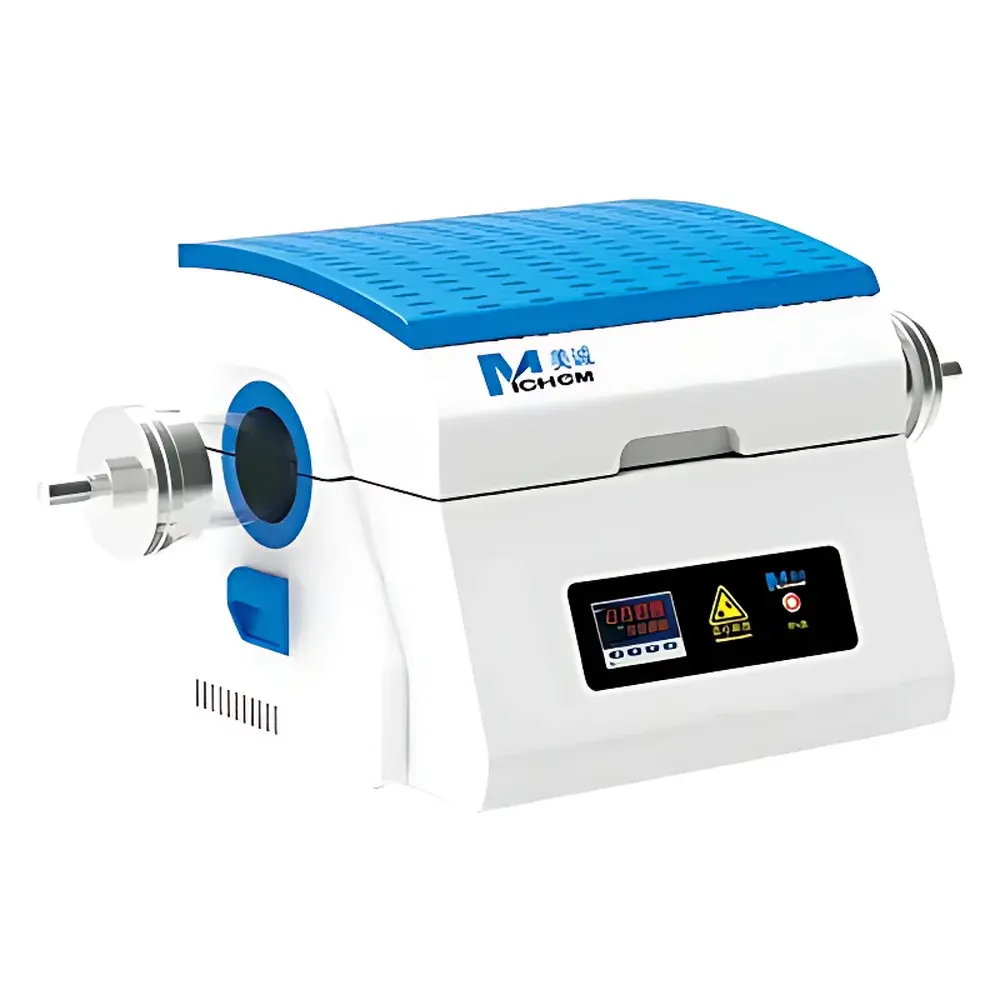
MICHEM TF10 Vacuum-Atmosphere Tube Furnace Series (1000°C)
| Brand | MICHEM |
|---|---|
| Origin | Beijing, China |
| Manufacturer Type | Authorized Distributor |
| Product Category | Domestic |
| Model | TF10 |
| Instrument Type | Horizontal Tube Furnace |
| Maximum Temperature | 1000°C |
| Temperature Control Accuracy | ±1°C |
| Rated Power | 2500 W |
| Heating Rate to Max Temp | ≤40 min |
| Heating Element | HRE High-Temperature Alloy |
| Internal Dimensions | Ø60×54×1000 mm / Ø80×74×1000 mm / Ø100×94×1000 mm |
Overview
The MICHEM TF10 Vacuum-Atmosphere Tube Furnace Series is a precision-engineered horizontal high-temperature thermal processing system designed for controlled-atmosphere and vacuum applications in materials science, metallurgy, ceramics, and advanced battery R&D laboratories. Unlike conventional muffle furnaces, the TF10 employs a sealed quartz or high-purity alumina tube configuration—enabling operation under inert gas (N₂, Ar), reducing (H₂/N₂), oxidizing (O₂), or vacuum conditions (down to 10⁻³ mbar with optional pump integration). Its core heating architecture utilizes HRE (High Resistance Electrical) alloy heating elements, offering superior thermal stability, extended service life, and resistance to thermal cycling fatigue at sustained 1000°C operation. The furnace is thermally insulated with multi-layer ceramic fiber modules rated for continuous use up to 1200°C, ensuring low external surface temperature (<60°C after 1 h at 1000°C) and energy efficiency compliant with ISO 50001 principles. Designed for GLP-compliant workflows, the TF10 supports traceable thermal profiles essential for ASTM E1142 (thermal calibration of furnaces), ISO 8501-3 (heat treatment verification), and USP <1225> method validation requirements.
Key Features
- Vacuum & Gas-Compatible Design: Integrated flanged tube ends with VCR or KF fittings support rapid evacuation and gas purging; compatible with standard mechanical vacuum pumps and mass flow controllers (MFCs) for precise atmosphere regulation.
- High-Stability Temperature Control: PID-based digital controller with 30-segment programmable ramp-soak capability; achieves ±1°C uniformity across the hot zone (measured per ASTM C1040) and <0.2% FS long-term stability.
- Optimized Thermal Architecture: Dual-zone heating (optional) minimizes axial temperature gradients; hot zone uniformity ±3°C over 300 mm length (verified by calibrated thermocouple mapping).
- Safety-Engineered Operation: Automatic power cutoff upon door/tube-end opening; over-temperature cutout (OTC) with independent thermocouple; grounding continuity monitoring per IEC 61000-6-3 EMC standards.
- Modular Internal Geometry: Three standard tube ID/length configurations (Ø60/Ø80/Ø100 × 1000 mm) accommodate diverse sample carriers—including ceramic boats, graphite crucibles, and custom fixtures—without compromising gas flow dynamics.
- Energy-Efficient Construction: Low thermal mass ceramic fiber insulation (density: 128 kg/m³) reduces standby heat loss by >40% versus refractory brick alternatives; 2500 W nominal draw enables operation on standard 16 A/220 V single-phase circuits.
Sample Compatibility & Compliance
The TF10 accommodates solid-state samples in powder, pellet, thin-film, or wire form, including but not limited to Li-ion cathode precursors (e.g., NMC, LFP), metal oxides (CuO, Fe₂O₃), catalyst supports (Al₂O₃, SiO₂), and sintering-grade ceramics (ZrO₂, SiC). It complies with key international standards for laboratory thermal equipment: IEC 61010-1 (safety requirements for electrical equipment), ISO/IEC 17025:2017 (calibration traceability of integrated K-type thermocouples), and ASTM E2555 (performance verification of tube furnaces). Optional accessories—including quartz tube liners, water-cooled end flanges, and integrated pressure transducers—enable compliance with OSHA 1910.1200 (hazard communication) and EU Directive 2014/34/EU (ATEX Zone 2 compatibility when configured with explosion-proof gas manifolds).
Software & Data Management
The furnace integrates with MICHEM’s optional PC-based control software (TF-Control Suite v3.2), supporting real-time temperature logging at 1 Hz resolution, CSV export for LIMS integration, and audit-trail generation per FDA 21 CFR Part 11 requirements—including electronic signatures, user access levels, and immutable event logs. All temperature setpoints, ramp rates, soak durations, and gas flow parameters are stored with timestamped metadata. The system supports Modbus RTU/TCP protocols for SCADA-level integration into centralized lab automation platforms. Calibration certificates include as-found/as-left data, uncertainty budgets (k=2), and NIST-traceable references from accredited third-party labs (ISO/IEC 17025 certified).
Applications
- Controlled-atmosphere calcination of battery electrode materials under N₂/H₂ mixtures
- Vacuum annealing of semiconductor wafers and thin-film photovoltaic substrates
- Thermal gravimetric analysis (TGA) pre-conditioning of catalysts and adsorbents
- Heat treatment of shape-memory alloys (NiTi) requiring precise austenite finish (Af) temperature control
- Synthesis of metal–organic frameworks (MOFs) via solvent-assisted linker exchange (SALE) under dynamic gas flow
- Pre-sintering of dental zirconia blanks prior to HIP densification
- Reference standard calibration for high-temperature pyrometers (up to 1000°C blackbody source validation)
FAQ
What vacuum level can the TF10 achieve without auxiliary pumping?
The base configuration maintains static vacuum integrity ≤50 mbar; for operational vacuum down to 10⁻³ mbar, a separate two-stage rotary vane pump (e.g., Edwards RV8) is required and available as an accessory kit.
Is the furnace suitable for hydrogen atmospheres?
Yes—when equipped with H₂-rated seals, stainless-steel gas lines, and optional flame arrestors; full H₂ compatibility requires factory configuration per CGA P-21 and NFPA 55 guidelines.
Can the internal tube be replaced in the field?
Quartz tubes (standard) and high-purity alumina tubes (optional) are user-replaceable; replacement kits include dimensional specifications, thermal expansion coefficients, and cleaning protocols aligned with SEMI F57 standards.
Does the system support remote monitoring via Ethernet or Wi-Fi?
Ethernet (RJ45) connectivity is standard for local network integration; Wi-Fi operation is not supported due to electromagnetic interference constraints in high-power thermal environments.
What maintenance intervals are recommended for optimal performance?
Heating element resistance verification every 200 operating hours; ceramic fiber integrity inspection annually or after 50 thermal cycles exceeding 900°C; thermocouple recalibration biannually per ISO/IEC 17025 procedures.



