
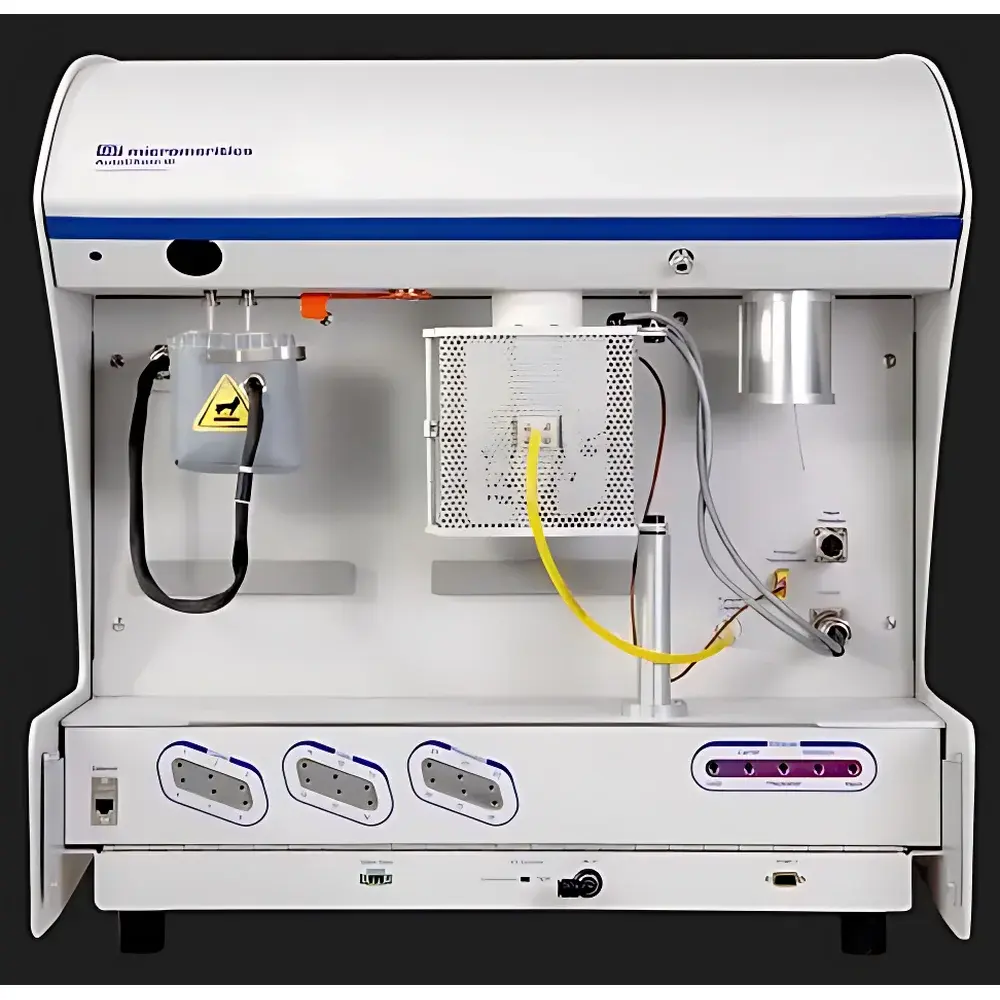
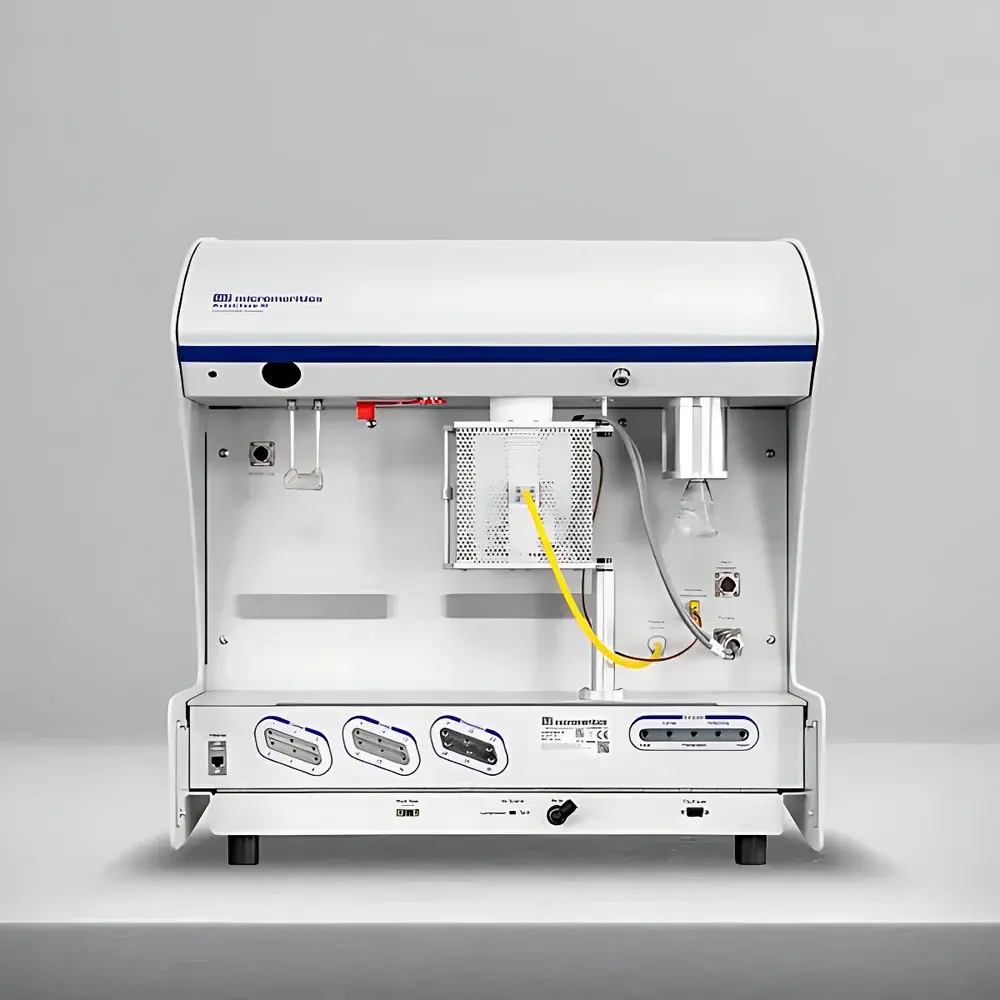
Micromeritics AutoChem III Chemisorption Analyzer
| Brand | Micromeritics |
|---|---|
| Origin | USA |
| Model | AutoChem III |
| Instrument Type | Chemisorption Analyzer |
| Measurement Principle | Gas-solid surface reaction kinetics and thermal desorption analysis |
| Number of Gas Inlets | 18 |
| Temperature Range | Ambient to 1200 °C |
| Heating Rate | Up to 100 °C/min from –100 °C to 800 °C |
| Core Functions | Pulse chemisorption, Temperature-Programmed Reduction (TPR), Single-point BET surface area estimation |
| Cooling System | Integrated air-cooled AutoCool™ (no liquid nitrogen or external chiller required) |
| Sample Tube Interface | Patented KwikConnect™ one-piece sealed sample tube assembly (US Pat. No. 11,105,825 B2) |
| Water Removal Technology | AutoTrap™ integrated condensate management for TPR (US Pat. No. 10,487,954 B) |
Overview
The Micromeritics AutoChem III Chemisorption Analyzer is a fully automated, high-precision instrument engineered for quantitative characterization of catalyst surface chemistry and reactivity. It operates on the fundamental principles of gas–solid heterogeneous reaction kinetics, thermal programmed desorption (TPD), temperature-programmed reduction (TPR), and pulse chemisorption—enabling rigorous determination of active metal dispersion, metal surface area, stoichiometric uptake, reduction profiles, and adsorption enthalpies. Designed specifically for R&D and QC laboratories engaged in catalysis science, the AutoChem III delivers reproducible, trace-level detection of surface reactions under precisely controlled gas environments and dynamic thermal conditions. Its architecture supports both routine screening and deep mechanistic studies—critical for advancing next-generation catalysts in carbon capture and utilization (CCU), green hydrogen production, ammonia synthesis, and sustainable chemical manufacturing.
Key Features
- 18 independently programmable gas inlets with mass flow controllers (MFCs) for precise multi-gas switching and blending—enabling complex reaction sequences such as sequential oxidation–reduction–adsorption cycles.
- Extended temperature range from –100 °C to 1200 °C, with rapid heating rates up to 100 °C/min over the –100 °C to 800 °C span—facilitating fast thermal ramping without thermal lag or overshoot.
- AutoCool™ integrated air-cooling system eliminates dependency on liquid nitrogen or external chillers, reducing cooldown time by ≥30 minutes per run and improving daily throughput.
- AutoTrap™ water and condensate management subsystem ensures robust removal of H2O and other volatile byproducts during TPR experiments—removing the need for manual cryogenic slurry preparation (e.g., isopropanol–LN2) and minimizing operator intervention.
- KwikConnect™ patented one-piece sample tube assembly guarantees leak-tight integrity through tool-free, repeatable insertion—eliminating thread-based sealing variability and enabling consistent baseline stability across hundreds of analyses.
- Modular reactor design accommodates standard U-shaped quartz tubes (6 mm OD) and optional high-temperature alloy reactors for corrosive or ultra-high-temperature applications.
Sample Compatibility & Compliance
The AutoChem III supports solid catalysts including supported metals (e.g., Pt/Al2O3, Ni/SiO2), metal oxides (e.g., CuO, Fe2O3), zeolites, MOFs, and carbide/nitride-based materials. Sample masses typically range from 0.05 to 1.0 g, depending on surface area and reactivity. The system complies with ASTM D7215 (standard test method for determining metal dispersion via H2 chemisorption), ISO 18317 (gas adsorption for surface area and porosity), and supports audit-ready operation under GLP and GMP frameworks. Full 21 CFR Part 11 compliance is enabled via optional software modules—including electronic signatures, audit trails, and user-access controls—making it suitable for regulated pharmaceutical and industrial catalyst development environments.
Software & Data Management
Instrument control, data acquisition, and analysis are managed through Micromeritics’ proprietary ChemiSoft™ v5.x platform. The software provides real-time visualization of temperature, flow, pressure, and detector signals (TCD or MS-coupled); automated peak integration for quantification; customizable method templates; and batch processing for multi-sample campaigns. All raw and processed data are stored in secure, timestamped project files with embedded metadata (operator ID, calibration history, gas lot numbers). Export formats include CSV, PDF reports, and XML for LIMS integration. Optional ChemiSoft Connect enables remote monitoring and centralized fleet management across distributed lab networks.
Applications
- Determination of active metal dispersion and particle size distribution in supported noble-metal catalysts using H2 or CO pulse chemisorption.
- Quantitative profiling of reducibility and oxygen mobility in transition metal oxides via H2-TPR, CO-TPR, or CH4-TPR.
- Surface acidity/basicity assessment via NH3-TPD or CO2-TPD, including desorption energy distribution modeling.
- Stability evaluation under cyclic redox conditions simulating industrial reactor start-up/shutdown protocols.
- Single-point BET estimation for comparative surface area screening when full isotherm acquisition is impractical.
- Method development for emerging applications including electrocatalyst support interactions, low-temperature CO2 hydrogenation intermediates, and sulfur-tolerant reforming catalysts.
FAQ
What gases are compatible with the AutoChem III?
The system supports inert (He, Ar, N2), reductive (H2, CO, CH4), oxidative (O2, NO, air), and acidic/basic probe gases (NH3, CO2, SO2)—all delivered via calibrated MFCs and validated for purity and flow linearity.
Can the AutoChem III be coupled to a mass spectrometer?
Yes—optional MS interface kits support direct coupling to quadrupole or TOF mass spectrometers for evolved gas analysis (EGA), enabling speciation of desorbed fragments during TPD/TPR and kinetic isotope tracing.
Is calibration traceable to NIST standards?
All gas flow controllers are factory-calibrated against NIST-traceable reference standards, and temperature sensors (Type S thermocouples) are certified per ASTM E230. Certificate of Calibration is provided with each instrument shipment.
How does the AutoChem III handle moisture-sensitive samples?
The system includes a high-vacuum manifold (<1 × 10⁻⁶ Torr base pressure), inert gas purging protocols, and optional glovebox integration—ensuring sample integrity from loading through analysis.
What maintenance intervals are recommended?
Routine maintenance includes quarterly MFC verification, biannual TCD filament inspection, and annual furnace calibration—documented in the included Preventive Maintenance Guide aligned with ISO/IEC 17025 laboratory requirements.



