
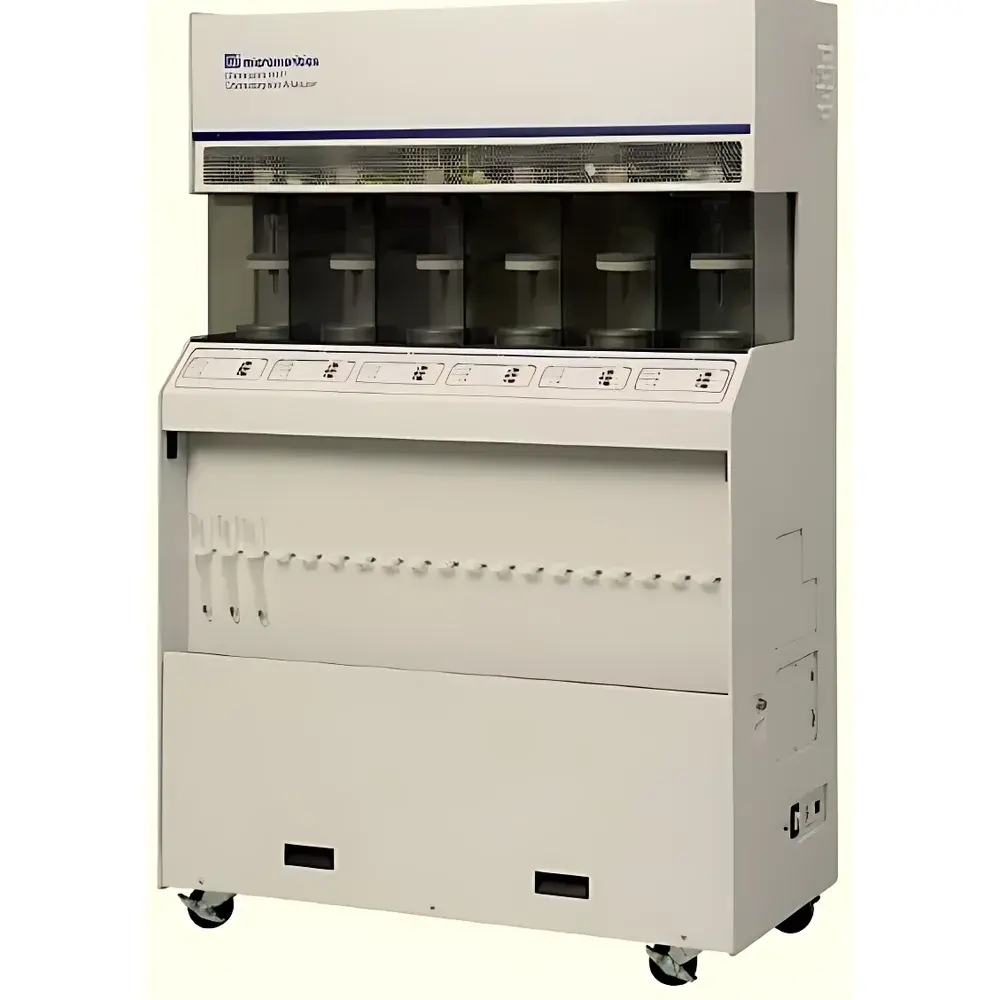
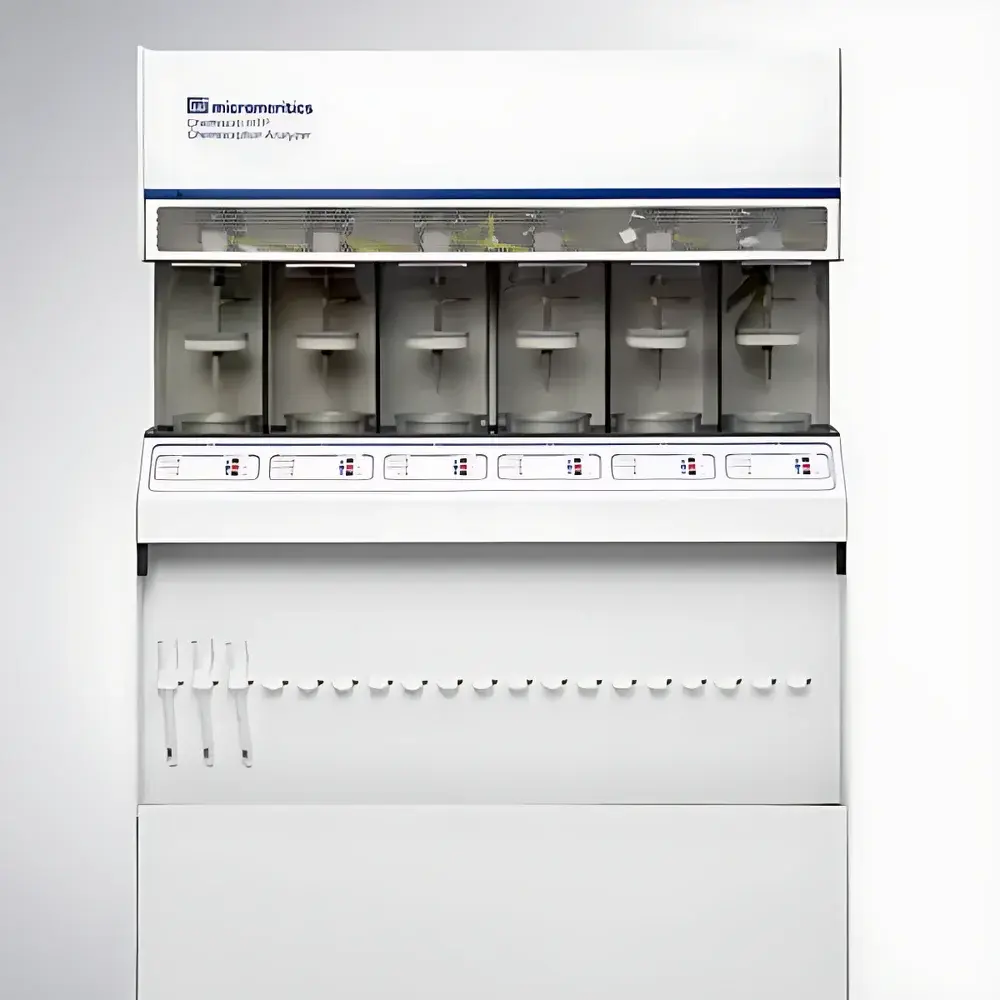
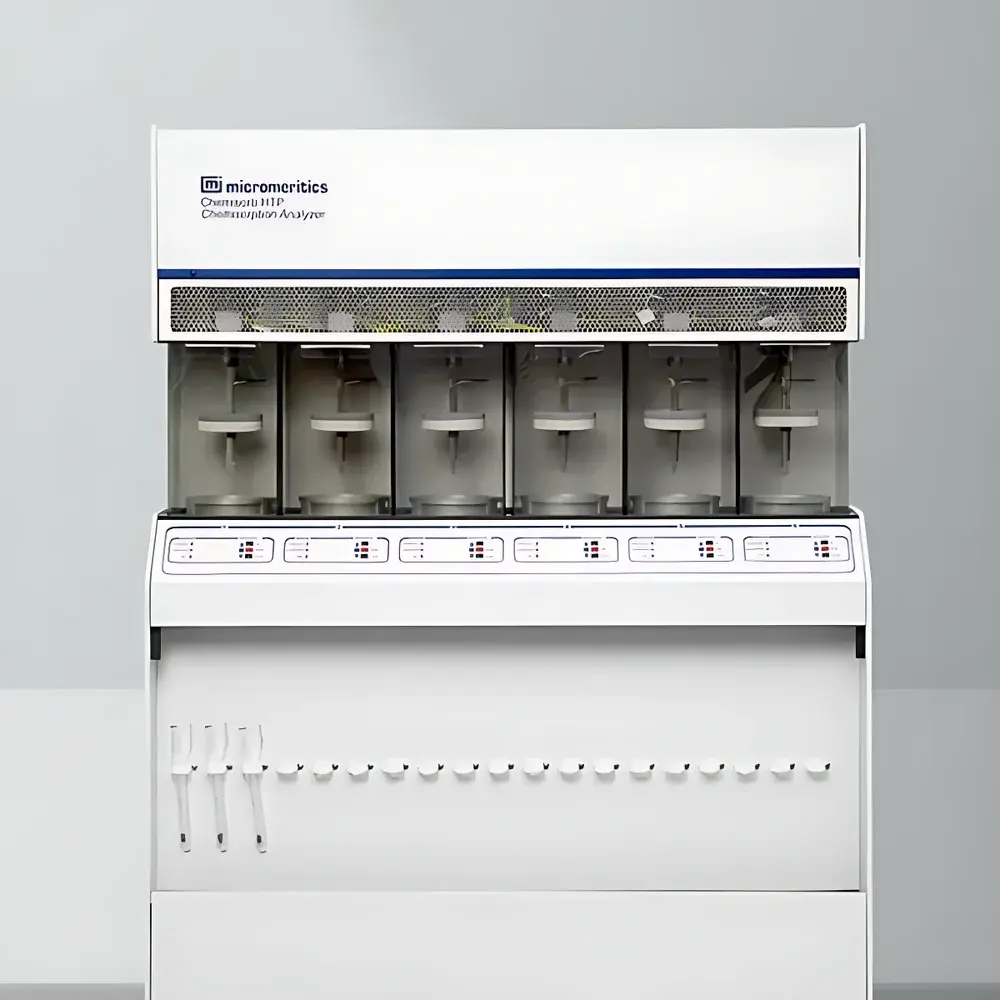
Micromeritics ChemiSorb HTP Multi-Station Static Volumetric Chemisorption Analyzer
| Brand | Micromeritics |
|---|---|
| Origin | USA |
| Model | ChemiSorb HTP |
| Principle | Static Volumetric Method |
| Gas Inlet Ports | 12 |
| Analysis Stations | 6 |
| Temperature Range | Ambient +10 °C to 700 °C |
| Sample Reactor | Quartz with Overflow Channel Design |
| Automation Level | Fully Automated |
| Software Interface | Windows-Based Control & Reporting Platform |
Overview
The Micromeritics ChemiSorb HTP is a fully automated, multi-station static volumetric chemisorption analyzer engineered for high-throughput quantitative characterization of heterogeneous catalysts and surface-active materials. It operates on the fundamental principle of static volumetric gas adsorption/desorption, where precise pressure measurements—under controlled temperature and ultra-high vacuum conditions—are used to determine gas uptake at equilibrium across defined partial pressures. This method enables thermodynamically rigorous determination of surface chemical properties including metal dispersion, active metal surface area, average crystallite size (via stoichiometric uptake), and acid site concentration and strength distribution (using probe molecules such as NH₃ or CO). Designed for R&D laboratories and QC environments in catalysis, petrochemicals, and advanced materials development, the ChemiSorb HTP supports ASTM D7215–18 (Standard Test Method for Determination of Metal Dispersion in Supported Catalysts by Chemisorption) and aligns with ISO 18314–2 (Catalysts — Determination of active surface area by chemisorption) requirements.
Key Features
- Six independent analysis stations, each equipped with a dedicated quartz reactor, programmable furnace (ambient +10 °C to 700 °C), pressure transducer, and mass flow controller—enabling true parallel operation without cross-talk.
- Integrated ultra-high vacuum manifold with individual pressure monitoring per station, ensuring reproducible base pressures <1×10⁻⁴ Torr prior to dosing.
- Twelve independently regulated gas inlet ports support sequential or simultaneous introduction of reactant gases (e.g., H₂, CO, O₂, NH₃, NO), carrier gases, and calibration standards—eliminating manual gas switching and minimizing contamination risk.
- On-board sample degassing station integrated into each analysis module; samples may be degassed *in situ* under dynamic vacuum or controlled purge flow, with real-time temperature ramping and hold profiles.
- Overflow-channel quartz reactors accommodate diverse sample geometries—from fine powders to mm-scale extrudates—while maintaining uniform thermal contact and minimizing dead volume effects.
- Automated equilibrium detection algorithm allows user-defined stabilization criteria (e.g., ΔP/Δt < 0.001 Torr/min over 60 s), ensuring robust isotherm construction even for slow-surface-reaction systems.
Sample Compatibility & Compliance
The ChemiSorb HTP accommodates solid catalysts in powder, pellet, or extrudate form (typical mass range: 0.05–2.0 g per station). Its inert quartz microreactor system minimizes catalytic side reactions during pretreatment and analysis. Instrument design conforms to IEC 61000-6-3 (EMC emissions) and UL 61010-1 safety standards. Data acquisition and reporting workflows support 21 CFR Part 11 compliance when deployed with validated software configurations—including electronic signatures, audit trails, and user-access controls. Routine calibration verification follows NIST-traceable pressure and temperature protocols, and system suitability tests (e.g., H₂ uptake on standard Pt/Al₂O₃ reference material) are embedded in SOP templates.
Software & Data Management
Control and analysis are executed via Micromeritics’ proprietary Windows-based software suite, featuring intuitive workflow-driven navigation, real-time multi-station status visualization, and synchronized data logging (pressure, temperature, time, valve state). Isotherms are constructed using nonlinear least-squares fitting against Langmuir, Temkin, or dual-site models. Raw data files (.csv, .txt) and processed reports (.pdf, .xlsx) are exportable with full metadata tagging (operator ID, method version, instrument serial number, timestamp). Graphical tools allow axis rescaling, curve overlay, derivative analysis (dθ/dP), and annotation. Reports are customizable: header/footer fields accept institutional logos, font selection is configurable, and modular report sections (e.g., “Dispersion Summary”, “Acid Strength Distribution”) can be enabled/disabled per user preference.
Applications
- Quantification of Pt, Pd, Ni, Rh, or Cu dispersion in supported metal catalysts for hydrogenation, reforming, and emission control applications.
- Determination of active surface area and particle size of oxide catalysts (e.g., V₂O₅/TiO₂, MoO₃/Al₂O₃) used in selective oxidation.
- Acid site titration and strength profiling of zeolites, aluminas, and sulfated metal oxides using NH₃-TPD or pyridine-FTIR coupled workflows.
- Stability assessment via repeated chemisorption cycles to monitor sintering or poisoning under simulated aging conditions.
- Batch-to-batch quality control in catalyst manufacturing, supporting release testing against pre-defined dispersion and surface area specifications.
FAQ
How many samples can be analyzed simultaneously?
Up to six samples can be processed in parallel—one per analysis station—with fully independent temperature, pressure, and gas-dosing control.
Is *in situ* degassing supported?
Yes. Each station includes an integrated degassing capability with programmable heating ramps, vacuum levels down to 1×10⁻⁴ Torr, and optional inert gas purging.
What gases are compatible with the 12-port manifold?
Any non-corrosive, non-condensable gases commonly used in chemisorption (H₂, CO, O₂, He, Ar, N₂, NH₃, NO, SO₂) may be connected—subject to compatibility verification with stainless-steel and Viton/Kalrez wetted materials.
Does the system support temperature-programmed desorption (TPD)?
While primarily optimized for static volumetric isotherms, the ChemiSorb HTP’s precise furnace control and pressure monitoring enable semi-quantitative TPD experiments when combined with external mass spectrometry or thermal conductivity detection.
Can data be exported for LIMS integration?
Yes. ASCII-formatted output files include complete experimental metadata and are structured for direct ingestion into laboratory information management systems (LIMS) via standard import protocols.



