
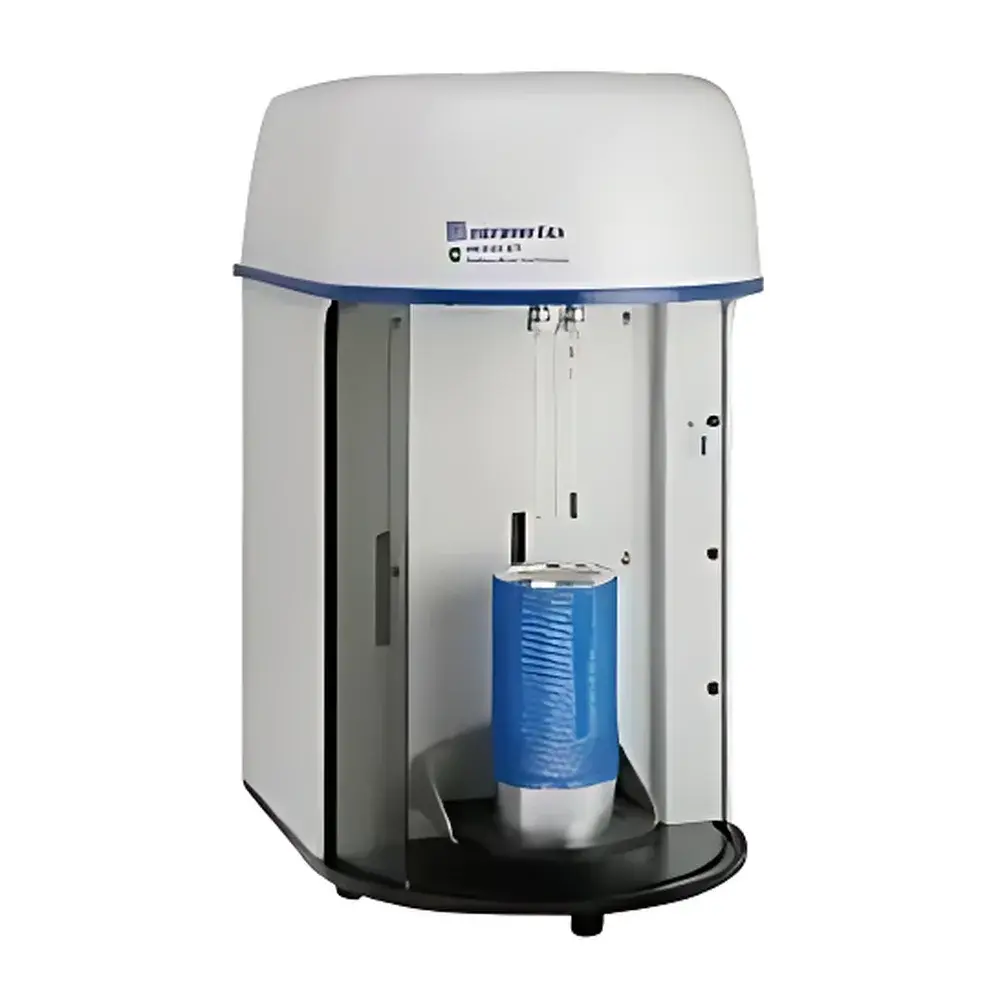
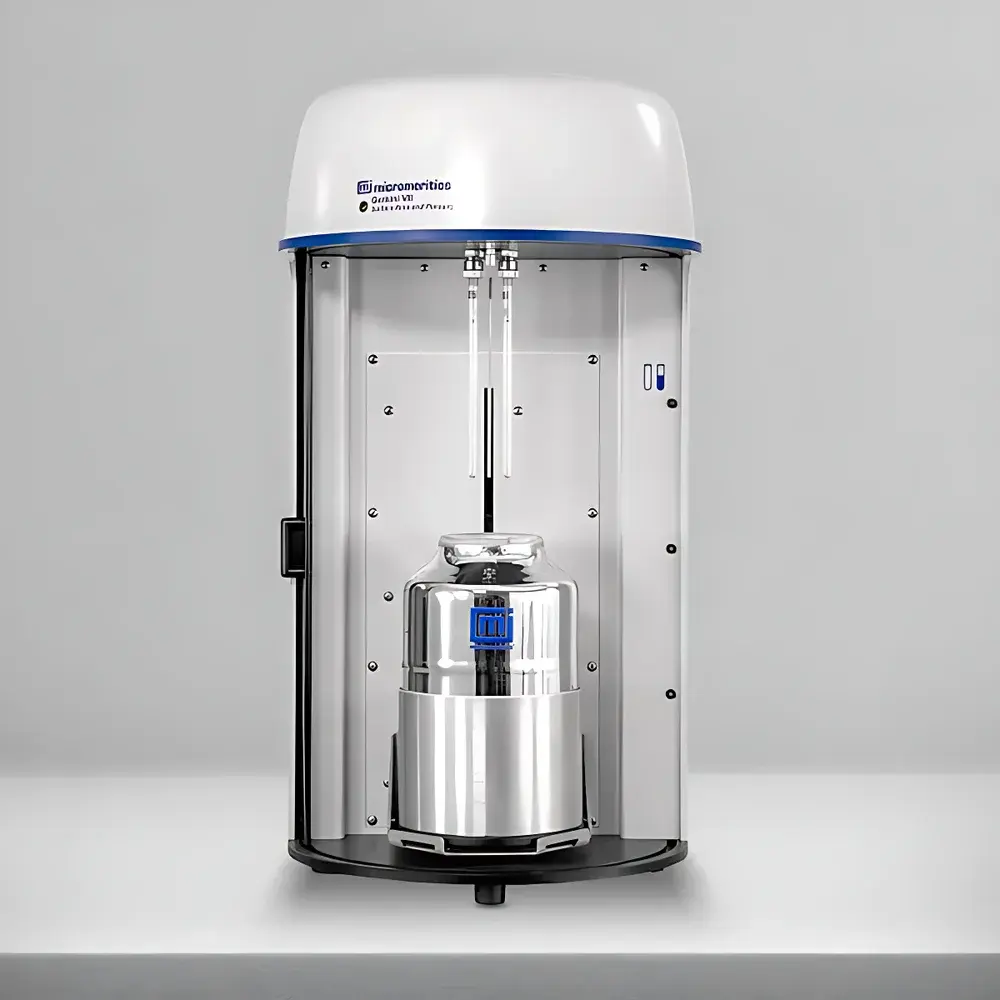
Micromeritics Gemini VII 2390 Series Automated Specific Surface Area and Pore Size Analyzer
| Brand | Micromeritics |
|---|---|
| Origin | USA |
| Model | Gemini VII 2390 Series |
| Analysis Principle | Static Volumetric Gas Adsorption |
| Number of Analysis Stations | 1 |
| Specific Surface Area Range | ≥0.01 m²/g (no upper limit) |
| Pressure Range | 0–1000 mmHg |
| Adsorptive Gas | N₂ (optimized for liquid nitrogen bath), He, Ar, O₂, CO₂, CH₄, C₄H₁₀ |
| Relative Pressure (P/P₀) Range | 0–1.0 (adsorption only) |
| P/P₀ Resolution | <10⁻⁴ |
| Pressure Resolution | <0.1 mmHg |
| Sensor Accuracy & Linearity | ±0.5% of full scale |
| Operating Temperature | 10–35 °C |
| Relative Humidity | 20–80% RH (non-condensing) |
Overview
The Micromeritics Gemini VII 2390 Series Automated Specific Surface Area and Pore Size Analyzer is a benchtop gas adsorption instrument engineered for precision, reproducibility, and operational simplicity in measuring specific surface area (SSA), total pore volume, and pore size distribution of solid materials. It employs the static volumetric method—also known as the manometric or equilibrium gas adsorption technique—in accordance with ISO 9277, ASTM D3663, and IUPAC recommendations for physisorption analysis. The system utilizes high-stability pressure transducers and a proprietary differential balance tube design to eliminate free-space calibration errors inherent in conventional single-manometer configurations. This architecture ensures robust quantification of adsorbed gas volumes across the full relative pressure range (0–1.0 P/P₀), enabling accurate Brunauer–Emmett–Teller (BET) surface area determination down to 0.01 m²/g without requiring krypton (Kr) adsorption—even for ultra-low-surface-area samples such as highly sintered ceramics or dense metals.
Key Features
- Differential balance tube manifold: Eliminates systematic error from dead-volume uncertainty and thermal drift during equilibration.
- Single-analysis-station configuration optimized for high-throughput routine testing in QC labs and academic teaching environments.
- Nitrogen-optimized cryogenic operation at 77 K using standard liquid nitrogen baths; fully compatible with alternative non-corrosive adsorbates including argon (87 K), carbon dioxide (273 K), methane (111 K), and butane (273 K).
- Integrated helium pycnometry port for independent skeletal density measurement—essential for accurate pore volume calculation and true density correction.
- High-resolution pressure sensing: <0.1 mmHg absolute resolution over 0–1000 mmHg range, with transducer linearity certified to ±0.5% of full scale.
- Automated degas control with programmable temperature ramping (up to 400 °C) and vacuum level monitoring (≤10⁻³ Torr).
Sample Compatibility & Compliance
The Gemini VII 2390 accommodates powdered, granular, monolithic, and fibrous solids—including catalysts, battery electrode materials, pharmaceutical excipients, activated carbons, metal–organic frameworks (MOFs), and geological specimens. Sample holders support masses from 0.05 g to 2.0 g, with optional low-mass crucibles for trace-surface-area characterization. All hardware and software comply with GLP documentation requirements, supporting audit trails, electronic signatures (per FDA 21 CFR Part 11 when deployed with compliant LIMS integration), and standardized reporting per ISO/IEC 17025 laboratory accreditation criteria. Instrument validation protocols align with USP and Ph. Eur. 2.9.33 for surface area determination in pharmaceutical development.
Software & Data Management
Operated via Micromeritics’ proprietary ASAP Software Suite, the Gemini VII 2390 delivers intuitive workflow management—from automated degas scheduling and isotherm acquisition to multi-point BET, Langmuir, t-plot, and BJH/DFT pore size analysis. Raw pressure–time datasets are stored in vendor-neutral ASCII format (.dat) with embedded metadata (date/time stamp, operator ID, sample ID, instrument serial number). Batch processing supports up to 24 sequential runs with customizable pass/fail criteria based on isotherm reproducibility (R² > 0.9995 for linear BET region) and monolayer capacity convergence. Export modules generate PDF reports compliant with internal QA templates or external regulatory submissions.
Applications
- Quality control of catalyst supports (e.g., γ-Al₂O₃, SiO₂, TiO₂) for automotive and petrochemical industries.
- Characterization of anode/cathode materials (e.g., graphite, NMC, LFP) in lithium-ion battery R&D.
- Pharmaceutical solid-state assessment: polymorph screening, excipient surface interaction studies, and dissolution rate correlation.
- Geotechnical evaluation of clay mineral reactivity and contaminant sorption capacity.
- Educational use in materials science laboratories for hands-on instruction in surface thermodynamics and porous media physics.
FAQ
Can the Gemini VII 2390 perform micropore analysis using CO₂ at 0 °C?
Yes—the instrument supports CO₂ adsorption at 273 K for rapid micropore assessment (t-plot, DA, or HK methods) in carbons and zeolites, provided the sample is pre-degassed under vacuum at ≤150 °C.
Is helium pycnometry integrated into the same sample tube used for gas adsorption?
Yes—helium intrusion occurs through the same sample holder without transfer, minimizing handling error and ensuring consistent skeletal density input for pore volume calculations.
What is the minimum sample mass required for reliable SSA measurement at 0.01 m²/g?
For optimal signal-to-noise ratio, a minimum of 1.0 g is recommended for materials near the lower detection limit; however, validated results have been obtained with 0.25 g using extended equilibration times and duplicate runs.
Does the system support automated multi-point BET analysis with variable P/P₀ spacing?
Yes—ASAP software allows user-defined P/P₀ points (e.g., logarithmic spacing below 0.1, linear above) and automatic selection of the optimal linear BET region (typically 0.05–0.30 P/P₀) with residual error reporting.
How is calibration traceability maintained?
Pressure transducers are factory-calibrated against NIST-traceable dead-weight testers; users receive calibration certificates with each instrument shipment, and annual verification kits are available through Micromeritics Service Centers.



