
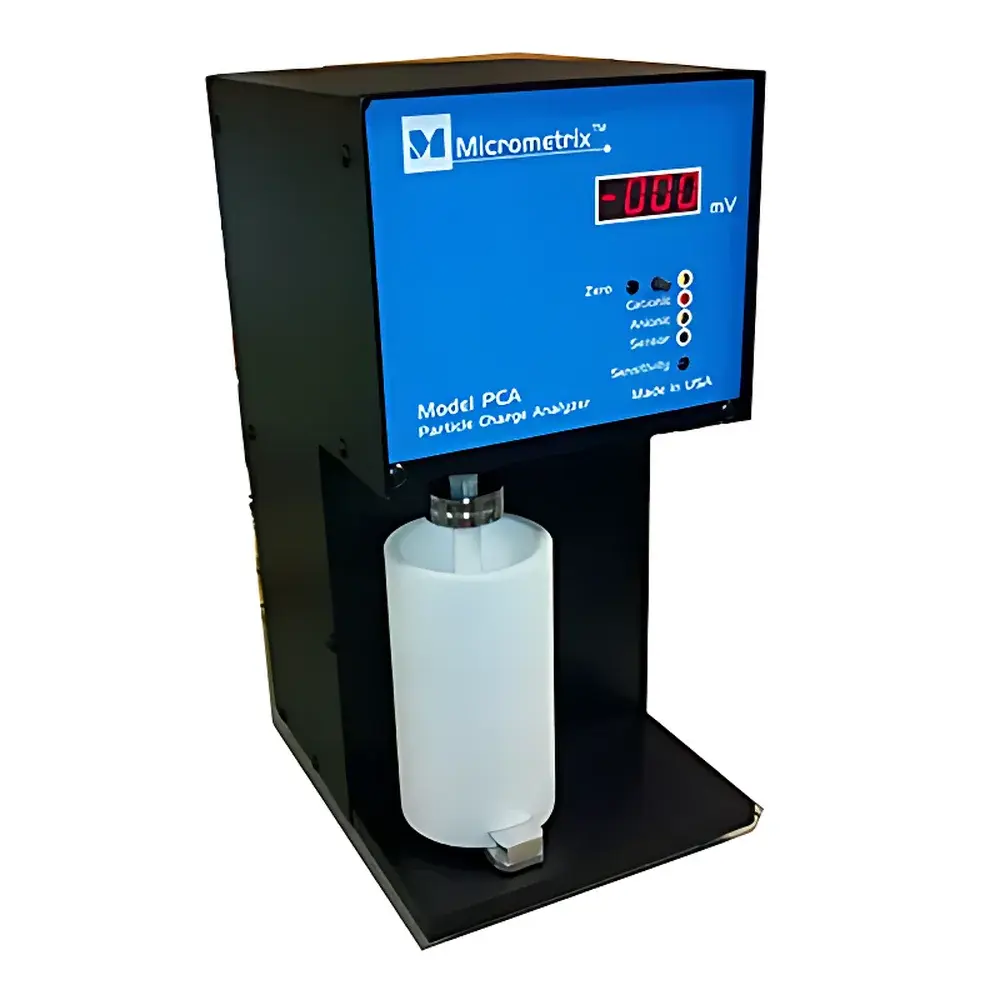
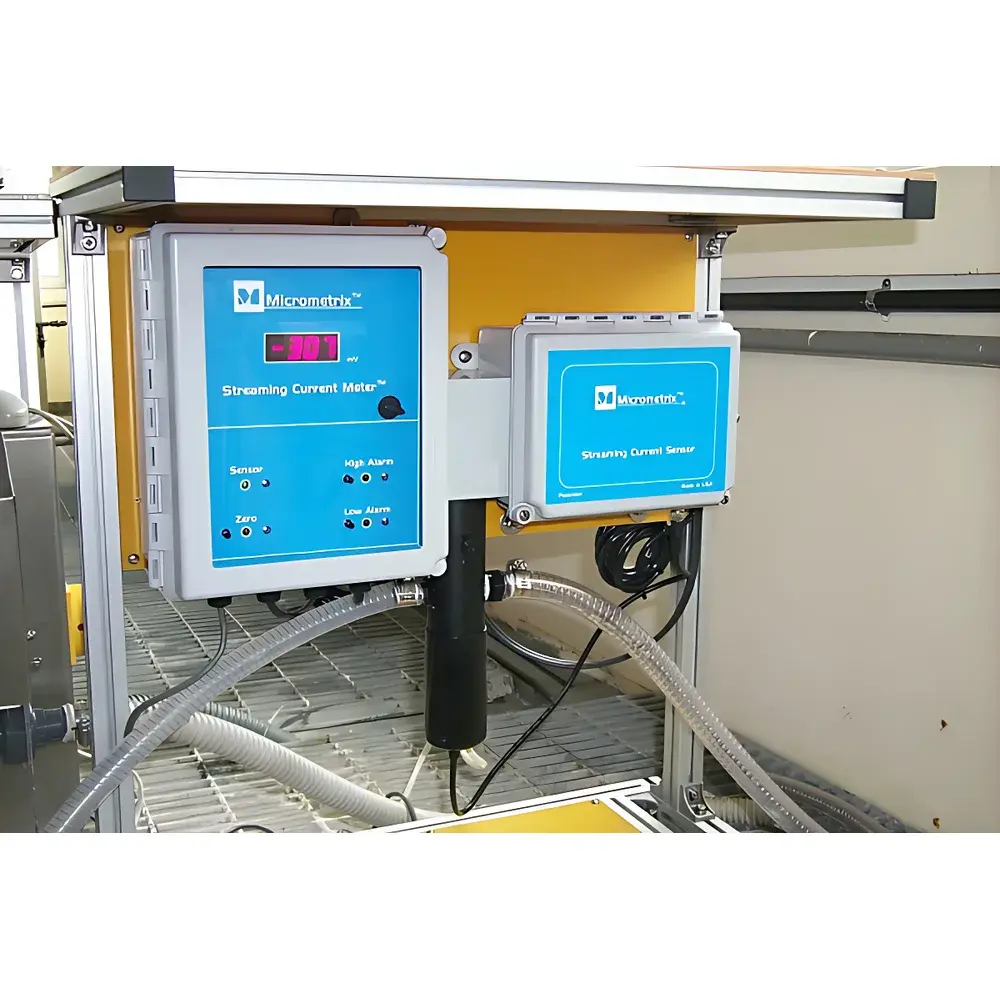
Micrometrix SCM-2 Integrated/Remote Flow-Through Streaming Current Monitor
| Origin | USA |
|---|---|
| Manufacturer Type | Authorized Distributor |
| Origin Category | Imported |
| Model | SCM-2 |
| Pricing | Upon Request |
Overview
The Micrometrix SCM-2 is a precision-engineered, NEMA 4X-rated streaming current monitor designed for continuous, real-time measurement of net ionic and colloidal surface charge in aqueous process streams. Operating on the principle of streaming current electrophoresis, the SCM-2 detects the electrical potential generated when water flows past charged particle surfaces—primarily colloids, suspended solids, and dissolved ionic species—within a defined flow cell. This electrokinetic signal (measured in millivolts) correlates directly with the zeta potential trend and serves as a robust surrogate for coagulant and flocculant demand in water and wastewater treatment. Unlike offline titration or jar testing, the SCM-2 delivers second-level response (<1 s), enabling closed-loop feedback control of chemical dosing systems. Its core application domain includes potable water treatment plants, municipal wastewater facilities, pulp & paper wet-end optimization, sludge dewatering polymer control, and industrial process water management where charge neutralization governs floc formation and solids removal efficiency.
Key Features
- Patented flow-through sensor architecture with Delrin® and PTFE-wetted materials for chemical resistance and long-term stability in aggressive water matrices
- True remote configuration: sensor head mounted directly in-line or sidestream, while electronics module resides up to 100 m away via shielded cable
- Dual-range analog output: isolated 4–20 mA and 0–10 V signals, both scalable to full ±1000 mV measurement span
- Onboard LED diagnostics: real-time status indication including sensor health, flow presence, and alarm activation
- Field-configurable high/low alarm relays with independent setpoint adjustment and visual LED indicators
- Auto-zero function with manual override; user-accessible gain and sensitivity trim for calibration refinement
- Modbus RTU (RS-485) optional communication protocol compliant with industry-standard SCADA integration requirements
- NEMA 4X non-metallic enclosure rated for outdoor, washdown, and corrosive environments
Sample Compatibility & Compliance
The SCM-2 is validated for continuous operation in raw water, clarified effluent, filtered water, activated sludge supernatant, and process water containing suspended solids ≤ 500 mg/L and turbidity ≤ 500 NTU. It accommodates typical municipal and industrial pH ranges (4.5–9.5) and temperatures from 2°C to 45°C. The sensor’s 3/4″ barbed inlet/outlet interface supports standard polyethylene or EPDM tubing at nominal flow rates of 1 US gallon per minute (3.78 L/min). All wetted components comply with NSF/ANSI Standard 61 for drinking water system components. The instrument meets IEC 61000-4 electromagnetic compatibility requirements and is suitable for deployment in facilities adhering to ISO 9001, ISO 14001, and EPA-approved water treatment protocols. While not intrinsically safe, it may be installed in Class I, Division 2 hazardous locations when used with appropriate barriers.
Software & Data Management
The SCM-2 operates as a standalone analog transmitter without embedded software or local data logging. Its outputs integrate seamlessly into existing DCS, PLC, or SCADA platforms via 4–20 mA loop or Modbus RTU. When paired with the optional SCC Flow-Through Controller (sold separately), the system enables automated setpoint tracking, programmable self-cleaning cycles, and hold-mode signal freezing during valve actuation—ensuring uninterrupted control continuity. For regulatory compliance, the analog output path satisfies FDA 21 CFR Part 11 requirements when interfaced with validated data acquisition systems that provide audit trails, electronic signatures, and secure storage. No firmware updates or cloud connectivity are required; all configuration is performed via front-panel buttons and backlit LCD on the SCC unit.
Applications
- Optimization of coagulant dosing (e.g., Al₂(SO₄)₃, FeCl₃, PACl) in conventional and membrane-assisted drinking water treatment
- Real-time monitoring of anionic polymer overdosing in sludge dewatering centrifuges and belt presses
- Detection of “anionic trash” in paper machine white water systems to prevent deposition and sheet defects
- Charge balance assessment in tertiary filtration and advanced oxidation processes
- Process validation support for GLP/GMP-compliant pharmaceutical water systems requiring consistent particulate removal
- Troubleshooting destabilization events in cooling tower and boiler feedwater circuits
FAQ
What is the difference between SCM-1 and SCM-2?
The SCM-1 integrates the sensor and electronics in a single housing (all-in-one design), whereas the SCM-2 separates the flow cell (remote sensor) from the transmitter/display unit, allowing flexible mounting in confined or hazardous areas.
Does the SCM-2 require regular calibration?
It does not require routine calibration; however, periodic verification using a certified reference solution (e.g., 100 mV KCl standard) is recommended every 3–6 months per site-specific QA/QC protocols.
Can the SCM-2 operate in seawater or brackish water?
Yes—it functions reliably in salinities up to 35,000 µS/cm, though signal magnitude decreases linearly with increasing conductivity; compensation algorithms are implemented in compatible controllers like the SCC.
Is the sensor replaceable without system shutdown?
Yes—the modular sensor assembly can be swapped in under pressure using isolation ball valves, minimizing process interruption.
What maintenance is required?
Annual inspection of O-rings, cleaning of the flow cell with mild citric acid (pH 3–4), and verification of tubing integrity and flow rate consistency constitute standard preventive maintenance.
Related Products







