
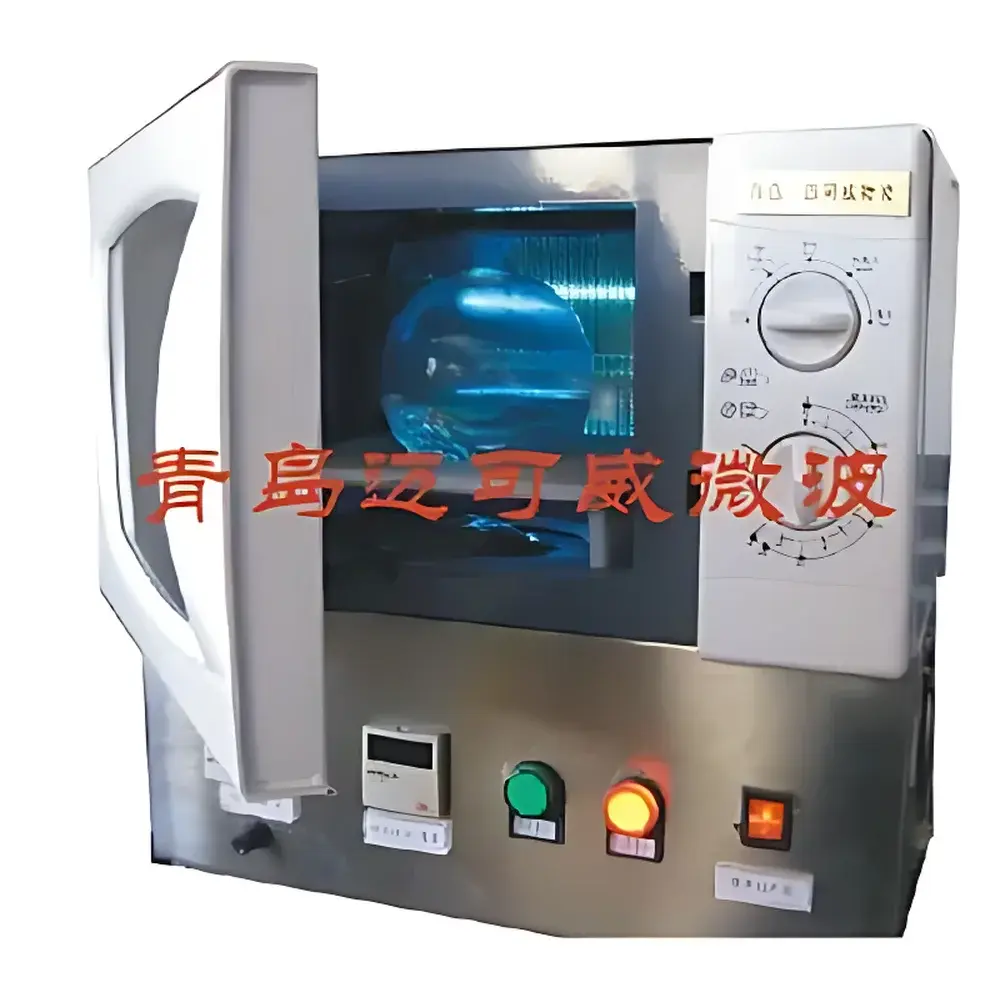
Microwave-UV Hybrid Synthesis Reactor MKJ-J1-5 by Makewave
| Brand | Makewave |
|---|---|
| Origin | Shandong, China |
| Manufacturer Type | Direct Manufacturer |
| Country of Origin | China |
| Model | MKJ-J1-5 |
| Temperature Range | 0–300 °C |
| Pressure Condition | Ambient (Atmospheric) |
| Microwave Output Power | 800 W (0–900 W continuously adjustable) |
| Magnetron Frequency | 2450 MHz |
| Stirring Method | Mechanical Stirring |
| Reaction Vessel Capacity | 0.5 L |
| Power Supply | 220 V / 50 Hz |
| External Dimensions (W×D×H) | ≈500 × 220 × 500 mm |
| Microwave Leakage | Compliant with GB 4706.21 (Chinese National Standard for Microwave Oven Safety) |
| Control Interface | Rotary Knob + Digital Millisecond Timer |
| Optional Integration | RS232 Serial Interface, PLC Automation Upgrade |
Overview
The Makewave MKJ-J1-5 Microwave-UV Hybrid Synthesis Reactor is an engineered platform for controlled, energy-efficient chemical synthesis and sample treatment under atmospheric pressure conditions. It integrates two complementary non-thermal activation modalities—2450 MHz microwave irradiation and post-chamber ultraviolet (UV) irradiation—enabling synergistic reaction pathways in organic synthesis, catalytic studies, hydrolysis, digestion, and photochemical-assisted transformations. Unlike conventional thermal reactors, this system delivers rapid, volumetric heating via dipole rotation and ionic conduction mechanisms, while the rear-mounted UV source (typically UVC or broadband UV-A/UV-B, depending on lamp configuration) provides simultaneous or sequential photonic excitation. Designed for academic research laboratories and applied R&D centers, the MKJ-J1-5 operates exclusively at ambient pressure, eliminating the need for high-pressure vessel certification and simplifying workflow integration in teaching labs and method-development environments.
Key Features
- Single-source 2450 MHz magnetron delivering up to 800 W nominal output power, with continuous 0–900 W analog adjustment via precision rotary control—enabling fine-tuned energy dosing for kinetic optimization.
- Digital millisecond-resolution timer ensures reproducible exposure durations critical for reaction scalability and mechanistic studies.
- Integrated mechanical stirring mechanism maintains homogeneous temperature distribution and mass transfer during microwave-driven exothermic or heterogeneous reactions.
- Optimized cavity geometry accommodates standard laboratory glassware: supports up to 1000 mL round-bottom flasks with neck protrusion for vacuum line attachment, reflux condensers, or gas inlet/outlet tubing.
- Modular control architecture allows field-upgradeable automation: RS232 serial interface enables external PC-based logging and script-driven parameter sequencing; optional PLC integration supports SOP-compliant batch execution in regulated environments.
- Complies with GB 4706.21–2008 safety limits for microwave leakage (<5 mW/cm² at 5 cm), verified during factory calibration and documented in the device’s CE-equivalent conformity report.
Sample Compatibility & Compliance
The MKJ-J1-5 accepts borosilicate glass, quartz, and PTFE-lined reaction vessels rated for continuous operation up to 300 °C. Its atmospheric-pressure design eliminates constraints associated with sealed-vessel pressure ratings, supporting open-vessel reflux, solvent evaporation, and gas-evolving reactions without safety interlocks. While not certified to IEC 61000-6-3 (EMC) or UL 61010-1 for North American markets, the unit meets essential electromagnetic compatibility and electrical safety requirements per GB/T 18268.1–2010 (measurement equipment) and GB 4793.1–2007 (laboratory electrical equipment). For GLP/GMP-aligned workflows, audit-ready operation logs can be generated when paired with RS232-connected data acquisition software compliant with FDA 21 CFR Part 11 (electronic records/signatures) via third-party middleware.
Software & Data Management
The base unit operates via embedded hardware controls (rotary knob + digital display), requiring no proprietary software. However, its RS232 port supports ASCII command protocol for bidirectional communication with custom LabVIEW, Python (PySerial), or MATLAB applications. Users may log time-stamped power setpoints, elapsed irradiation duration, and external sensor inputs (e.g., PT100 temperature probes via optional analog input module). When upgraded with PLC control, the system supports deterministic timing cycles, alarm thresholds, and event-triggered data capture—facilitating traceability in method validation studies per ISO/IEC 17025 or ASTM E2500.
Applications
- Accelerated organic synthesis (e.g., Suzuki couplings, esterifications, heterocycle formation) under open-flask conditions.
- UV-assisted photocatalytic degradation studies using TiO₂ or g-C₃N₄ suspensions.
- Controlled microwave-assisted hydrolysis of polysaccharides, proteins, or nucleic acid samples prior to HPLC or MS analysis.
- Routine microwave digestion of environmental or biological matrices for elemental analysis (ICP-OES/MS), though closed-vessel systems are preferred for volatile element recovery.
- Teaching laboratory demonstrations of dielectric heating principles, Arrhenius kinetics, and multi-modal energy input effects on reaction selectivity.
FAQ
Is the MKJ-J1-5 suitable for closed-vessel high-pressure synthesis?
No. This model is explicitly designed for ambient-pressure operation only. Closed-vessel microwave synthesis requires dedicated pressure-rated reactors with safety interlocks and temperature/pressure feedback control.
Can the UV lamp wavelength be customized?
Yes. Standard configuration includes a 254 nm low-pressure mercury lamp; optional upgrades include 365 nm UV-A or deuterium broadband sources (190–400 nm), subject to optical path revalidation.
Does the system support real-time internal temperature monitoring?
Not natively. The unit lacks built-in fiber-optic or IR pyrometry. External PT100 or thermocouple probes may be inserted through flask ports, with signal interfacing possible via optional analog input modules.
What is the expected service life of the magnetron under continuous use?
Rated for ≥5000 hours at ≤80% nominal power. Actual lifetime depends on duty cycle, cooling efficiency, and voltage stability per IEC 60705 guidelines.
Is regulatory documentation (e.g., Declaration of Conformity, test reports) provided with shipment?
Yes. Each unit ships with GB-compliance certificates, factory calibration records, and electrical safety test reports. EU/US market documentation requires supplemental third-party testing and is available upon request.



