
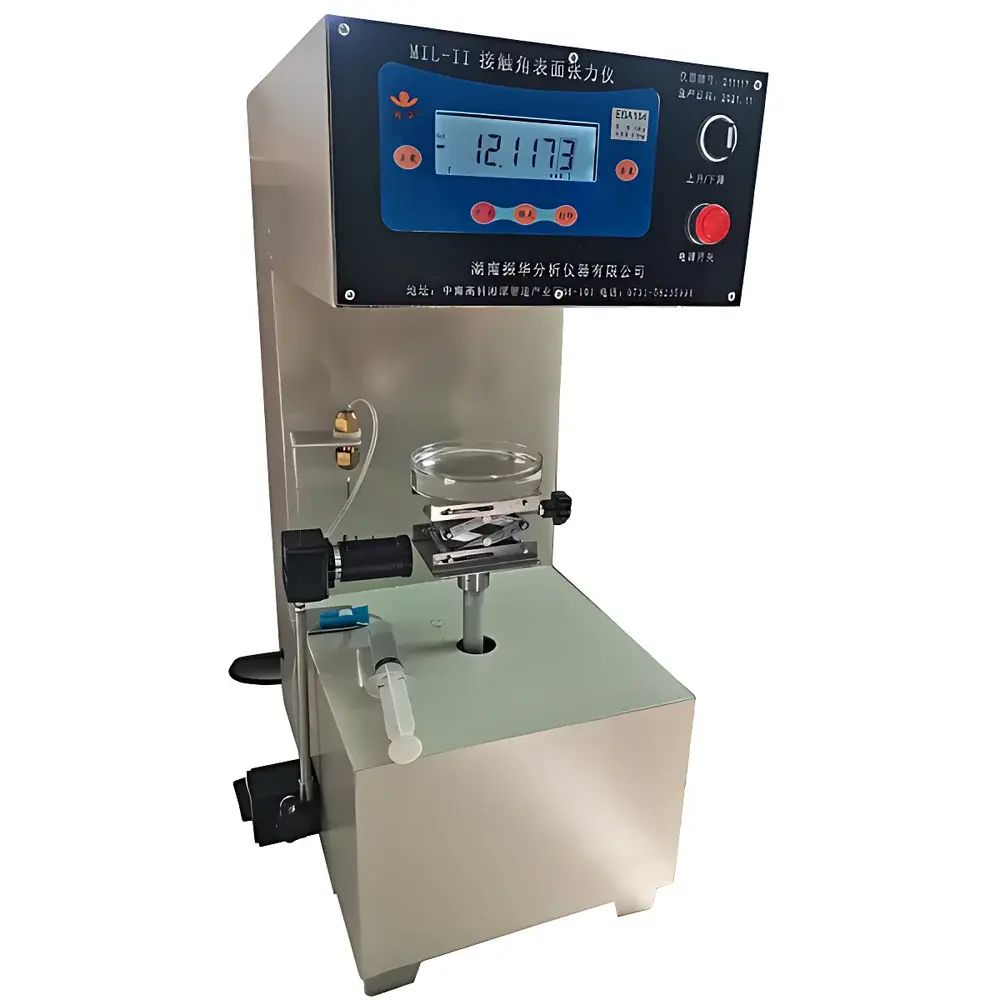
MIL-II Contact Angle & Surface Tension Analyzer
| Origin | Hunan, China |
|---|---|
| Manufacturer Type | Authorized Distributor |
| Origin Category | Domestic (PRC) |
| Model | MIL-II |
| Price Range | USD 1,400 – 7,000 (FOB) |
| Measurement Range | 1–200 mN/m |
| Resolution | 0.05 mN/m |
| Accuracy | ±0.1 mN/m |
| Temperature Display Range | 0–100 °C |
| Temperature Display Accuracy | ±0.1 °C |
| Primary Method | Du Noüy Ring / Wilhelmy Plate (Detachment Force Method) |
| Contact Angle Range | 0–180° |
| Contact Angle Resolution | ±0.1° |
| Imaging System | ≥5 MP CCD camera, ≥30 fps |
| Data Acquisition Rate | 50 readings/sec |
| Repeatability | <0.3% RSD |
| Compliance Standards | ISO 8296:2003, ISO 6295:1983, ASTM D971, GB/T 14216–2008 |
| Sample Holder Options | 50 mm / 70 mm / 100 mm diameter cups |
| Power Supply | 85–264 V AC, 40–60 Hz |
| Power Consumption | 40 W (operational), 5 W (standby) |
| Interfaces | 2 × USB 2.0 |
| Lift Travel | 100 mm (manual or motorized option) |
Overview
The MIL-II Contact Angle & Surface Tension Analyzer is a dual-function benchtop instrument engineered for precision measurement of liquid surface tension, interfacial tension, and solid–liquid contact angle—core parameters governing wettability, adhesion, dispersion stability, and surface energy characterization. It operates on the detachment force principle (Du Noüy ring and Wilhelmy plate methods), where a calibrated platinum–iridium ring or plate is immersed in and withdrawn from the test liquid; the maximum pull-off force is quantified via a high-stability displacement-force transducer integrating a Hall-effect sensor within a gradient magnetic field. This non-electrical measurement architecture ensures long-term calibration stability and immunity to electromagnetic interference. The system simultaneously supports static and dynamic contact angle analysis using real-time video capture (≥5 MP resolution, ≥30 fps), enabling sessile drop, pendant drop, and tilt-stage measurements. Designed for routine QC/QA labs and R&D environments, the MIL-II delivers traceable, reproducible results under ambient or temperature-controlled conditions (0–100 °C monitoring capability).
Key Features
- Dual-mode operation: Surface/interfacial tension (1–200 mN/m) and contact angle (0–180°) measured on a single platform
- High-resolution force detection: 0.05 mN/m resolution with ±0.1 mN/m accuracy and <0.3% repeatability (RSD)
- Modular sample handling: Interchangeable sample cups (50 mm, 70 mm, 100 mm diameters) accommodate viscous, volatile, or low-volume samples
- Motorized or manual Z-axis lift with 100 mm travel range and fine-positioning control
- Integrated temperature monitoring: Digital readout (±0.1 °C) over 0–100 °C range—supports correlation of surface tension with thermal history
- Real-time imaging subsystem: Industrial-grade CCD camera (>5 MP), frame rate ≥30 fps, synchronized with force acquisition
- Flexible dispensing options: Manual syringe pump or automated dosing module (optional) for precise droplet volume control
- Comprehensive data synchronization: Simultaneous time-stamped logging of force, position, temperature, and image metadata
Sample Compatibility & Compliance
The MIL-II accommodates a broad spectrum of industrial and research fluids—including aqueous surfactant solutions, organic solvents, polymer melts, emulsions, ink formulations, coating resins, transformer oils, agrochemical concentrates, and cosmetic emulsions. Its Wilhelmy plate and ring modules comply with standardized geometries per ISO 6295 and ASTM D971. For plastic film surface energy evaluation, the instrument implements the dyne solution test protocol defined in ISO 8296:2003 and GB/T 14216–2008: sequential application of calibrated surfactant mixtures until sustained wetting (≥2 s) is observed, with statistical validation across ≥3 replicates. All measurement workflows support audit-ready documentation, including user-defined pass/fail thresholds, operator ID tagging, and timestamped raw data export—aligning with GLP-aligned laboratory practices.
Software & Data Management
The MIL-II is operated via Windows-based analytical software with bilingual UI (English/Chinese). The interface provides real-time force–distance curve visualization, automatic baseline correction, and dynamic contact angle calculation (left/right asymmetry, advancing/receding angles, roll-off analysis). All measurements are auto-saved in structured binary + CSV format, preserving full metadata (instrument ID, date/time, operator, method parameters, environmental logs). Reporting modules generate customizable PDF/Excel reports compliant with internal SOPs; optional digital signature and electronic lab notebook (ELN) integration support FDA 21 CFR Part 11 readiness. Raw image sequences and force traces are archived losslessly, enabling retrospective reanalysis without retesting.
Applications
- Surface energy mapping of polymer films, metallized foils, and printed circuit board substrates
- Surfactant efficacy screening in detergent, pesticide adjuvant, and oilfield chemical development
- Wettability assessment of biomedical coatings, dental composites, and hydrophilic/hydrophobic membranes
- Quality control of inkjet inks, flexographic inks, and UV-curable coatings for print uniformity
- Stability analysis of nanoemulsions, microcapsules, and Pickering systems via interfacial rheology coupling
- Correlation of surface tension vs. concentration (critical micelle concentration determination)
- Evaluation of cleaning efficiency in semiconductor wafer rinsing and medical device reprocessing
FAQ
What measurement standards does the MIL-II support?
ISO 8296:2003, ISO 6295:1983, ASTM D971, and GB/T 14216–2008 are fully implemented in method templates and reporting logic.
Can the instrument perform interfacial tension measurements between two immiscible liquids?
Yes—using the Wilhelmy plate method with appropriate density-matched subphase selection and buoyancy compensation algorithms.
Is temperature control integrated, or is external bath required?
The MIL-II includes embedded temperature sensing and display (0–100 °C), but active heating/cooling requires an external Peltier stage or circulating bath (optional accessory).
How is calibration verified during routine use?
Calibration is performed using certified reference liquids (e.g., ultra-pure water at 20 °C = 72.75 mN/m); the software stores calibration history with date, operator, and deviation logs.
Does the software support GMP/GLP-compliant audit trails?
Yes—full electronic audit trail (user actions, parameter changes, report generation) is enabled by default and exportable as encrypted XML or PDF/A.



