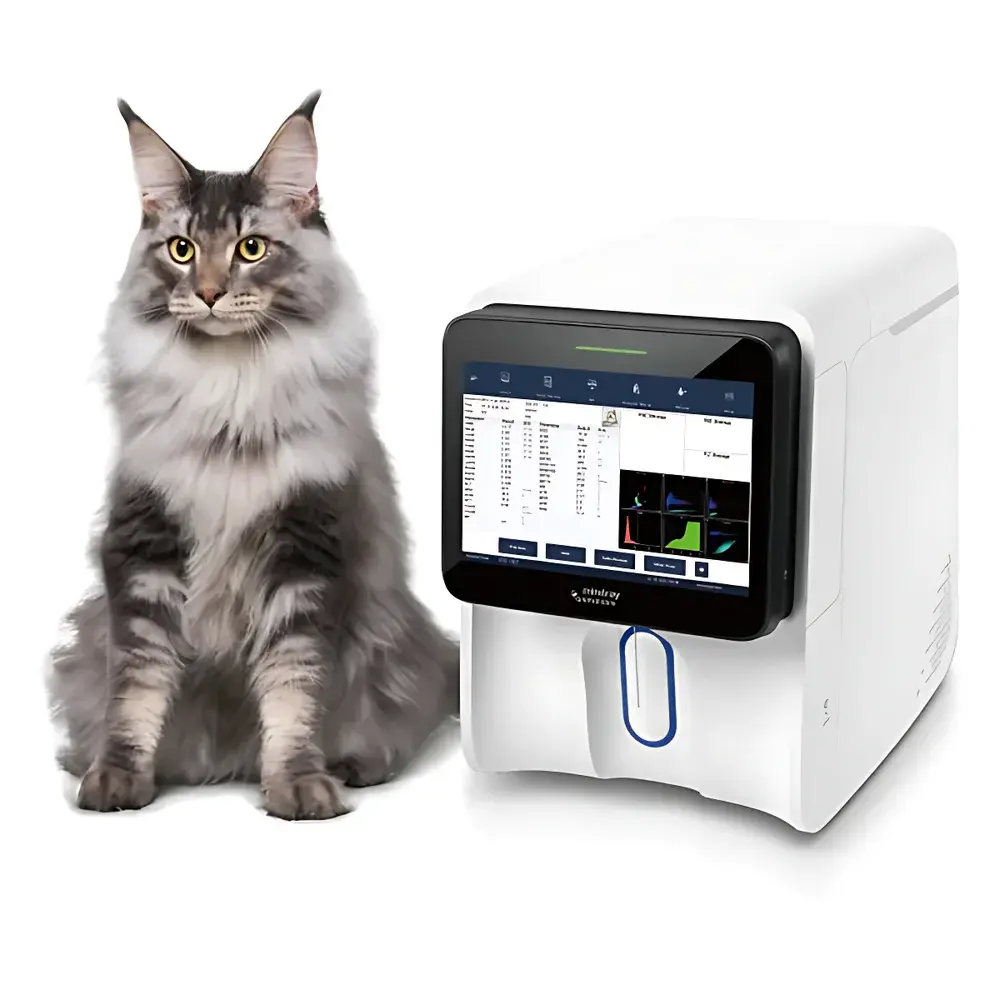
Mindray BC-60R Vet Hematology Analyzer
| Brand | Mindray |
|---|---|
| Model | BC-60R Vet |
| Origin | Shanghai, China |
| Instrument Type | Veterinary Hematology Analyzer |
| Detection Principle | SF-Cube Platform — Laser Scatter + Fluorescent Staining (S-Scatter & F-Fluorescence) |
| Analysis Dimensionality | 3D Multi-Parameter Cell Discrimination |
| WBC Differential Technology | Third-Generation Animal-Specific Fluorescent Staining |
| Reticulocyte (RET) Detection | Optimized RNA-Specific Fluorescent Dye with 650 nm Excitation |
| Compliance | Designed for GLP-aligned veterinary diagnostic workflows |
| Software | Embedded veterinary-specific analysis algorithms with audit trail capability |
Overview
The Mindray BC-60R Vet Hematology Analyzer is a dedicated veterinary hematology system engineered for precision, reproducibility, and clinical relevance in small animal practice. Built upon Mindray’s proprietary SF-Cube analytical platform, it integrates dual-modal optical detection—laser-based light scatter and animal-optimized fluorescent staining—to deliver three-dimensional cellular characterization. Unlike human-oriented analyzers adapted for veterinary use, the BC-60R Vet employs a purpose-built architecture where optical geometry, fluidics, reagent formulation, and algorithmic logic are co-developed for canine, feline, equine, and avian blood matrices. The core measurement principle relies on simultaneous acquisition of forward scatter (FSC), side scatter (SSC), and side fluorescence (SFL) signals, enabling quantitative discrimination of cell volume, internal complexity, and nucleic acid content. This multi-parameter approach forms the foundation for high-fidelity white blood cell (WBC) differential counts—including identification of band neutrophils, nucleated red blood cells (nRBCs), and atypical lymphoid populations—as well as accurate reticulocyte (RET) enumeration critical for anemia staging.
Key Features
- Third-generation animal-specific fluorescent staining technology: Enhanced signal-to-noise ratio for both DNA (WBC classification) and RNA (reticulocyte detection), minimizing cross-reactivity and background interference.
- SF-Cube 3D analysis engine: Combines S-Scatter (size/complexity) and F-Fluorescence (nucleic acid content) into a unified decision space, improving resolution between lymphocytes and segmented neutrophils by >35% compared to legacy two-dimensional gating.
- 650 nm excitation wavelength: Strategically selected to avoid spectral overlap with endogenous fluorophores (e.g., porphyrins, flavins) and common veterinary therapeutics (e.g., tetracyclines, phenothiazines), ensuring robust performance in medicated or icteric samples.
- RNA-selective reticulocyte dye: Utilizes base-intercalating chemistry with preferential binding affinity for ribosomal RNA over genomic DNA, achieving <2.5% coefficient of variation (CV) in RET% across low-, mid-, and high-count ranges.
- Veterinary-validated reference intervals: Pre-loaded species-specific hematologic reference databases for dogs, cats, horses, and rabbits—calibrated against peer-reviewed clinical pathology studies and aligned with ASVCP (American Society for Veterinary Clinical Pathology) guidelines.
- Integrated quality control tracking: Supports daily, weekly, and user-defined QC protocols with Levey-Jennings charting, Westgard rule application, and automatic flagging of drift or outlier events.
Sample Compatibility & Compliance
The BC-60R Vet accepts EDTA-anticoagulated whole blood (0.5 mL minimum) from domestic mammals and birds. It demonstrates validated performance across hematocrit ranges of 15–65% and total WBC counts from 0.5 × 10⁹/L to 50 × 10⁹/L. Sample stability is maintained for up to 8 hours at room temperature (20–25°C) and 24 hours refrigerated (2–8°C), consistent with CLSI H20-A3 recommendations for veterinary specimens. The system supports GLP-compliant operation through configurable user access levels, electronic signature capability, and full audit trail logging—including timestamped records of sample ID entry, reagent lot tracking, calibration history, and result modification events. While not FDA-cleared for human diagnostics, the analyzer meets ISO 15189:2022 requirements for pre-analytical, analytical, and post-analytical phase control in accredited veterinary diagnostic laboratories.
Software & Data Management
The embedded operating system features a veterinary-dedicated software suite with intuitive touchscreen navigation and bilingual (English/Spanish) interface options. All hematologic parameters—including CBC, differential WBC count, platelet indices, and reticulocyte maturity index—are reported in SI units and accompanied by automated interpretive flags (e.g., “nRBC detected”, “RET% elevated”, “platelet clumping suspected”). Raw scatterplot data and histogram overlays are exportable in CSV and PDF formats. LIS connectivity is supported via ASTM E1384-compliant HL7 v2.5.1 messaging, enabling bidirectional integration with practice management systems. Data retention complies with regional veterinary recordkeeping mandates: local storage retains ≥10,000 patient records with automatic backup to external USB drives or network-attached storage (NAS) devices.
Applications
- Comprehensive anemia evaluation: Differentiation of regenerative vs. non-regenerative anemias via precise RET% quantification and morphologic correlation with nRBC presence.
- Early sepsis and inflammation monitoring: Detection of left-shifted neutrophil populations (band forms, toxic granulation) and reactive lymphocyte subsets not resolvable by impedance-only platforms.
- Oncology support: Identification of atypical lymphoid blasts and myeloid precursors in lymphoma and leukemia screening workflows.
- Chronic disease management: Longitudinal tracking of platelet distribution width (PDW), mean platelet volume (MPV), and immature platelet fraction (IPF) in renal, hepatic, and endocrine disorders.
- Clinical trial readiness: Generates data traceable to ISO/IEC 17025:2017 standards, facilitating submission to regulatory bodies for veterinary drug development programs.
FAQ
Is the BC-60R Vet approved for use in USDA-registered research facilities?
Yes—the instrument’s design, documentation, and software architecture align with USDA Animal Welfare Act (AWA) recordkeeping expectations and NIH OLAW guidance for veterinary diagnostic instrumentation in federally funded animal studies.
Does it require daily calibration with proprietary calibrators?
No—calibration is performed semi-annually using Mindray-certified verification materials; daily operation relies on stabilized optical alignment and internal reference bead tracking.
Can it analyze avian or reptilian blood without manual dilution?
It supports direct analysis of chicken and pigeon blood; for species with nucleated erythrocytes (e.g., snakes, lizards), optional manual dilution protocols are provided in the veterinary application guide.
How is software updated and validated?
Firmware and application updates are distributed via secure Mindray Cloud Portal; each release includes version-controlled validation reports compliant with IEC 62304 Class B medical device software requirements.
What maintenance intervals are recommended?
Preventive maintenance is scheduled every 12 months by certified Field Service Engineers; consumables (sheath fluid, cleaning solution, stain reagents) are tracked automatically and trigger alerts at 10% remaining volume.