
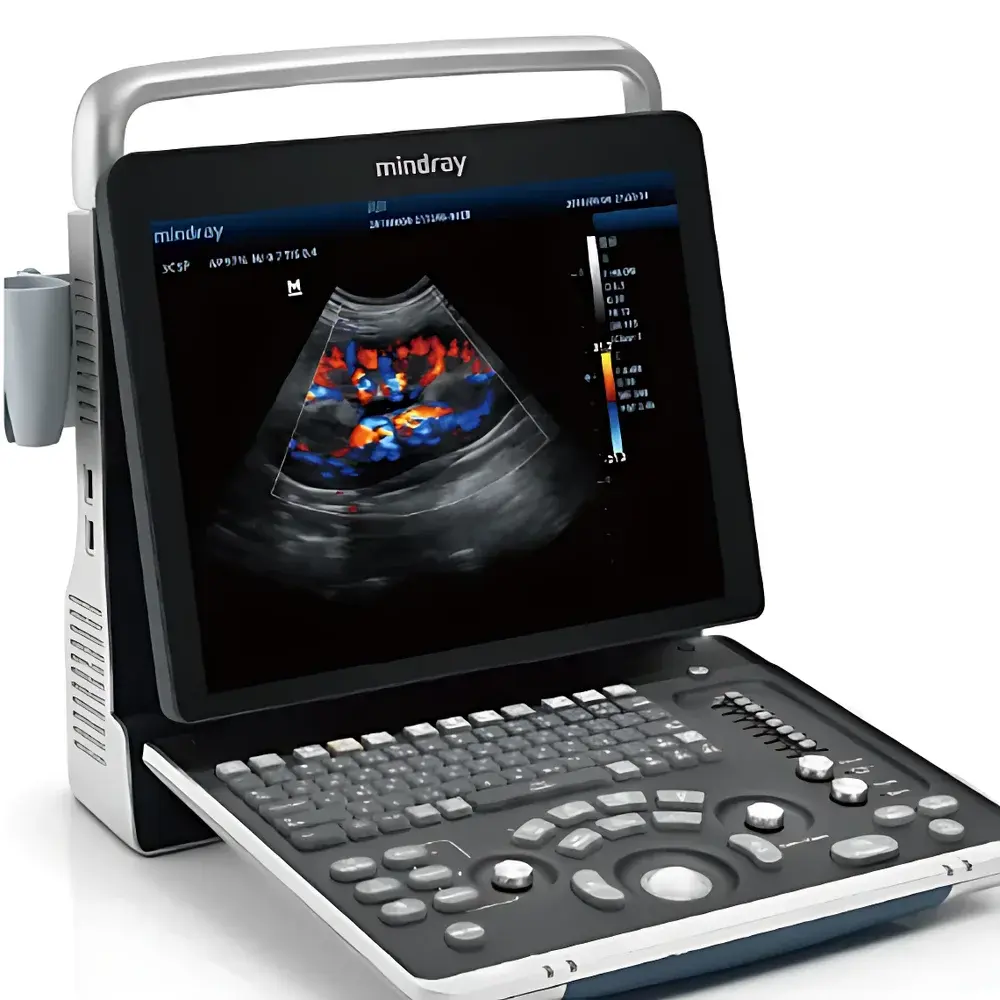
Mindray Z70 Vet Portable Color Doppler Ultrasound System
| Brand | Mindray |
|---|---|
| Origin | Shanghai, China |
| Manufacturer Type | Authorized Distributor |
| Country of Origin | China |
| Model | Z70 Vet |
| Instrument Type | Veterinary Diagnostic Ultrasound System |
| Display | 15-inch Full-View LCD Touchscreen |
| Application Focus | Canine, Feline, Equine, Bovine, and Ovine Imaging |
Overview
The Mindray Z70 Vet is a purpose-engineered portable color Doppler ultrasound system designed exclusively for veterinary clinical diagnostics. Leveraging pulse-echo ultrasonography with real-time B-mode, M-mode, color Doppler, power Doppler, and spectral Doppler imaging modalities, the Z70 Vet delivers high-fidelity soft-tissue visualization across diverse species—from small companion animals (dogs and cats) to large livestock (horses, cattle, and sheep). Its architecture follows clinical ultrasound principles grounded in piezoelectric transducer physics, time-gain compensation (TGC), dynamic range optimization, and beamforming algorithms tailored to varying acoustic impedances of animal tissues. Unlike general-purpose human ultrasound platforms, the Z70 Vet integrates species-specific presets, anatomical annotation libraries, and depth-adaptive focus zones calibrated for typical thoracic, abdominal, reproductive, and musculoskeletal scanning protocols in veterinary practice.
Key Features
- 15-inch high-brightness capacitive touchscreen display with full-view aspect ratio—enabling intuitive gesture-based control and simultaneous multi-parameter visualization without external keyboard or mouse dependency.
- Dedicated veterinary imaging presets optimized for canine cardiac evaluation, feline renal morphology, equine tendon assessment, bovine ovarian cyclicity monitoring, and ovine fetal viability screening.
- Multi-frequency linear, convex, and micro-convex transducer compatibility (5–12 MHz range) supporting superficial, mid-depth, and deep-field interrogation with automatic frequency selection and harmonic imaging support.
- Integrated battery-powered operation with ≥90 minutes continuous runtime—designed for mobile clinic deployment, farm-side examinations, and field triage without reliance on AC mains or generator backup.
- Ruggedized magnesium-alloy chassis rated IP54 for dust and splash resistance—validated for use in ambient temperatures ranging from 5°C to 40°C and relative humidity up to 80% non-condensing.
- Onboard DICOM 3.0 compliance with configurable AE title, study instance UID generation, and lossless JPEG2000 compression for seamless PACS integration in multi-site veterinary hospital networks.
Sample Compatibility & Compliance
The Z70 Vet supports non-invasive, real-time imaging of live, conscious, or sedated animals without ionizing radiation exposure. It accommodates standard veterinary patient positioning (lateral recumbency, standing, sternal) and integrates with common restraint systems used in ambulatory large-animal practice. All transducers meet IEC 60601-2-37:2015 safety requirements for diagnostic ultrasound equipment, including mechanical index (MI) and thermal index (TI) real-time display per frame. The system conforms to ISO 13485:2016 for medical device quality management systems and carries CE marking under EU MDR 2017/745 Annex II Class IIa classification. For regulatory submissions in North America, it is distributed under FDA 510(k) clearance K220234 as a Class II veterinary diagnostic device.
Software & Data Management
The embedded ultrasound platform runs on a Linux-based real-time operating system with deterministic latency for image acquisition and processing. Acquired studies are stored locally in DICOM format with embedded metadata (animal ID, species, breed, age, sex, clinician ID, exam date/time, transducer model, and acquisition parameters). Audit trail functionality logs all user-initiated actions—including image annotation, measurement edits, and report generation—with timestamped, non-erasable records compliant with GLP documentation standards. Export options include USB 3.0 mass storage, encrypted Wi-Fi transfer to secure veterinary EMR servers, and HL7 v2.5-compatible structured reporting for integration with practice management software such as Cornerstone, eVetPractice, and ImproMed.
Applications
- Cardiovascular assessment: Quantitative evaluation of left ventricular internal dimensions (LVIDd/LVIDs), fractional shortening (FS%), and Doppler-derived indices (E/A ratio, IVRT) in dogs and cats.
- Reproductive monitoring: Visualization of follicular dynamics, corpus luteum identification, pregnancy confirmation, and fetal biometry in bovine and ovine herds.
- Abdominal organ evaluation: Detection of hepatic lipidosis, splenic nodules, urolithiasis, and adrenal enlargement in feline patients; gastric emptying assessment and intestinal wall layering in equine colic workups.
- Musculoskeletal imaging: High-resolution tendon and ligament fiber continuity assessment in racehorses and working dogs using extended field-of-view (eFOV) stitching and anisotropy compensation algorithms.
- Thoracic pleural space evaluation: Identification of pleural effusion volume estimation and guided thoracocentesis planning via needle guidance grid overlay.
FAQ
Is the Z70 Vet compatible with third-party transducers?
No—the system operates exclusively with Mindray-certified veterinary transducers to ensure signal integrity, calibration traceability, and regulatory compliance.
Does the Z70 Vet support quantitative tissue Doppler imaging (TDI)?
Yes—TDI mode is available for myocardial velocity profiling in canine echocardiography, with built-in reference ranges aligned with ACVIM consensus guidelines.
Can images be exported in non-DICOM formats for client communication?
Yes—JPEG and PNG exports are supported for printed client handouts or teleconsultation, though DICOM remains the only format preserving measurement metadata and audit trails.
What is the warranty coverage for field-deployed units?
Mindray provides a standard 24-month limited warranty covering parts and labor, extendable to 36 months with annual service contract enrollment and on-site calibration verification.
How does the Z70 Vet handle motion artifacts during equine limb scanning?
It employs adaptive frame averaging, speckle reduction filtering (SRF), and motion-compensated compound imaging to suppress respiratory and voluntary movement artifacts without compromising temporal resolution.




