
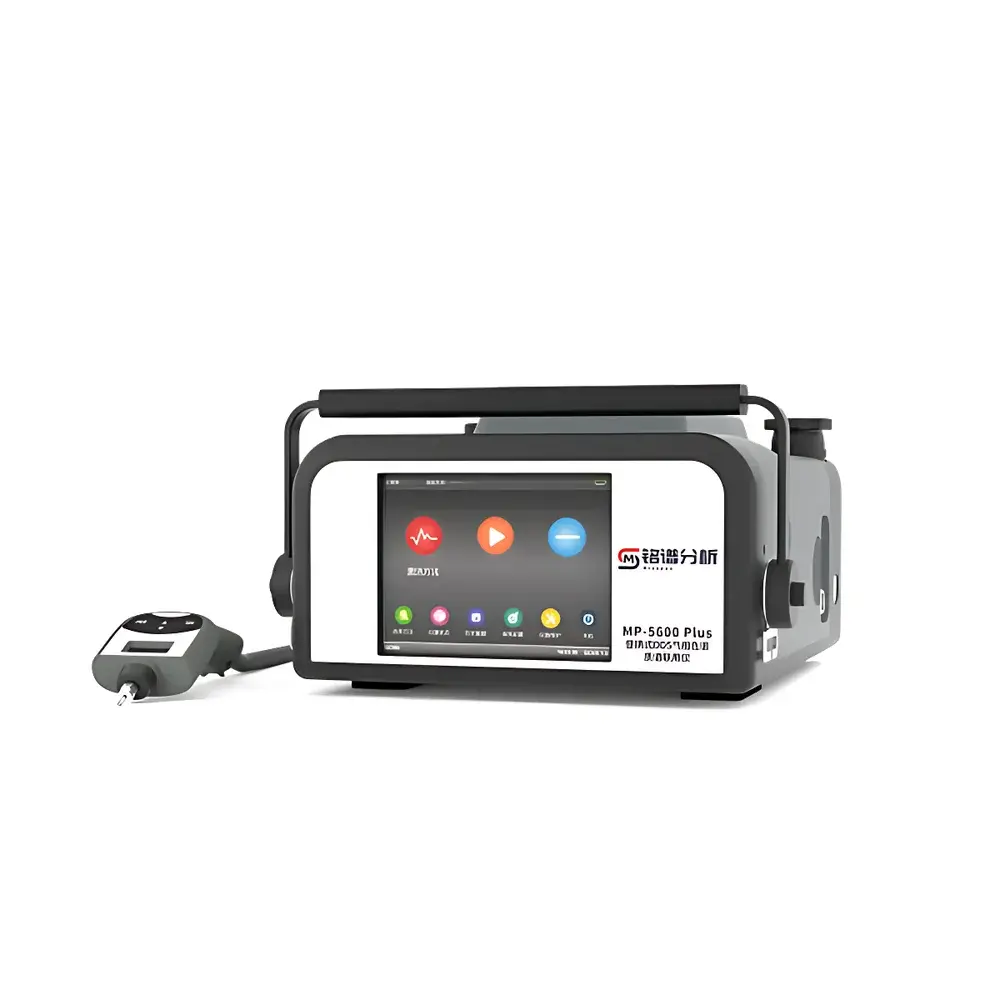
MINSPEC MP-5600Plus Portable ODS Gas Chromatography-Mass Spectrometry (GC-MS) Analyzer
| Brand | MINSPEC |
|---|---|
| Model | MP-5600Plus |
| Origin | Shandong, China |
| Detection Targets | ODS (CFCs, HCFCs, Halons, Methyl Bromide), VOCs, SVOCs |
| Sample Matrices | Ambient Air, Water (via Headspace), Soil (via Purge-and-Trap or Thermal Desorption), Refrigerant Gases |
| Compliance | GB/T 32210–2015, HJ 11223–2021, HJ 1227–2021, HJ 1058–2019 |
| Detection Principle | Capillary GC separation coupled with linear ion trap MS detection |
| Ionization Mode | Electron Ionization (EI), inertized high-temperature source (up to 300 °C) |
| Preconcentration | Integrated cryogenic trapping (down to 0 °C) |
| Mass Analyzer | Dual-curved linear ion trap |
| Dynamic Range | 7 orders of magnitude |
| Internal Standard Delivery | Automated, inertized, programmable syringe-based introduction |
Overview
The MINSPEC MP-5600Plus is a field-deployable gas chromatography–mass spectrometry (GC-MS) analyzer engineered specifically for on-site identification and quantification of ozone-depleting substances (ODS), including chlorofluorocarbons (CFCs), hydrochlorofluorocarbons (HCFCs), halons, carbon tetrachloride, methyl chloroform, and methyl bromide. Unlike laboratory-bound GC-MS systems, the MP-5600Plus integrates miniaturized cryogenic preconcentration, high-efficiency capillary chromatography, and a dual-curved linear ion trap mass analyzer into a rugged, battery-operated platform weighing under 18 kg. Its core measurement principle relies on thermal desorption or headspace sampling followed by separation on an ODS-optimized fused-silica column and detection via electron ionization (EI) in an inertized, heated ion source. This architecture ensures trace-level sensitivity (sub-pptv in air, low-ng/L in water), high chromatographic resolution for co-eluting isomers (e.g., CFC-11 vs. CFC-12), and robust performance under variable ambient conditions—critical for enforcement, border control, and refrigeration system leak verification.
Key Features
- Cryogenic micro-trapping module with temperature control down to 0 °C, enabling quantitative enrichment of highly volatile ODS (e.g., CFC-12, HCFC-22) without breakthrough or condensation loss.
- Dedicated ODS-selective capillary column with optimized stationary phase polarity and thermal stability, delivering baseline separation of regulated compounds per HJ 1058–2019 and GB/T 32210–2015.
- Dual-curved linear ion trap mass analyzer featuring extended ion storage capacity and enhanced duty cycle, supporting wide dynamic range detection (10⁰–10⁷ cps) and reliable isotopic ratio measurement for confirmatory analysis.
- Inertized high-temperature EI source (operable up to 300 °C), housed in a physically isolated chamber to prevent cross-contamination and eliminate memory effects—even after repeated analysis of concentrated refrigerant samples.
- Integrated programmable internal standard delivery system using inertized syringe actuation, ensuring precise, reproducible spiking of deuterated or ¹³C-labeled surrogates prior to each run for accurate quantitation and instrument response monitoring.
- Field-optimized hardware: IP54-rated enclosure, shock-mounted optics and electronics, dual power input (12–24 V DC / AC adapter), and >4 hours continuous operation on hot-swappable Li-ion batteries.
Sample Compatibility & Compliance
The MP-5600Plus supports direct analysis of gaseous samples (ambient air, duct effluent, refrigerant lines), aqueous matrices (via automated headspace vial heating per HJ 1227–2021), and solid-phase environmental media (soil, foam insulation, sorbent tubes) using optional purge-and-trap or thermal desorption accessories. All operational protocols align with Chinese national standards for emergency environmental monitoring: GB/T 32210–2015 (performance requirements for portable GC-MS), HJ 11223–2021 (air VOCs), HJ 1227–2021 (water VOCs), and HJ 1058–2019 (ODS in polyurethane foams). Data acquisition and reporting modules support audit-ready metadata logging—including operator ID, GPS coordinates, ambient T/P, calibration history, and raw spectral files—to facilitate GLP-compliant documentation and regulatory submission.
Software & Data Management
The embedded Linux-based acquisition software provides real-time chromatogram display, automated peak detection using retention time locking (RTL), and library matching against NIST/EPA ODS-specific spectral libraries (including custom entries for halogenated compounds). Quantitative workflows incorporate internal standard normalization, multi-point calibration curve fitting (linear/log-linear), and uncertainty estimation per ISO/IEC 17025 guidelines. Raw data (.D format) and processed reports (PDF/CSV) are exportable via USB or Wi-Fi. The system supports 21 CFR Part 11-compliant user authentication, electronic signatures, and immutable audit trails when deployed with optional networked server integration.
Applications
- Real-time leak detection and source attribution in HVAC/R maintenance, decommissioning, and retrofit operations.
- Customs and border inspection for illicit ODS trade, including container screening and vehicle-mounted mobile surveillance.
- Environmental enforcement actions: rapid assessment of illegal dumping, industrial emissions, and unauthorized foam manufacturing sites.
- Emergency response to accidental releases—e.g., refrigerant ruptures, fire suppression system discharges—enabling immediate hazard classification per WHO/EPA toxicity thresholds.
- Field validation of remediation effectiveness at contaminated sites, particularly where legacy ODS residues persist in soil or groundwater plumes.
FAQ
Does the MP-5600Plus meet international ODS monitoring requirements beyond Chinese standards?
Yes—it adheres to methodological principles aligned with EPA Method TO-15 and ISO 16000-6 for air, and EPA Method 524.2 for water, enabling cross-jurisdictional data comparability.
Can it quantify ODS in complex refrigerant blends without matrix interference?
Its cryogenic trapping + selective column + ion trap MS/MS capability allows targeted quantitation of individual ODS components even in multi-component R-400 series or R-500 series mixtures.
Is routine calibration required between field deployments?
A full calibration check is recommended before each mission; however, the inertized source and internal standard system maintain <±5% response stability over 8-hour continuous operation.
What sample volume is needed for sub-ppbv air detection?
Typical enrichment uses 1–5 L of ambient air at flow rates of 100–300 mL/min, achieving method detection limits of 0.05–0.3 ppbv depending on compound volatility and matrix.
Is remote diagnostics and firmware update supported?
Yes—via secure TLS-encrypted Wi-Fi connection, enabling over-the-air updates, log retrieval, and collaborative troubleshooting with technical support engineers.
Related Products







