
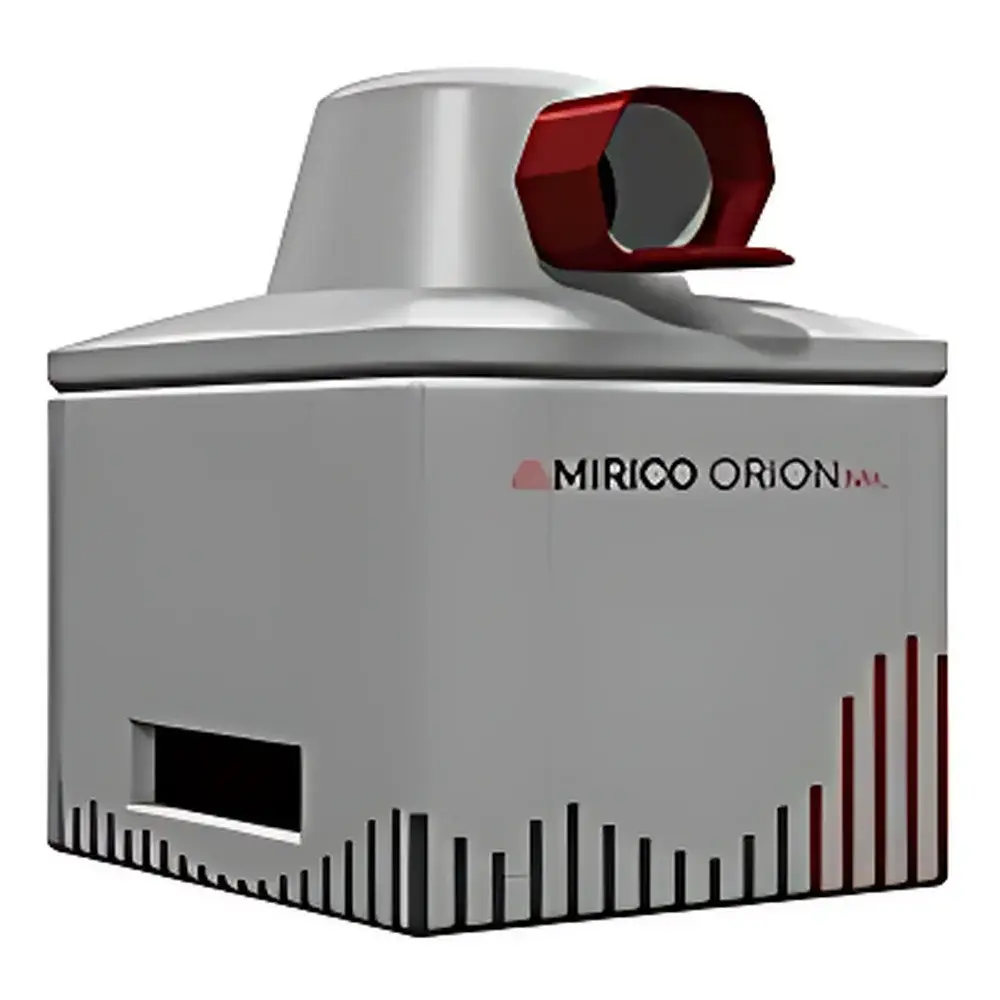
MIRICO ORION NH3 Open-Path Ammonia Analyzer
| Origin | UK |
|---|---|
| Manufacturer Type | Distributor |
| Origin Category | Imported |
| Model | ORION NH3 |
| Pricing | Upon Request |
Overview
The MIRICO ORION NH3 Open-Path Ammonia Analyzer is a field-deployable, laser-based trace gas measurement system engineered for continuous, real-time quantification of atmospheric ammonia (NH3) in unconfined environments. It employs tunable mid-infrared (MIR) laser dispersion spectroscopy — a direct-absorption technique operating in the fundamental vibrational band near 10.3 µm — to achieve high selectivity and sensitivity without sample extraction or conditioning. Unlike closed-path chemiluminescence or metal oxide semiconductor sensors, the ORION’s open-path architecture eliminates inlet-related artifacts (e.g., adsorption/desorption losses, wall reactions, or flow-induced delays), making it uniquely suited for eddy covariance flux studies, boundary-layer profiling, and long-term ecosystem monitoring where representative spatial averaging is critical.
Key Features
- True open-path design: Measures NH3 across path lengths of 50–400 m without optical windows, tubing, or sampling pumps — preserving native gas-phase composition and enabling integration with 3D ultrasonic anemometers for high-frequency (10–20 Hz) flux computation.
- Mid-infrared laser dispersion spectroscopy: Leverages narrow-linewidth quantum cascade lasers (QCLs) and balanced photodetection to resolve NH3 absorption features with minimal spectral interference from H2O, CO2, or CH4, ensuring robust performance under variable humidity and temperature conditions.
- Full-field scanning capability: 360° horizontal azimuthal rotation and −10° to +10° vertical elevation enable dynamic sector-based mapping of NH3 plumes across heterogeneous terrain — including agricultural fields, wetlands, urban canyons, and lake margins.
- Onboard self-calibration and diagnostics: Integrated reference cell and automated wavelength stabilization routines support drift-free operation over extended deployments; system health metrics (laser power, detector SNR, alignment stability) are logged continuously for GLP-compliant data auditing.
- Web-native interface: Configurable via secure Wi-Fi connection using standards-based HTTP/HTTPS protocols; supports remote firmware updates, real-time spectral visualization, and configurable alarm thresholds aligned with ISO 14644-1 or EPA Method TO-15 data integrity expectations.
Sample Compatibility & Compliance
The ORION NH3 analyzer is designed for ambient air analysis only and does not require gas handling hardware, calibration gases, or consumables during routine operation. Its open-path geometry inherently accommodates natural turbulence and thermal gradients typical of outdoor sites. The instrument complies with the physical measurement principles outlined in ISO 17025:2017 (clause 7.2.2 on method validation) and supports traceability through NIST-traceable laser wavelength references. When deployed in regulatory monitoring networks (e.g., EMEP, CASTNET), its output meets the data quality objectives specified in EU Directive 2008/50/EC Annex IX for reactive nitrogen compounds. No sample pre-treatment or drying is required — eliminating bias associated with condensation or chemical scrubbing.
Software & Data Management
Data acquisition and control are managed via the ORION Web Console — a responsive, browser-based application compatible with Chrome, Firefox, and Edge. Raw spectra, concentration time series (1–10 Hz resolution), and diagnostic logs are stored locally on industrial-grade SD cards and synchronized to network-attached storage (NAS) or cloud endpoints via TLS 1.2–encrypted MQTT or SFTP. All data files include embedded metadata (GPS coordinates, UTC timestamps, instrument serial number, firmware version) compliant with CF Metadata Conventions v1.8. Audit trails record all user-initiated configuration changes, satisfying FDA 21 CFR Part 11 requirements for electronic records in environmental research applications. Export formats include NetCDF-4, CSV, and HDF5 for interoperability with flux processing toolkits such as EddyPro® and TK3.
Applications
- Quantification of NH3 emission fluxes from livestock housing, manure application sites, and fertilizer-amended cropland using eddy covariance or gradient methods.
- Urban air quality studies linking NH3 concentrations to secondary inorganic aerosol (SIA) formation and PM2.5 composition dynamics.
- Long-term ecological monitoring of nitrogen cycling in sensitive ecosystems — including peatlands, riparian zones, and coastal marshes — where diel and seasonal NH3 exchange patterns inform biogeochemical modeling.
- Validation of regional atmospheric chemistry transport models (e.g., CMAQ, LOTOS-EUROS) through spatially resolved concentration mapping across complex topography.
- Regulatory compliance monitoring at industrial facilities subject to VOC/NH3 reporting obligations under the U.S. Clean Air Act Title V or EU IED Directive Annex I.
FAQ
What is the minimum detectable concentration (MDL) for NH3 under field conditions?
The MDL is path-length dependent and typically ranges from 0.05 to 0.3 ppb (1σ, 10-second average) across 100–300 m paths, validated per EPA Method IO-3.1 guidelines.
Can the ORION be operated unattended for extended periods?
Yes — it supports solar/battery hybrid power configurations and includes low-power sleep modes; field deployments exceeding 12 months have been documented in UK DEFRA and USDA ARS networks.
Is co-location with meteorological sensors mandatory?
For flux calculations, synchronization with a collocated 3D ultrasonic anemometer (e.g., Gill WindMaster, R.M. Young 81000) is required; for concentration mapping, wind vector data enhances source attribution but is not essential for basic monitoring.
How is optical alignment maintained in high-wind or freezing conditions?
The transmitter/receiver units feature passive thermal stabilization and vibration-damped mounts; automated beam tracking algorithms compensate for sub-milliradian angular drift caused by thermal expansion or mechanical settling.
Does the system require annual factory recalibration?
No — the laser wavelength reference and internal diagnostics eliminate the need for routine external calibration; users perform quarterly functional checks using certified NH3 permeation tubes per ISO 17025 clause 7.7.2.
Related Products





