
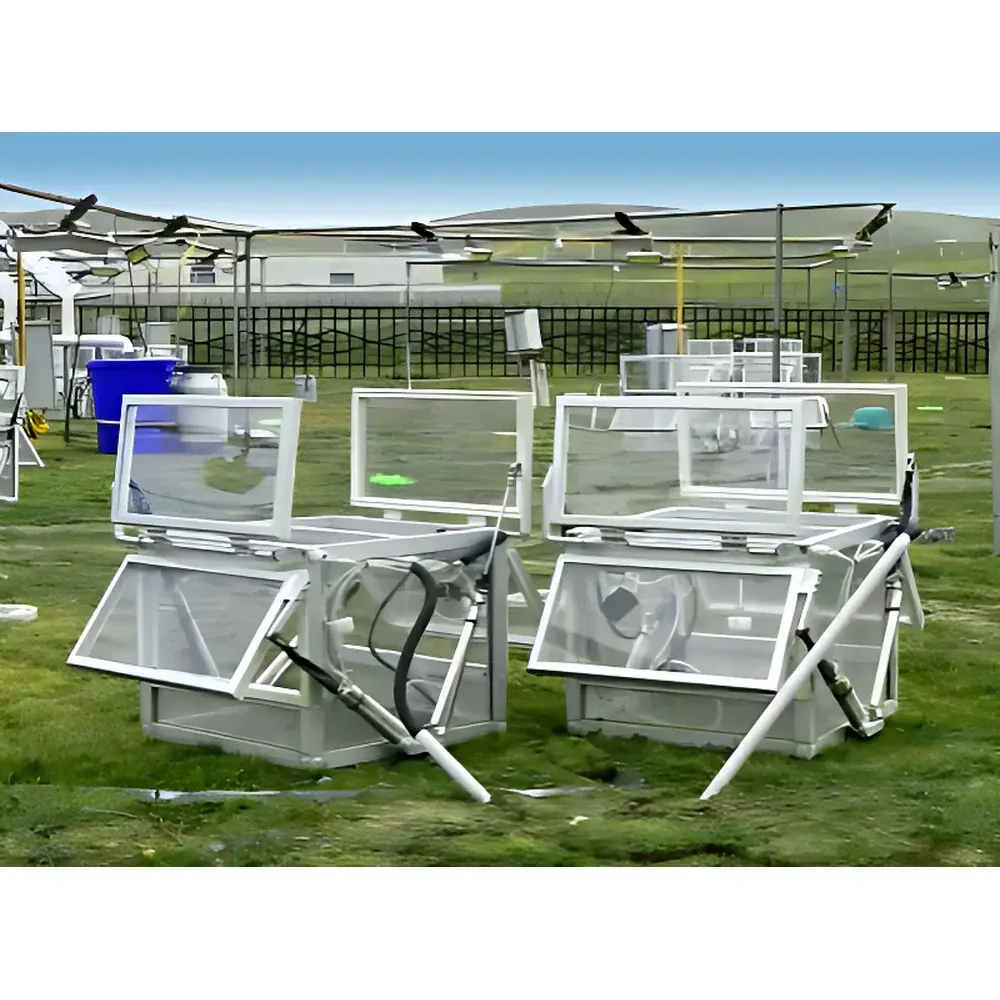
Pri-ECO CC-50 Dual-Cycle Canopy Photosynthesis and Soil Respiration Chamber System
| Brand | Pri-ECO |
|---|---|
| Origin | Beijing, China |
| Manufacturer Type | Original Equipment Manufacturer (OEM) |
| Country of Manufacture | China |
| Model | CC-50 |
| Chamber Dimensions | 50(L) × 50(W) × 40(H) cm |
| Net Weight | ~15 kg |
| Chamber Volume | 90.5 L (customizable) |
| Measurement Area | 0.1936 m² (customizable) |
| Optical Transmission | 93% (polycarbonate panel) |
| Light Control | Removable aluminized foil overlay for dark-adapted measurements |
| Window Actuation | Motorized linear actuators (top window: 90° rotation |
| side window | 45° rotation) |
| Sealing Mechanism | Precision pneumatic-assisted compression seal |
| Internal Mixing | Low-turbulence axial fan with adjustable RPM |
| Structural Material | Anodized aluminum frame + UV-stabilized optical-grade polycarbonate |
| Temperature Monitoring Range | –40 °C to +85 °C |
| Temp. Sensor Accuracy | ±2% FS |
| Power Supply | 12 V DC / 50 W nominal |
| Control Interface | Industrial-grade PLC + 7-inch resistive touchscreen HMI |
| Compliance | Designed for ISO 14064-3 field verification workflows and ASTM D6866–22 compatible δ¹³C flux partitioning protocols |
Overview
The Pri-ECO CC-50 Dual-Cycle Canopy Photosynthesis and Soil Respiration Chamber System is an engineered field-deployable enclosure designed for high-fidelity, non-invasive quantification of net ecosystem exchange (NEE), gross primary production (GPP), and autotrophic/heterotrophic soil carbon fluxes under ambient or controlled canopy conditions. Operating on the closed-chamber accumulation principle, the CC-50 integrates real-time CO₂ and δ¹³C isotopic monitoring via external cavity quantum cascade laser (EC-QCL) or tunable diode laser absorption spectroscopy (TDLAS) analyzers—enabling dual-isotope (¹²CO₂/¹³CO₂) kinetic modeling of photosynthetic assimilation and respiratory efflux within a defined plant-soil microcosm. Its dual-cycle architecture supports sequential light/dark measurement sequences without chamber removal, minimizing disturbance artifacts and permitting robust δ¹³C-based flux partitioning per ISO 14064-3 Annex B guidance. The system is not a standalone analyzer but a precision environmental interface—optimized for integration with Picarro G2201-i, Los Gatos RMT-200, or similar high-sensitivity isotopic gas analyzers.
Key Features
- Optically transparent chamber body fabricated from UV-resistant, low-birefringence polycarbonate (93% visible transmittance, 250–2500 nm spectral range) with optional removable aluminized foil overlay for rapid transition to dark-respiration mode
- Motorized, programmable actuation system using industrial-grade linear actuators: top lid rotates 90° for full canopy access; side panel rotates 45° for lateral sensor insertion or root-zone sampling—both sealed via spring-loaded pneumatic compression gaskets
- Low-shear internal mixing fan (0–1200 RPM, PWM-controlled) ensures <±1.5 ppm CO₂ spatial homogeneity across the 90.5 L volume within ≤45 s (validated per ASTM D6866–22 Appendix X2)
- Modular aluminum frame (6061-T6 anodized) provides structural rigidity under wind loads up to 15 m/s and thermal stability across –30 °C to +60 °C ambient extremes
- Embedded temperature sensing array (3× PT1000 sensors) distributed at chamber apex, mid-wall, and base plane enables vertical thermal gradient correction in flux calculations
- PLC-based control logic with deterministic timing resolution (±10 ms) supports synchronized valve sequencing, fan ramping, and data trigger outputs compatible with National Instruments DAQ systems or Campbell Scientific CR6 loggers
Sample Compatibility & Compliance
The CC-50 accommodates intact vegetation stands up to 35 cm tall—including grassland monocultures, shrub understories, and juvenile crop canopies—with minimal edge effects due to its 0.1936 m² footprint and chamfered base geometry. It complies with the physical design criteria outlined in IPCC 2006 Guidelines Vol. 4, Chapter 3 (Tier 2 chamber methods) and supports measurement traceability per ISO/IEC 17025:2017 when operated with certified reference gases (NIST SRM 1662a/b). All electrical components meet IEC 60529 IP54 ingress protection standards; no internal batteries or wireless transceivers are integrated—ensuring electromagnetic compatibility during co-location with sensitive magnetic susceptibility or eddy covariance instrumentation.
Software & Data Management
Chamber operation is managed via a local HMI running deterministic ladder logic firmware (IEC 61131-3 compliant), with configuration parameters stored in non-volatile EEPROM. Raw actuator positions, fan speed, temperature readings, and digital I/O states are timestamped and exported via RS-485 Modbus RTU (slave ID configurable) for ingestion into LabVIEW, Python Pandas, or MATLAB environments. No proprietary cloud platform is required; all data streams adhere to CF-1.8 metadata conventions, enabling direct import into FluxNet-FLUXPART or AmeriFlux QA/QC pipelines. Audit trails for parameter changes are retained for ≥12 months per GLP-aligned field data management practices.
Applications
- Partitioning of total soil respiration into rhizospheric vs. bulk-soil components using δ¹³C natural abundance or pulse-labeling approaches
- Diurnal characterization of light-response curves (A–PAR) for C₃/C₄ species under field conditions
- Validation of terrestrial biosphere models (e.g., CLM, ORCHIDEE) at plot scale
- Long-term monitoring of carbon sequestration efficacy in restored grasslands or afforested marginal soils
- Controlled-stress experiments (drought, warming, N-fertilization) with replicated chamber treatments and randomized block design
FAQ
Can the CC-50 be used with infrared gas analyzers (IRGAs) only—or is isotopic capability mandatory?
The chamber functions with standard NDIR-based IRGAs (e.g., Li-Cor LI-840A); however, δ¹³C-enabled flux partitioning requires integration with a calibrated isotopic analyzer (e.g., Picarro G2131-i) and adherence to dual-inlet referencing protocols.
Is custom sizing available beyond the standard 50×50×40 cm configuration?
Yes—volume scaling from 30 L to 250 L and planar area adjustments between 0.09 m² and 0.5 m² are supported, subject to structural validation and sealing integrity testing.
Does the system include calibration gas handling or pressure compensation hardware?
No—the CC-50 is a passive enclosure; users must supply external pressure transducers, zero/span gas manifolds, and flow controllers as part of their analytical stack per ISO 14064-3 Section 7.3.2.
What maintenance intervals are recommended for field deployments exceeding six months?
Polycarbonate panels require annual inspection for UV haze; actuator grease should be replenished every 18 months; sealing gaskets are rated for 5,000 compression cycles and supplied with replacement kits.







