
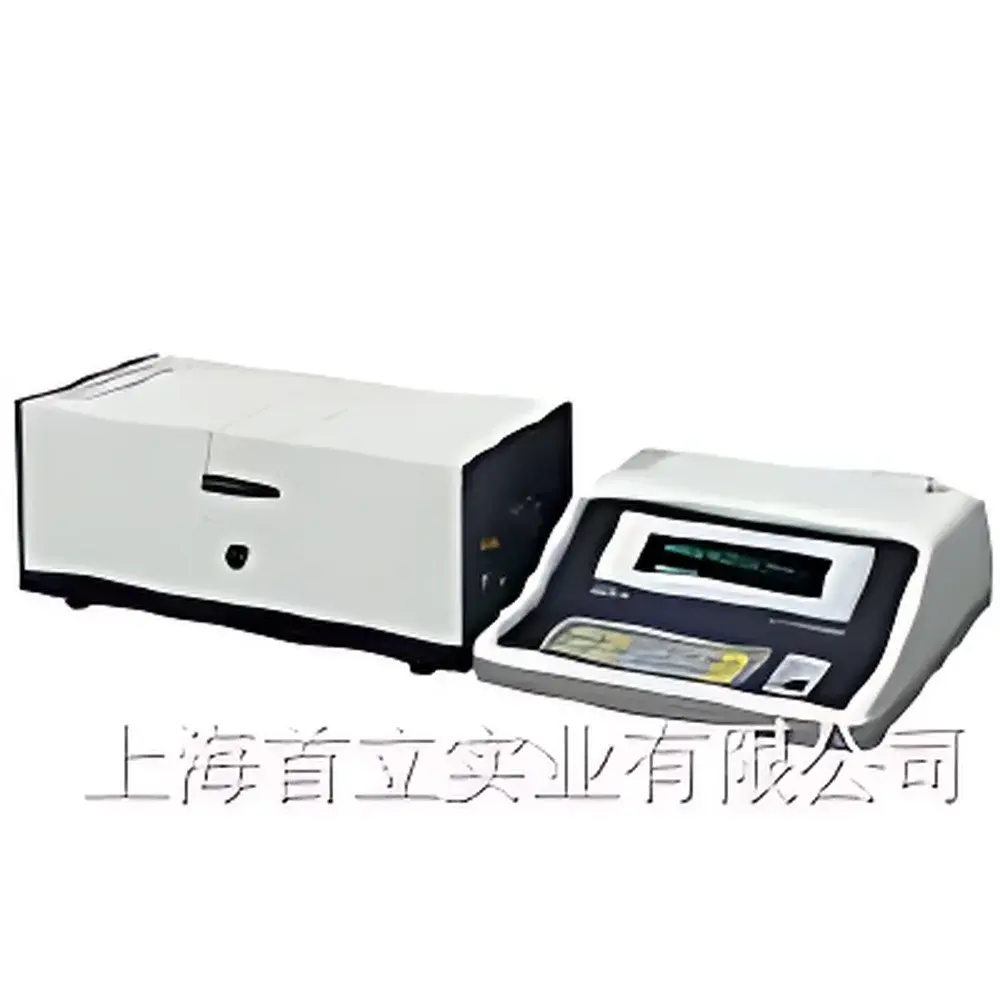
NDH-300A Turbidimeter and Haze/Transmittance Analyzer
| Origin | Japan |
|---|---|
| Manufacturer Type | Authorized Distributor |
| Origin Category | Imported Instrument |
| Model | NDH-300A |
| Pricing | Available Upon Request |
| Measurement Parameters | Total Transmittance, Diffuse Transmittance, Direct (Parallel) Transmittance, Turbidity (Haze) |
| Turbidity/Haze Range | 0–100% |
| Diffuse Transmittance Range | 0–100% |
| Direct Transmittance Range | 0–100% |
| Aperture Size | Φ12 mm |
| Measurement Method | Integrating Sphere Photometry |
| Compliance Standard | JIS K 7105 |
| Accuracy & Repeatability | ±0.002% of full scale |
| Optical Unit Dimensions | 484 mm (W) × 220 mm (D) × 186 mm (H) |
| Measurement Unit Dimensions | 350 mm (W) × 360 mm (D) × 110 mm (H) |
| Weight | Optical Unit: 12 kg |
| Measurement Unit | 6 kg |
| Power Supply | AC |
| Power Consumption | Optical Unit: 75 W |
| Measurement Unit | 35 W |
| Light Source | 12 V / 4 A Halogen Lamp |
| Interface | RS-232C Serial Port |
Overview
The NDH-300A Turbidimeter and Haze/Transmittance Analyzer is a precision optical measurement instrument engineered for simultaneous quantitative evaluation of turbidity (haze), total transmittance, diffuse transmittance, and direct (parallel) transmittance in transparent and semi-transparent solid materials and aqueous samples. Based on the integrating sphere photometry principle—where incident light from a stabilized halogen source (12 V / 4 A) is uniformly diffused across an internal spherical coating—the system captures both specular and scattered components with high angular sensitivity. This architecture enables traceable, repeatable measurements compliant with JIS K 7105, the Japanese Industrial Standard governing haze and transmittance testing of plastic films, glassine, cellophane, polyethylene sheets, and other optically homogeneous substrates. Unlike conventional single-beam or filter-based meters, the NDH-300A employs a dedicated single-optical-path receiver design that eliminates alignment drift and minimizes thermal noise, ensuring long-term stability across low-haze (80%) regimes without recalibration.
Key Features
- High-resolution dual-mode detection: independent quantification of diffuse and direct transmittance components using calibrated photodiode arrays within a precision-machined integrating sphere (Φ12 mm measurement aperture)
- Stabilized halogen illumination system with regulated current supply, delivering consistent spectral output (320–2500 nm effective range) and minimizing intensity drift over extended operation
- Opto-mechanical architecture optimized for minimal stray light contribution—critical for accurate haze assessment per JIS K 7105 definitions
- Real-time alphanumeric display via high-brightness fluorescent tube interface, supporting immediate visual verification without external software
- Dual-unit modular configuration: compact measurement head (350 × 360 × 110 mm) decoupled from optical engine (484 × 220 × 186 mm) to reduce vibration coupling and thermal cross-talk
- RS-232C serial interface compliant with EIA/TIA-232-F specifications, enabling bidirectional communication with laboratory PCs for automated data logging and script-driven test sequencing
Sample Compatibility & Compliance
The NDH-300A accommodates rigid and flexible sheet materials up to 5 mm thickness—including PET, PVC, polycarbonate, cellulose acetate, and laminated safety glass—as well as liquid samples in standardized cuvettes (10 mm path length). Its measurement methodology satisfies the geometric and photometric requirements of JIS K 7105 for haze (defined as the ratio of diffusely transmitted flux to total transmitted flux) and transmittance classification. While not certified to ISO 14782 or ASTM D1003, its optical design and calibration traceability align with the foundational principles of those standards. The instrument supports GLP-compliant workflows through timestamped measurement records and user-accessible calibration history logs stored in non-volatile memory.
Software & Data Management
Though fully functional in standalone mode, the NDH-300A integrates seamlessly with custom or third-party data acquisition platforms via its RS-232C port. Communication follows ASCII-based command-response protocol with configurable baud rates (9600–115200 bps), parity, and stop bits. Each measurement packet includes sample ID (user-defined), date/time stamp, all four primary metrics (total/diffuse/direct transmittance, haze), and instrument status flags. Raw data export supports CSV and tab-delimited formats suitable for import into LIMS environments, statistical process control (SPC) tools, or regulatory submission packages under FDA 21 CFR Part 11—provided the host software implements appropriate audit trail, electronic signature, and data integrity controls.
Applications
- Quality control of packaging films in food and pharmaceutical manufacturing, where haze directly correlates with consumer perception and barrier performance
- Optical validation of display cover glasses and touch sensor overlays during R&D and incoming inspection
- Environmental monitoring of surface water clarity in municipal treatment facilities and watershed studies
- Material development labs assessing the impact of filler dispersion, phase separation, or crystallinity on optical homogeneity in polymer blends
- Educational laboratories demonstrating fundamental light-matter interaction phenomena including Mie scattering and Rayleigh extinction
FAQ
Does the NDH-300A require NIST-traceable calibration standards?
Yes—routine verification requires certified haze standards (e.g., PMMA reference plates with certified haze values per JIS K 7105 Annex B) and neutral density filters for transmittance linearity checks.
Can the instrument measure samples thicker than 5 mm?
No—optical path geometry and sphere acceptance angle limit usable sample thickness to ≤5 mm for solid sheets; liquid measurements are restricted to standard 10-mm cuvettes.
Is USB or Ethernet connectivity available?
No—the NDH-300A provides only RS-232C serial interface; USB-to-serial adapters may be used, but native USB/Ethernet are not supported.
What maintenance intervals are recommended?
Halogen lamp replacement every 1,000 hours; integrating sphere interior cleaning with lint-free optics swabs and reagent-grade isopropanol every 6 months or after exposure to particulate-laden environments.
Is firmware upgrade capability built-in?
Firmware updates require authorized service technician intervention using proprietary diagnostic hardware; no end-user field-upgrade functionality is provided.




