
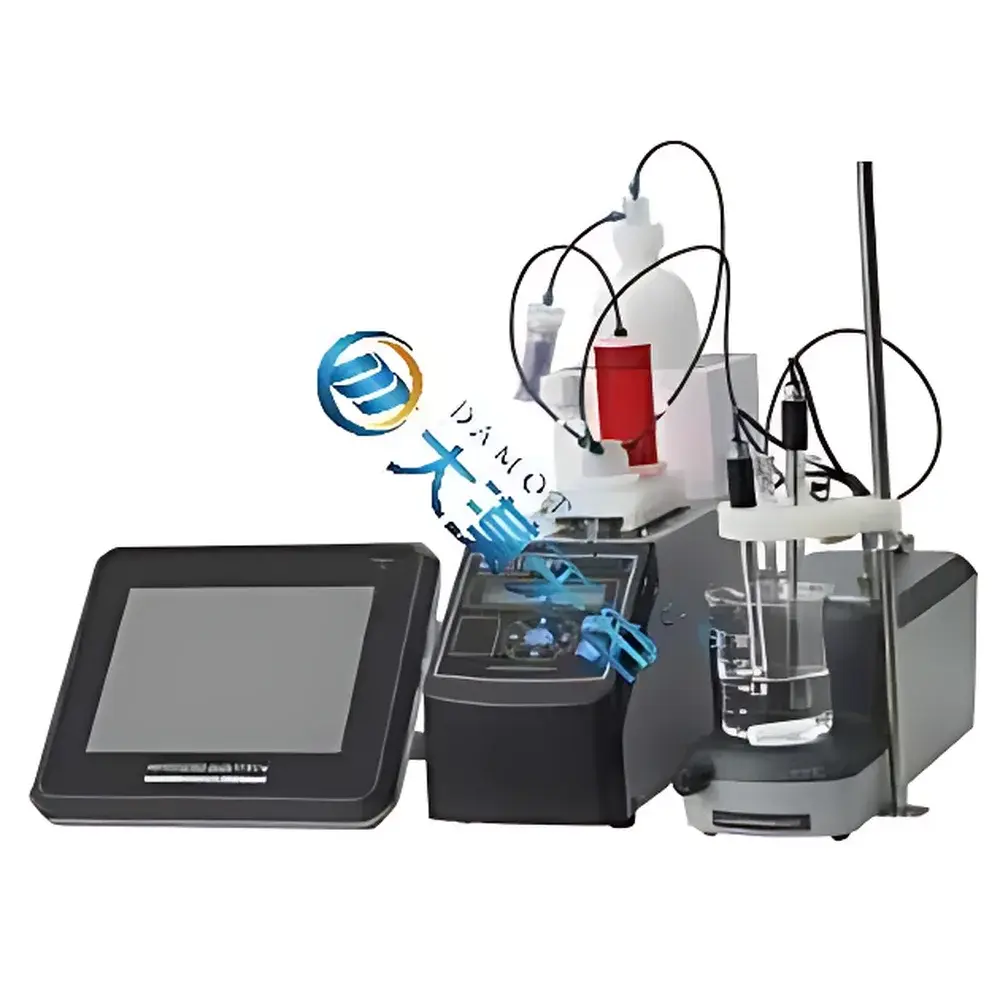
MITSUBISHI CHEMICAL GT-310 Automatic Potentiometric Titrator
| Brand | MITSUBISHI CHEMICAL |
|---|---|
| Origin | Japan |
| Model | GT-310 |
| Instrument Type | General-purpose Potentiometric Titrator |
| pH Range | 0–14 |
| mV Range | –2000 to +2000 mV |
| Meter Accuracy | ±0.2% of full scale |
| pH Resolution | 0.001 pH unit |
| Titration Endpoint Precision | ±0.3 mV |
| Maximum Simultaneous Modules | 4 titration units (potentiometric and/or Karl Fischer) |
| Endpoint Detection Modes | First Derivative (Inflection Point), Fixed Potential, Pre-/Post-Intersection, V-Crosspoint, and Second Derivative |
Overview
The MITSUBISHI CHEMICAL GT-310 Automatic Potentiometric Titrator is a modular, microprocessor-controlled analytical platform engineered for high-reproducibility potentiometric and coulometric titrations in regulated laboratory environments. It operates on the fundamental principle of measuring potential difference (in mV) between a reference electrode and an indicator electrode as a function of titrant volume, enabling precise endpoint determination without reliance on visual indicators. Designed for versatility across quality control, research, and routine QC/QA workflows, the GT-310 supports both classical acid-base, redox, precipitation, and complexometric titrations — as well as integrated Karl Fischer moisture analysis — within a single instrument architecture. Its dual-capability design allows concurrent operation of up to four independent titration modules, each with autonomous electrode management, dosing control, and real-time potential monitoring.
Key Features
- Modular multi-channel architecture: Supports simultaneous connection and operation of up to four titration units — including combinations of potentiometric and volumetric/coulometric Karl Fischer modules — with fully independent parameter sets per channel.
- Intelligent endpoint recognition: Offers five algorithmic detection methods — inflection point (first derivative), fixed-potential threshold, pre- and post-intersection, V-crosspoint, and second-derivative peak analysis — ensuring robust endpoint identification across diverse reaction kinetics and sample matrices.
- Automated calibration and measurement sequence: When used with Mitsubishi’s proprietary MST (Multi-Step Titration) software, the system executes end-to-end workflows — from automatic pH electrode calibration (including two-point or three-point calibration with slope and offset verification) through sample aspiration, titrant delivery, endpoint detection, and result calculation — without manual intervention.
- Re-analysis functionality: Enables retrospective reprocessing of raw titration curves using alternative endpoint algorithms or adjusted parameters, supporting method validation, troubleshooting, and regulatory audit readiness.
- Stability-driven measurement logic: Built-in auto-stability assessment continuously monitors potential drift during titration pauses; measurements proceed only when potential variation falls below user-defined thresholds (e.g., <0.1 mV/10 s), minimizing error from electrode polarization or junction potential instability.
Sample Compatibility & Compliance
The GT-310 accommodates aqueous and non-aqueous samples across a broad pH spectrum (0–14) and wide electrochemical window (±2000 mV), making it suitable for applications ranging from strong acid–strong base titrations in pharmaceutical active ingredient assays to redox titrations of transition metal ions in catalyst characterization. Electrode compatibility includes glass pH electrodes, silver/silver chloride reference electrodes, platinum redox electrodes, and specialized ion-selective electrodes (ISEs). The system meets essential requirements for GLP-compliant environments: full audit trail logging (user ID, timestamp, parameter changes, endpoint selection method), electronic signature support (when paired with compliant LIMS or ELN systems), and data integrity features aligned with FDA 21 CFR Part 11 expectations. While not certified as standalone 21 CFR Part 11 hardware, its data export formats (CSV, PDF reports with embedded metadata) and configurable access controls facilitate integration into validated workflows adhering to ISO/IEC 17025, ASTM E2656, and USP guidelines.
Software & Data Management
Controlled via the dedicated MST software suite (Windows-based), the GT-310 provides intuitive graphical titration curve visualization, real-time derivative plotting, and interactive curve adjustment. All raw potential-volume data are stored in proprietary binary format with checksum verification and can be exported in ASCII-compatible CSV for third-party statistical analysis or LIMS ingestion. Reports include instrument ID, operator name, date/time stamps, electrode serial numbers, calibration history, titrant concentration and batch traceability, and full endpoint calculation logs. Audit trail records capture every parameter modification, manual override, and re-analysis event — all time-stamped and linked to authenticated user accounts. Data backups follow NIST SP 800-88 Rev. 1 retention protocols, supporting long-term archival and regulatory inspection readiness.
Applications
- Pharmaceutical: Quantification of active pharmaceutical ingredients (APIs) via acid-base titration; residual solvent analysis using Karl Fischer coulometric titration; excipient purity verification.
- Chemical manufacturing: Acid number and base number determination in lubricants and petrochemicals per ASTM D974 and D664.
- Food & beverage: Total acidity (TA) in wines and fruit juices; chloride content in dairy products; preservative (e.g., sorbic acid) quantification.
- Environmental testing: Alkalinity and hardness profiling in wastewater; cyanide and fluoride analysis using ISE-coupled titration.
- Academic research: Kinetic studies of slow-reacting systems via controlled-potential titration; development and validation of novel endpoint detection algorithms.
FAQ
Can the GT-310 perform both potentiometric and Karl Fischer titrations simultaneously?
Yes — the system supports up to four independent modules, allowing concurrent potentiometric and Karl Fischer titrations on separate channels with no cross-interference in control logic or data acquisition.
Is pH calibration fully automated?
When configured with MST software and compatible auto-calibration accessories (e.g., motorized calibration solution selector), the GT-310 performs automatic multi-point pH calibration, including slope verification and offset correction, without manual electrode immersion steps.
Does the system support custom titration methods?
Users may define and save unlimited method templates — including dosing profiles, endpoint criteria, electrode types, and report formatting — via MST software; methods are protected by password-locked editing rights.
How is data integrity ensured during power interruption?
The GT-310 employs non-volatile memory for real-time titration data buffering; in the event of unexpected power loss, the last complete titration cycle is preserved and recoverable upon restart.
What electrode diagnostics are available?
Real-time monitoring includes electrode slope (%), asymmetry potential (mV), response time (t95%), and junction potential stability — all logged alongside titration results for trending and preventive maintenance scheduling.
Related Products




