
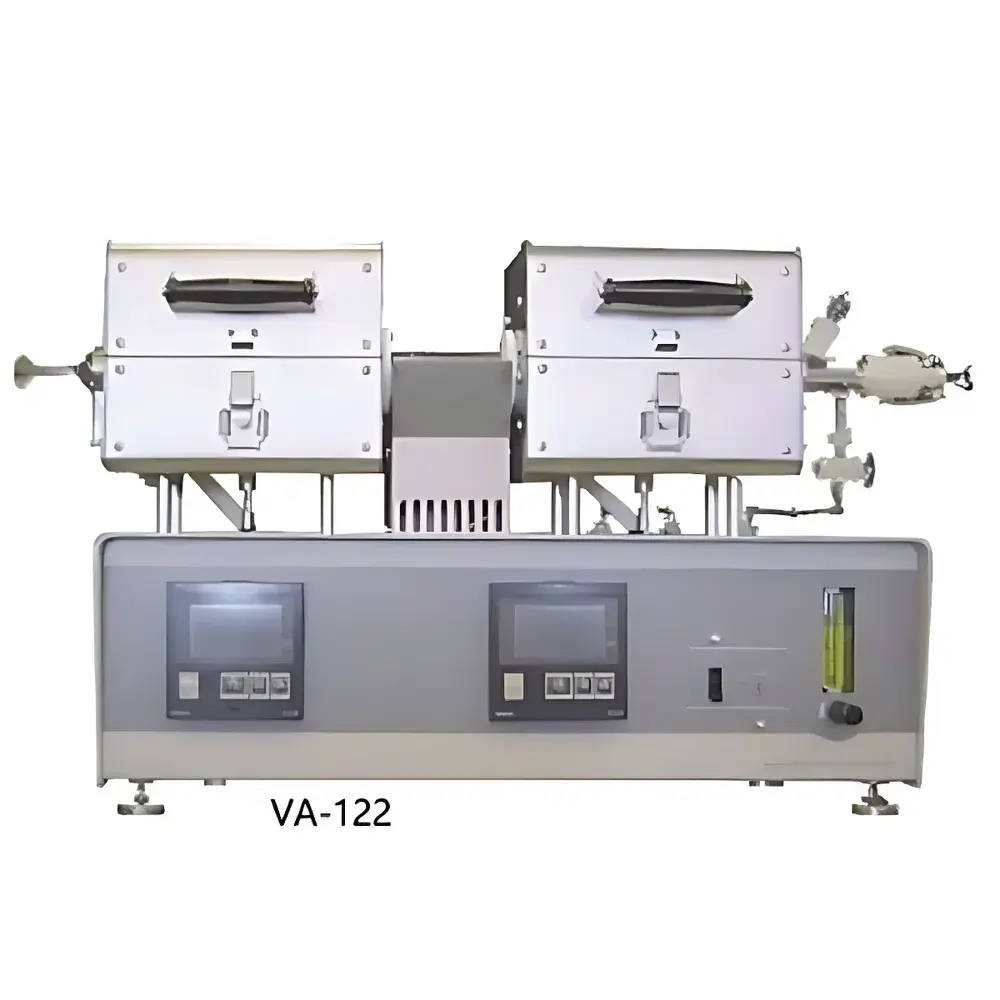
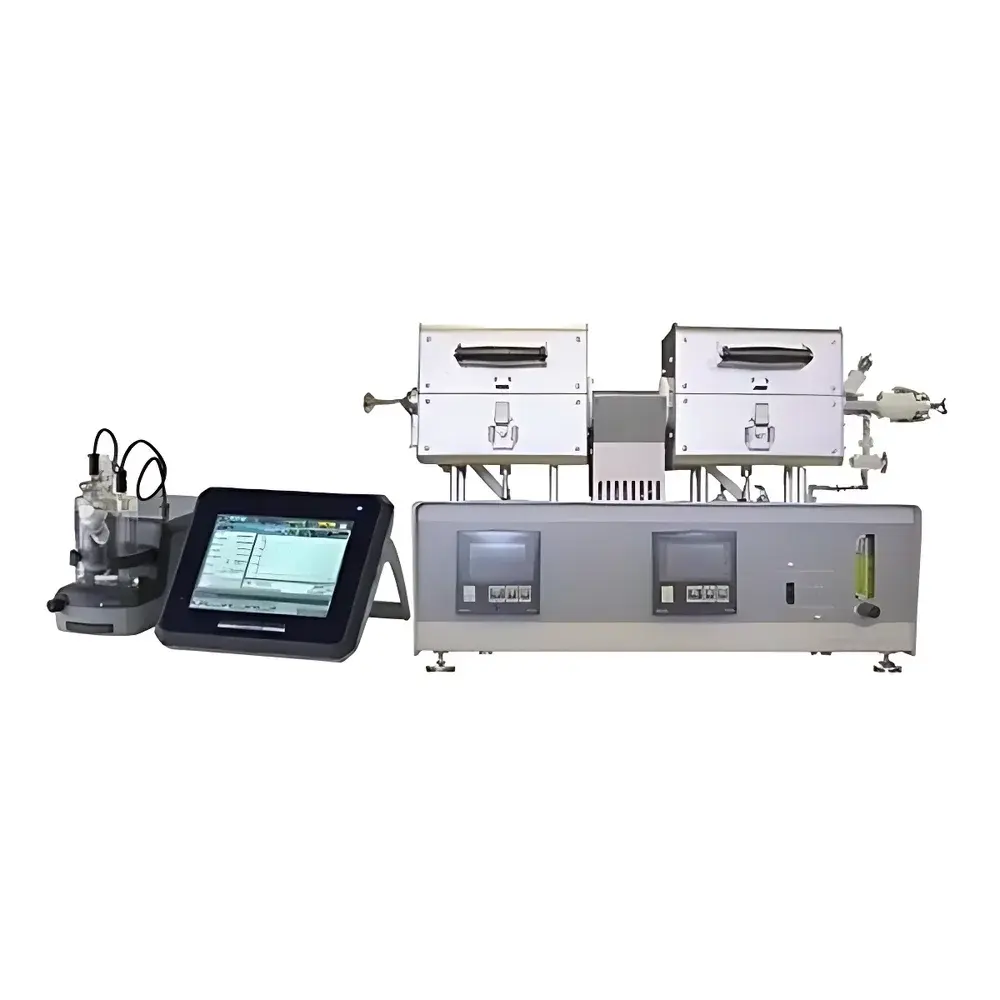
Mitsubishi Chemical VA-122 Dual-Temperature Furnace Sample Heater for Karl Fischer Moisture Determination
| Brand | Mitsubishi Chemical |
|---|---|
| Origin | Japan |
| Model | VA-122 |
| Heating Zones | Low-Temp Furnace (70–300 °C) & High-Temp Furnace (250–1000 °C) |
| Heating Element | Fe-Cr-Al resistance wire, 1000 W |
| Sample Capacity | ≤10 g |
| Detection Limit | ≥10 ppm (as H₂O) |
| Carrier Gas | N₂, flow rate 0.1–0.5 L/min |
| Power Supply | AC 100–120 V or 220–240 V, 50/60 Hz, 1900 VA |
| Dimensions | 690 × 290 × 410 mm (W×D×H) |
| Weight | ~20 kg |
| Compatible Analyzer | CA-310 Coulometric Karl Fischer Titrator |
| Measurement Principle | Thermal liberation of surface-bound and adsorbed water prior to coulometric KF titration |
Overview
The Mitsubishi Chemical VA-122 is a dual-zone, temperature-programmable sample heating unit engineered exclusively for coupling with coulometric Karl Fischer moisture analyzers—primarily the CA-310—to enable precise quantification of non-volatile, surface-adsorbed, and lattice-associated water in thermally stable inorganic materials. Unlike conventional oven-based moisture liberators, the VA-122 implements two physically isolated furnace chambers: a low-temperature zone (70–300 °C) optimized for gentle desorption of physisorbed moisture and hygroscopic surface layers, and a high-temperature zone (250–1000 °C) capable of releasing strongly bound water from metal oxides, rare-earth compounds, refractory salts, and mineral matrices without decomposition-induced side reactions. Water vapor liberated from the solid sample is swept continuously by dry nitrogen carrier gas into the CA-310’s coulometric titration cell, where iodine is electrogenerated in real time; the total charge consumed correlates directly to water mass via Faraday’s law. This thermal–electrochemical integration ensures trace-level detection sensitivity (≥10 ppm), high reproducibility across heterogeneous particulate samples, and compliance with ASTM E203 and ISO 760 methodologies for bound-water analysis.
Key Features
- Dual independent furnace zones with digitally controlled, PID-regulated temperature profiles—enabling sequential or selective heating protocols for multi-stage moisture release studies.
- High-power (1000 W) Fe-Cr-Al resistance heating elements providing rapid thermal ramping and exceptional stability (<±1 °C) across the full operating range.
- Sample introduction via standardized ceramic crucible or quartz boat (≤10 g capacity), compatible with inert atmosphere handling and minimizing cross-contamination.
- Integrated gas flow control module supporting precise N₂ carrier delivery (0.1–0.5 L/min) with upstream pressure regulation and inline desiccant filtration.
- Robust mechanical architecture with front-accessible furnace doors, thermal insulation shielding, and overtemperature cut-off protection meeting IEC 61010-1 safety requirements.
- Direct hardware interface with CA-310 analyzer for synchronized start/stop, temperature logging, and automated result correlation in the KF software environment.
Sample Compatibility & Compliance
The VA-122 is validated for use with inorganic solids exhibiting low volatility below 1000 °C—including transition metal oxides (e.g., Fe₂O₃, Al₂O₃), rare-earth oxides (e.g., Y₂O₃, Nd₂O₃), alkaline earth carbonates, silicates, phosphates, and halide salts. It excludes organic polymers, volatile hydrates (e.g., CuSO₄·5H₂O), or thermally labile species that decompose before complete water release. Method development aligns with USP , EP 2.5.12, and JP 2.05 guidelines for loss-on-drying alternatives. When operated with CA-310 under GLP/GMP conditions, the combined system supports full audit trail generation, user access control, and electronic signature compliance per FDA 21 CFR Part 11 when configured with validated firmware and networked data archiving.
Software & Data Management
The VA-122 itself operates as a dedicated peripheral with no embedded display or standalone software. All operational parameters—including target temperatures, ramp rates, hold times, and gas flow—are configured and monitored through the CA-310’s proprietary KF-Manager software (v4.2+). Real-time furnace temperature feedback is logged alongside titration curves, enabling post-run correlation of moisture evolution profiles with thermal events. Data export supports CSV and PDF report formats with embedded metadata (operator ID, timestamp, method ID, calibration history). System validation documentation—including IQ/OQ protocols, temperature mapping reports, and gas flow verification procedures—is available from Mitsubishi Chemical upon request for regulated laboratory environments.
Applications
- Quantification of residual surface moisture in battery cathode precursors (e.g., Ni-rich NMC oxides) prior to sintering—critical for controlling Li/Ni cation mixing.
- Quality control of catalyst supports (γ-Al₂O₃, SiO₂) where trace adsorbed water impacts metal dispersion and reaction kinetics.
- Specification testing of high-purity rare-earth fluorides and chlorides used in optical crystal growth—where >50 ppm H₂O induces scattering centers.
- Research into dehydration pathways of layered double hydroxides (LDHs) and metal–organic frameworks (MOFs) under controlled thermal gradients.
- Verification of drying efficacy in pharmaceutical excipients such as colloidal silicon dioxide or calcium phosphate anhydrous grades.
FAQ
Can the VA-122 be used with non-Mitsubishi Karl Fischer analyzers?
No—the VA-122 is electrically and logically designed for native integration only with the CA-310 coulometric titrator. Its control signals, timing synchronization, and data handshake protocol are proprietary and not compatible with third-party instruments.
Is quartz boat cleaning required between runs?
Yes—residue buildup on quartz surfaces may retain moisture or catalyze side reactions. Mitsubishi Chemical recommends ultrasonic cleaning in high-purity acetone followed by 500 °C bake-out before reuse.
What is the recommended maintenance interval for the heating elements?
Under normal operation (≤8 hrs/day, ≤800 °C average), Fe-Cr-Al elements require inspection every 12 months; replacement is typically needed after 3–5 years depending on thermal cycling frequency and ambient humidity exposure.
Does the VA-122 support gradient heating programs?
Yes—via CA-310 software, users can define multi-step temperature ramps (e.g., 120 °C → hold 5 min → 650 °C → hold 10 min), allowing differentiation between weakly and strongly bound water fractions.
Is nitrogen the only acceptable carrier gas?
Yes—argon or helium may cause unstable baseline currents in the coulometric cell due to differing electrochemical reduction potentials; only dry, oil-free nitrogen meets the CA-310’s specification for stable iodine generation.





