
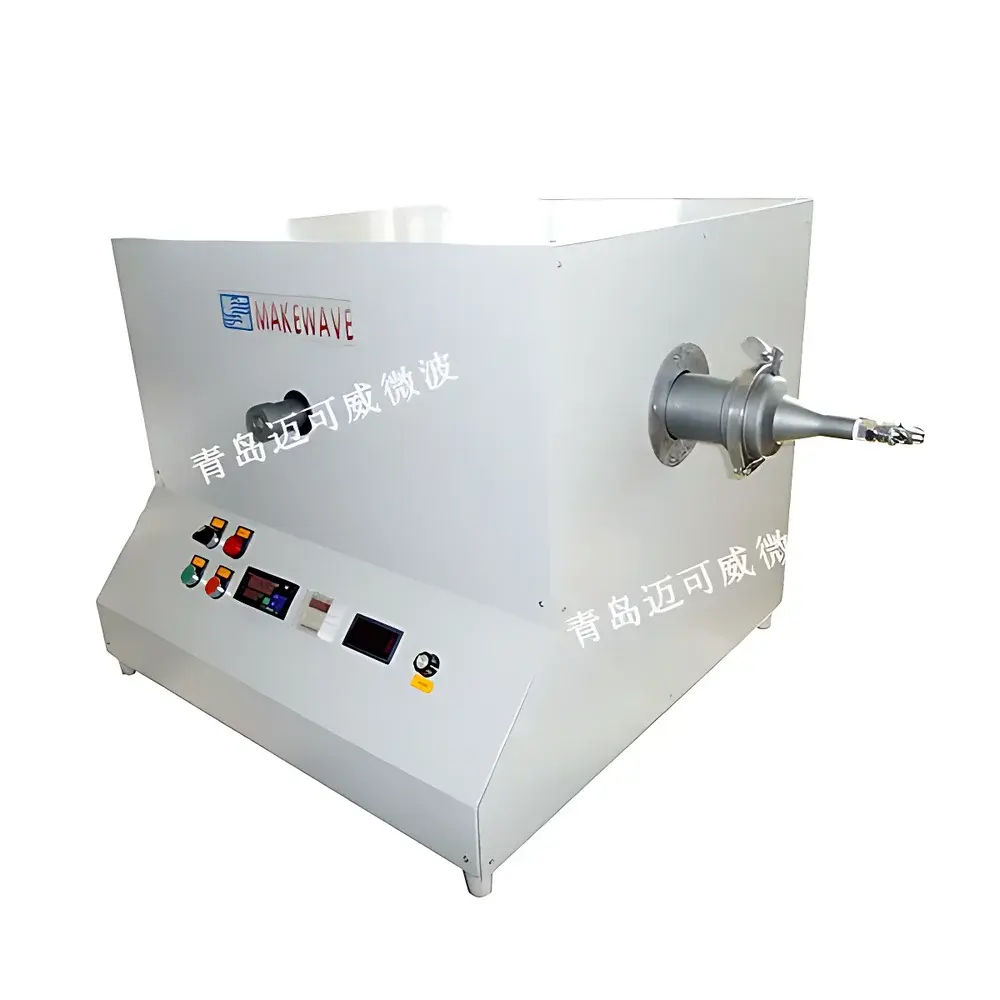
MKP-T2HA Microwave Plasma Tube Furnace
| Brand | Makewave |
|---|---|
| Origin | Shandong, China |
| Manufacturer Type | Direct Manufacturer |
| Model | MKP-T2HA |
| Microwave Power | 0–1600 W, 2450 MHz, continuously adjustable |
| Cavity Material | Vacuum-sealed, one-piece welded stainless steel, ultimate vacuum: –0.099 MPa |
| Plasma Reactor | Horizontal quartz tube, plasma generation zone: 40 × 400 mm |
| Observation Port | Single integrated viewport for real-time plasma monitoring |
| Gas System | Dual-channel sealed gas mixing inlet (left side), right-side exhaust, fully vacuum-compatible |
| Temperature Range | Up to 1700 °C, infrared pyrometric control |
| Control System | PLC-based intelligent control with color TFT touchscreen HMI |
| Data Management | Multi-step recipe storage, time–temperature profile logging, real-time curve display, USB data export |
| Dimensions (W×D×H) | 1500 × 800 × 800 mm, benchtop configuration |
| Compliance | Designed for ISO/IEC 17025-aligned lab environments |
Overview
The MKP-T2HA Microwave Plasma Tube Furnace is a precision-engineered benchtop system integrating 2.45 GHz microwave energy delivery with controlled atmospheric plasma generation inside a high-temperature horizontal quartz reactor. Unlike conventional thermal furnaces, this instrument leverages microwave-induced electron oscillation in low-pressure gas environments to generate non-equilibrium plasma—enabling selective surface activation, chemical vapor reaction, and low-thermal-budget material processing. Its core architecture features a vacuum-tight stainless-steel microwave cavity coupled to a thermally stable quartz tube reactor (40 mm ID × 400 mm active length), where plasma ignition and sustainment occur under precisely regulated pressure (down to –0.099 MPa) and gas composition. The system operates across a validated temperature range of ambient to 1700 °C, monitored via non-contact infrared pyrometry calibrated per ASTM E2847, ensuring traceable thermal measurement without sensor drift or contamination.
Key Features
- Horizontally oriented quartz tube reactor with dedicated microwave plasma generation zone (40 × 400 mm), optimized for uniform field distribution and reproducible discharge stability.
- Dual independent gas inlets on the left side enable precise binary or ternary gas mixing (e.g., Ar/H2, N2/NH3, O2/CF4) prior to plasma initiation—critical for controlled nitridation, oxidation, or fluorination processes.
- Integrated single-view optical port with borosilicate viewport allows real-time visual assessment of plasma morphology, glow intensity, and spatial uniformity—supporting process diagnostics without vacuum break.
- Leak-tight vacuum architecture with welded stainless-steel cavity and metal-gasketed flanges ensures compliance with ISO 2859-1 sampling plans for leak integrity verification.
- PLC-based control system with 7-inch color TFT touchscreen provides deterministic sequencing, ramp/soak programming, and synchronized logging of microwave power, temperature, pressure, and gas flow rates.
- Benchtop footprint (1500 × 800 × 800 mm) includes internal RF shielding, forced-air cooling ducts, and interlocked safety circuits meeting IEC 61000-6-4 emission limits.
Sample Compatibility & Compliance
The MKP-T2HA accommodates substrates up to Ø30 mm × 100 mm in length—including sintered ceramics, metallic foils, polymer fibers, nanoparticle powders, and semiconductor wafers—without requiring substrate-specific fixtures. Quartz tube geometry permits direct insertion of crucibles, boats, or custom holders compatible with ASTM F2628 standards for high-purity quartzware. All wetted surfaces are electropolished 316L stainless steel or fused quartz, minimizing metallic contamination during high-temperature plasma exposure. The system supports operation under inert, reducing, oxidizing, or reactive atmospheres at pressures from 10–3 to 105 Pa, enabling protocols aligned with ISO 10075 (plasma surface treatment), ASTM D7253 (polymer surface modification), and USP (pharmaceutical device cleaning validation).
Software & Data Management
Control firmware implements deterministic real-time scheduling with sub-second loop resolution. Up to 20 multi-segment thermal–plasma recipes can be stored locally, each defining time-synchronized setpoints for temperature, microwave power, gas flow ratios, and vacuum level. Time–temperature–power profiles are displayed live on-screen and exported as CSV files via USB 2.0 interface. Optional audit-trail module logs operator ID, timestamp, parameter changes, and alarm events—fully compliant with FDA 21 CFR Part 11 requirements when paired with networked authentication. Data timestamps are synchronized to UTC via NTP client support (firmware v2.3+).
Applications
- Synthesis of transition metal carbides/nitrides (e.g., TiN, WC) via microwave plasma-assisted carburization/nitridation of precursor powders.
- Surface functionalization of carbon nanotubes and graphene oxide films for enhanced dispersion in polymer matrices.
- Plasma-enhanced atomic layer deposition (PE-ALD) pre-treatment of SiO2/Si substrates prior to Al2O3 film growth.
- Low-temperature curing of photoresists and dielectric polymers used in flexible electronics manufacturing.
- Decomposition kinetics studies of VOCs (e.g., formaldehyde, toluene) under controlled Ar/O2 plasma for environmental catalysis R&D.
- Thermal stabilization and cross-linking of aramid and polyimide fibers for aerospace-grade composite reinforcement.
FAQ
What vacuum level is required to initiate stable microwave plasma in the MKP-T2HA?
Stable plasma ignition typically occurs between 100–500 Pa (0.75–3.75 Torr) depending on gas type and composition; the system achieves ultimate vacuum of –0.099 MPa to ensure rapid pump-down and residual gas removal.
Can the furnace operate under continuous flow conditions without vacuum hold?
Yes—the gas system supports both static batch mode and dynamic flow-through operation at pressures up to atmospheric, with mass flow controllers maintaining ±1% full-scale accuracy.
Is infrared pyrometry validated for emissivity variations across different sample materials?
The pyrometer includes user-adjustable emissivity compensation (0.10–0.99), and calibration certificates traceable to NIST SRM 1921b are provided with each unit.
Does the PLC controller support external trigger inputs for synchronization with other lab equipment?
Yes—four opto-isolated digital I/O ports (2 input, 2 output) are available for TTL-level triggering of auxiliary devices such as shutters, pumps, or spectrometers.
What maintenance intervals are recommended for the magnetron and waveguide components?
Magnetron service life exceeds 5,000 hours under nominal load; waveguide desiccant cartridges require replacement every 12 months in humid environments per IEC 60068-2-30 humidity testing guidelines.



