
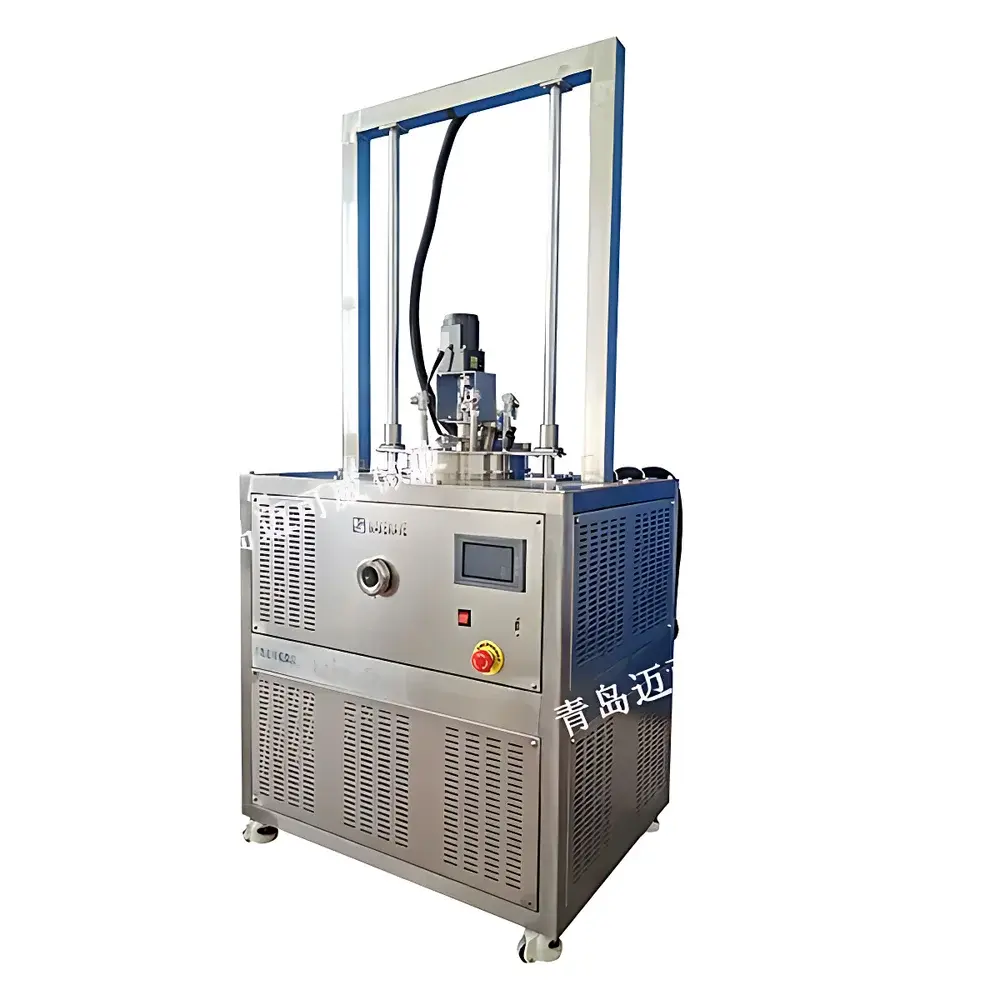
MKP-T4UA Microwave Plasma Furnace by Makewave
| Brand | Makewave |
|---|---|
| Origin | Shandong, China |
| Manufacturer Type | Direct Manufacturer |
| Product Category | Domestic Equipment |
| Model | MKP-T4UA |
| Pricing | Upon Request |
| Microwave Power | 0–3200 W, 2450 MHz, Continuously Adjustable |
| Cavity Material | Seamless Stainless Steel Welded Construction, Vacuum-Sealed, Ultimate Vacuum: −0.099 MPa |
| Plasma Reactor | Horizontal Quartz Tube, Plasma Generation Zone: Φ300 × 400 mm |
| Temperature Range | Up to 1700 °C |
| Temperature Measurement | Infrared Pyrometry |
| Control System | PLC-Based Intelligent Control with Color Touchscreen HMI |
| Atmosphere Control | 4 Gas Inlets + 2 Mist Injection Ports |
| Motion System | Integrated Rotational Motor for Sample Holder |
| Viewing Port | Single Optical Window with Dual-Mode LED Monitoring (Pre-ignition Observation & Real-Time Plasma Emission Visualization) |
| Safety Feature | Microwave Leakage Monitoring Port |
| Dimensions (W×D×H) | 1200 × 1000 × 1900 mm |
| Installation | Floor-Standing Configuration |
| Data Management | Multi-Program Storage, Multi-Stage Thermal Profiles, Real-Time Time–Temperature Curve Display, USB Data Export |
Overview
The MKP-T4UA Microwave Plasma Furnace is a high-precision, vacuum-compatible thermal processing system engineered for controlled plasma-assisted synthesis, surface functionalization, and high-temperature material modification under reactive or inert atmospheres. It operates on the principle of microwave-induced plasma generation within a quartz-lined reaction zone, where electromagnetic energy at 2450 MHz couples directly with process gases to produce non-equilibrium, high-energy plasma species—including excited atoms, ions, radicals, and UV photons—without requiring electrodes or external ignition sources. This enables low-thermal-load, highly selective surface reactions critical for advanced materials development. Designed for laboratory-scale R&D and pilot-line process validation, the furnace integrates vacuum integrity, precise gas dynamics, rotational sample handling, and real-time optical diagnostics into a single robust architecture suitable for GLP-compliant environments.
Key Features
- Vacuum-rated stainless steel cavity (ultimate vacuum: −0.099 MPa) with fully welded, leak-tight construction compliant with ISO 2859-1 sampling standards for pressure integrity verification.
- Horizontally oriented quartz plasma reactor (Φ300 × 400 mm) optimized for uniform microwave field distribution and stable plasma ignition across diverse gas chemistries (e.g., Ar, N₂, O₂, NH₃, CH₄, CF₄).
- Four independently controllable gas inlets and two ultrasonic mist injection ports support complex multi-gas and vapor-phase precursor delivery for co-deposition, nitridation, oxidation, or fluorination processes.
- Motor-driven rotation stage (0–30 rpm, programmable speed profile) ensures homogeneous exposure of powders, fibers, or substrates to plasma flux and thermal gradients.
- Dual-function optical viewport with integrated LED illumination enables pre-process visual inspection and real-time observation of plasma morphology, glow intensity, and spatial uniformity during operation.
- PLC-based control system with 10.1-inch color touchscreen HMI supports up to 99 customizable thermal–atmospheric programs, each with ≥20 programmable segments for temperature ramping, dwell, gas switching, and microwave power modulation.
- Embedded infrared pyrometer (spectral response: 1.0–1.6 µm) provides non-contact temperature measurement traceable to NIST standards, with emissivity compensation and auto-calibration routines.
Sample Compatibility & Compliance
The MKP-T4UA accommodates a broad range of sample formats—including ceramic and metallic powders (≤50 g), thin-film-coated wafers (up to 6-inch diameter), textile swatches (≤30 × 30 cm), fiber spools, and microelectronic packaging substrates—within its rotating quartz boat assembly. All wetted surfaces are electropolished 316L stainless steel or high-purity fused quartz, meeting USP Class VI and ASTM F86 surface finish requirements for biocompatible material processing. The system conforms to IEC 61000-6-4 (EMC emission limits) and IEC 61000-6-2 (immunity), and incorporates interlocked door safety circuits compliant with EN 60204-1. Vacuum and gas line components meet ISO 8573-1 Class 2 purity specifications for compressed air and process gases.
Software & Data Management
The embedded control firmware supports audit-trail-enabled data logging per FDA 21 CFR Part 11 requirements, including user login authentication, electronic signatures, and immutable timestamped records of all setpoints, actual values, alarms, and manual interventions. Process data—including time-stamped temperature, microwave power, chamber pressure, gas flow rates, and plasma emission status—is stored internally and exportable via USB 2.0 to CSV or XML formats. Optional Ethernet connectivity enables integration with LIMS or MES platforms using Modbus TCP or OPC UA protocols. Calibration logs, maintenance history, and system diagnostic reports are retained for ≥12 months and support GMP documentation workflows.
Applications
- Synthesis of nanostructured metal oxides (e.g., TiO₂, ZnO, SnO₂) and nitrides (e.g., Si₃N₄, AlN) via plasma-enhanced carbothermic reduction or direct nitridation.
- Surface activation and grafting of polymers and textiles for improved dye uptake, antimicrobial functionality, or adhesion promotion—without solvent use or thermal degradation.
- Plasma-assisted diffusion hardening and oxide scale formation on stainless steel, titanium alloys, and nickel-based superalloys for corrosion resistance enhancement.
- Low-damage passivation and doping of SiC and GaN wafers for power electronics fabrication.
- Decomposition of VOCs (e.g., formaldehyde, benzene) and NOₓ in exhaust streams using catalytic plasma–catalyst hybrid configurations.
- UV-emitting phosphor synthesis and rare-earth-doped alumina conversion coatings for solid-state lighting applications.
FAQ
What vacuum level can the MKP-T4UA achieve, and how is leak integrity verified?
The system achieves an ultimate vacuum of −0.099 MPa (≤100 Pa) using a dual-stage rotary vane pump. Leak integrity is validated using helium mass spectrometry per ASTM E499, with routine checks performed using built-in pressure-rise tests.
Is the quartz plasma tube replaceable, and what is its typical service life under continuous operation?
Yes—the horizontal quartz reactor is a field-replaceable consumable. Under standard operating conditions (≤1200 °C, inert atmosphere, ≤8 h/day), expected lifetime exceeds 1,500 operational hours before visible devitrification or microcracking occurs.
Can the system operate under reducing atmospheres such as H₂/Ar mixtures, and what safety provisions exist?
Hydrogen-compatible operation is supported with optional H₂-certified mass flow controllers, explosion-proof solenoid valves, and integrated hydrogen sensors (0–1000 ppm range) linked to automatic shutdown and purge sequences per IEC 60079-10-1.
Does the PLC controller support remote monitoring or integration with SCADA systems?
Yes—via optional RS485/Modbus RTU or Ethernet/IP interfaces. Full register mapping and configuration files are provided for third-party SCADA integration without proprietary middleware.
What calibration documentation is supplied with the furnace upon delivery?
Each unit ships with factory calibration certificates for the infrared pyrometer (NIST-traceable), pressure transducer (ISO/IEC 17025 accredited lab), and microwave power sensor (calibrated per IEEE Std 1528), all valid for 12 months from shipment date.



