
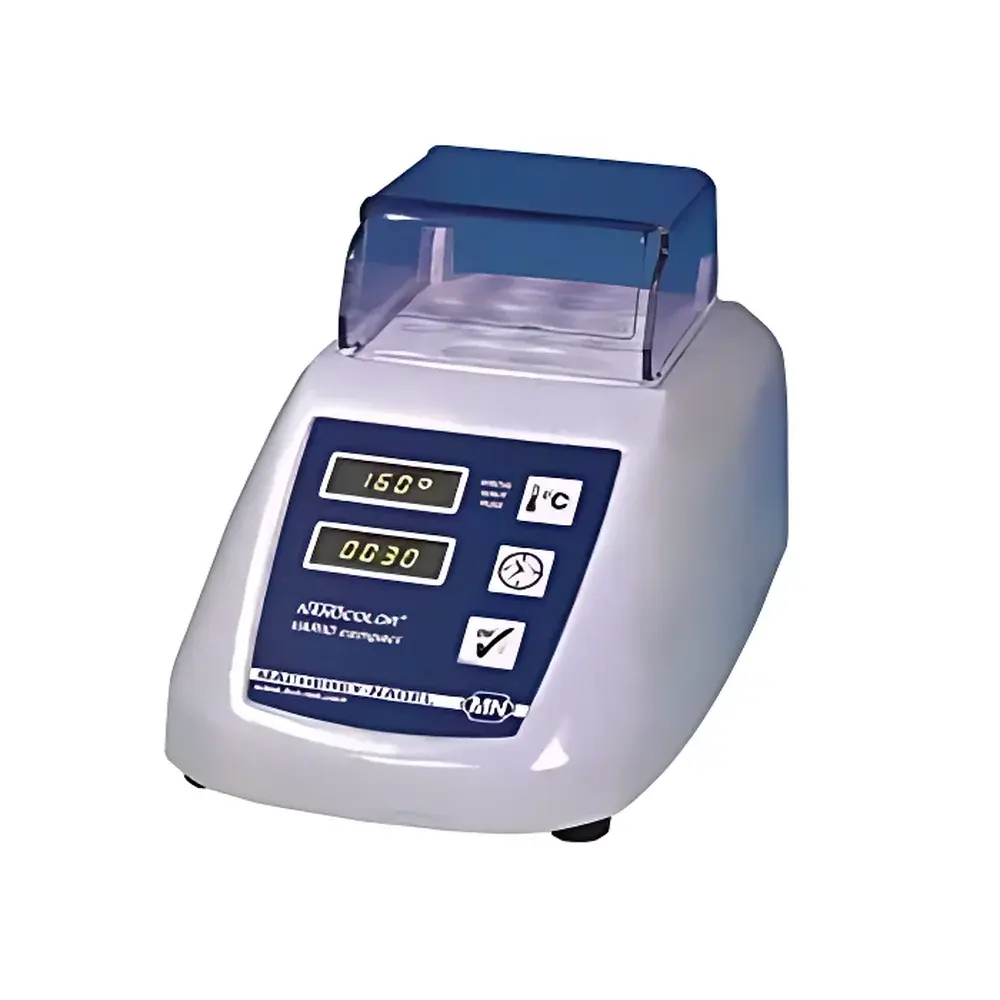
MN 91913 NANOCOLOR VARIO Compact COD Digestion Heater
| Brand | MN |
|---|---|
| Origin | Germany |
| Manufacturer Type | Authorized Distributor |
| Origin Category | Imported |
| Model | 91913 |
| Price | Upon Request |
| Display | 2-line LED, 6 mm character height |
| Voltage | 110–230 V~, 50/60 Hz |
| Power Consumption | 125 / 250 VA |
| Dimensions (W × D × H) | 150 × 250 × 140 mm |
| Sample Capacity | 12 positions |
| Predefined Temperatures | 70 / 100 / 120 / 148 / 160 °C |
| Predefined Timings | 1 / 2 h (at lower T), 1 / 2 h (at higher T) |
| User-Defined Temperature Range | 30–160 °C (1 °C increment) |
| User-Defined Time Range | 00:01–66:59 h (1 second increment) |
| Compliance | EN 61326-1:2013 (EMC), Directive 2014/30/EU (EMC), GLP-supporting firmware and interface logging |
Overview
The MN 91913 NANOCOLOR VARIO Compact COD Digestion Heater is a precision-engineered thermal digestion system designed for standardized wet-chemical oxidation of organic matter in aqueous samples. It operates on the principle of controlled conductive heating to accelerate redox reactions—specifically, the dichromate-based oxidation of organic carbon under acidic, high-temperature conditions per ISO 15705:2002 (“Water quality — Determination of chemical oxygen demand (COD) — Small-scale sealed-tube method”). Unlike open-reflux or block-heater variants lacking thermal uniformity, this unit delivers spatially consistent temperature profiles across all 12 sample positions via calibrated aluminum heating blocks with integrated thermal sensors. Its architecture supports not only standard COD determination but also parallel digestion protocols for total organic carbon (TOC), total nitrogen (TN), total phosphorus (TP), AOX (adsorbable organic halides), metals (e.g., Cr, Ni, Cu after acid digestion), and hydrocarbon quantification—enabling laboratory consolidation of multiple EPA- and ISO-aligned sample preparation workflows.
Key Features
- 12-position heated block with ±0.5 °C thermal uniformity across all wells at setpoints between 30–160 °C
- Dual-mode operation: five factory-programmed temperature presets (70, 100, 120, 148, 160 °C) and four time presets (1 h, 2 h at low-T; 1 h, 2 h at high-T), plus full user-defined programming (temperature resolution: 1 °C; time resolution: 1 second)
- GLP-compliant interface with timestamped parameter logging, password-protected configuration access, and firmware updatable via USB port
- Integrated safety enclosure with transparent polycarbonate shield and removable safety lid to prevent accidental contact during exothermic digestion cycles
- LED display (2 lines × 12 characters, 6 mm height) showing real-time temperature, elapsed time, remaining time, and status indicators (e.g., “HEATING”, “HOLD”, “COMPLETE”)
- Modular compatibility with NANOCOLOR® reagent vials (12/16 mm OD), including sealed digestion tubes compliant with ISO 15705, DIN 38409-H41, and ASTM D1252–12 (Method B)
Sample Compatibility & Compliance
The heater accommodates standard 12 mm and 16 mm diameter digestion vials used across the NANOCOLOR® portfolio—including pre-filled COD, TOC, TN, TP, and metal-speciation kits. All digestion protocols align with internationally recognized standards: ISO 15705 for COD, ISO 8245 for TOC, ISO 11908 for TN, ISO 6878 for TP, and ISO 9562 for AOX. Electrical safety and electromagnetic compatibility conform to EN 61326-1:2013 (measuring/control laboratory equipment) and EU Directive 2014/30/EU (EMC). The device includes traceable calibration documentation and supports audit-ready GLP practices through programmable operator ID entry, parameter change logs, and non-volatile memory retention of last-used settings—even after power interruption.
Software & Data Management
While the 91913 operates as a standalone benchtop instrument, its embedded firmware enables GLP-aligned data integrity: every run records date/time stamp, selected temperature/time profile, operator ID (if entered), and completion status. Optional integration with the NANOCOLOR® T-Set calibration module (Cat. No. 919917) introduces automated functional verification—performing real-time thermal validation using an external reference sensor, generating PDF-formatted calibration reports compliant with ISO/IEC 17025 requirements. No proprietary software installation is required; calibration logs export via USB to standard CSV or PDF formats compatible with LIMS environments supporting FDA 21 CFR Part 11 electronic signature readiness when paired with institutional authentication infrastructure.
Applications
This digestion heater serves environmental testing laboratories performing routine compliance monitoring under national discharge permits (e.g., US EPA NPDES, EU Urban Wastewater Treatment Directive), municipal wastewater treatment plant QC/QA, drinking water safety verification, industrial effluent screening, and academic research in biogeochemical cycling. Typical use cases include batch digestion of surface water, sewage influent/effluent, landfill leachate, and industrial process streams prior to spectrophotometric quantification of COD (using dichromate reduction at 600 nm), TOC (via persulfate UV oxidation), TN (alkaline persulfate digestion), TP (acid persulfate hydrolysis), and heavy metals (HNO₃/HF/HClO₄ mixtures). Its compact footprint (150 × 250 × 140 mm) and dual-voltage design (110–230 V~) ensure deployment flexibility across global laboratory infrastructures.
FAQ
Does the MN 91913 support ISO 15705-compliant COD digestion?
Yes—it is explicitly validated for use with NANOCOLOR® COD reagents and sealed digestion vials meeting ISO 15705:2002 specifications, delivering reproducible 2-hr digestion at 148 °C or accelerated 30-min protocols at 160 °C.
Can I validate thermal performance without external equipment?
When used with the optional NANOCOLOR® T-Set module (Cat. No. 919917), the system performs self-verifying thermal checks against NIST-traceable references and generates auditable calibration certificates.
Is the firmware upgradeable for future regulatory alignment?
Yes—firmware updates are distributed via MN’s authorized service portal and installed via USB, maintaining backward compatibility with existing method configurations and GLP logging structures.
What safety certifications does the unit carry?
It complies with EN 61326-1:2013 (EMC for lab equipment), Directive 2014/30/EU (EMC), and carries CE marking; the polycarbonate shield meets EN 166:2002 impact resistance Class B requirements.
How is operator accountability enforced under GLP?
The interface supports alphanumeric operator ID input prior to run initiation, and all parameter changes—including temperature/time edits—are time-stamped and stored in non-volatile memory for full traceability during internal or regulatory audits.







