
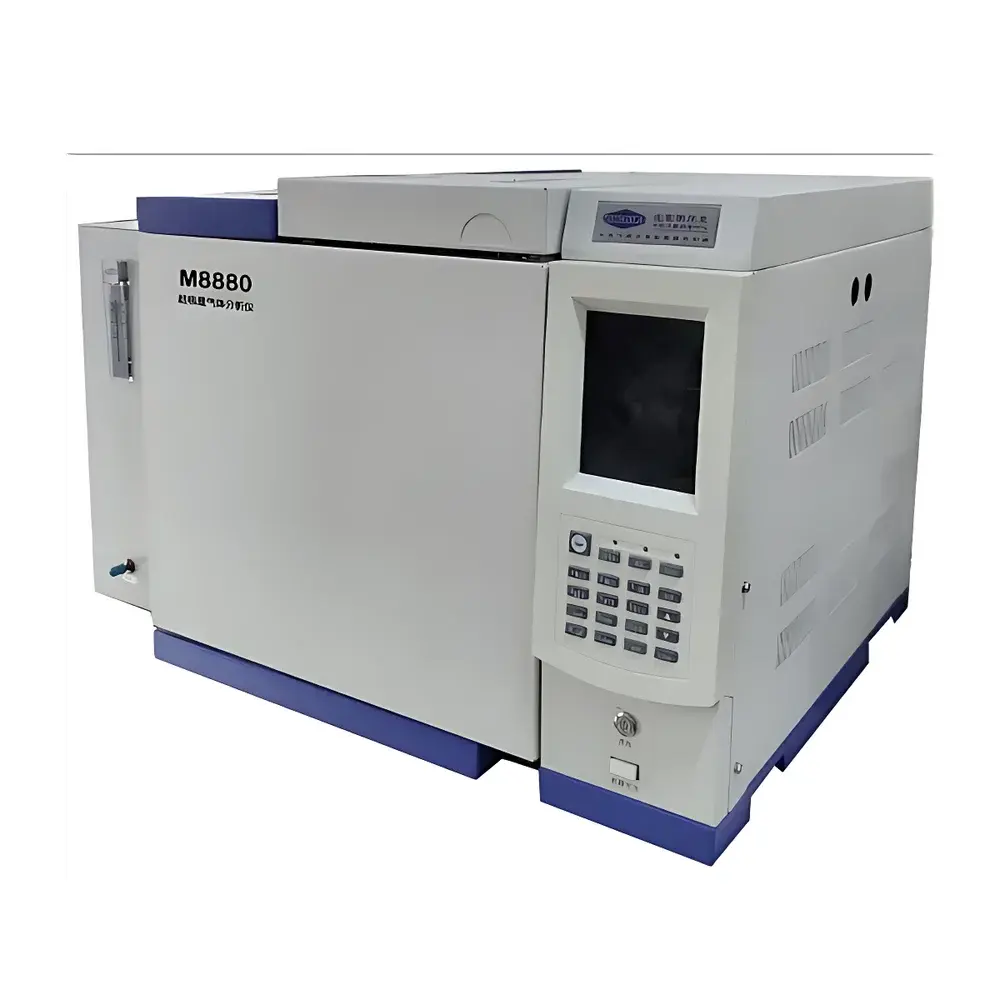
MNK M8880 Ultra-Trace Gas Analyzer
| Brand | MNK |
|---|---|
| Origin | Beijing, China |
| Model | M8880 |
| Instrument Type | Laboratory Gas Chromatograph |
| Application | High-Purity Gas Analysis |
| Carrier Gas Options | Single selectable gas (e.g., He, H₂, or Ar) |
| Dual-Detector Configuration | PDHID + TCD |
| Independent Temperature Zones | 8 |
| Oven Programmed Ramps | 20-step |
| Back-Flush & Heart-Cut Capability | Integrated |
| Detection Limits (v/v) | PDHID — H₂: 0.06 µL/L, CH₄: 0.08 µL/L, CO: 0.08 µL/L, C₂H₆: 0.01 µL/L, CO₂: 0.09 µL/L, C₂H₄: 0.01 µL/L, C₂H₂: 0.01 µL/L, C₃H₈: 0.01 µL/L, H₂S: 0.01 µL/L, C₃H₆: 0.01 µL/L, SO₂: 0.23 µL/L |
| TCD — O₂ | 49 µL/L, N₂: 70 µL/L |
| PDHID Specifications | Pulsed Discharge Helium Ionization Detector |
| TCD Specifications | Baseline Noise ≤ 20 µV |
Overview
The MNK M8880 Ultra-Trace Gas Analyzer is a dedicated laboratory-scale gas chromatograph engineered for high-sensitivity, multi-component quantification in ultra-high-purity process gases and specialty gas streams. Built upon a robust dual-detector architecture—integrating a pulsed discharge helium ionization detector (PDHID) and a thermal conductivity detector (TCD)—the system delivers simultaneous detection of permanent gases, hydrocarbons, sulfur compounds, and reactive impurities at sub-ppb (µL/L) levels. Its core analytical principle relies on high-resolution capillary or packed column separation coupled with selective, stable detection mechanisms optimized for trace-level speciation in inert matrices such as electronic-grade nitrogen, argon, hydrogen, helium, and synthesis gas. Designed specifically for compliance-critical environments—including petrochemical refineries, coal chemical plants, semiconductor gas supply facilities, and high-purity gas manufacturing—the M8880 meets foundational requirements for ISO 8573-1 (compressed air purity), ASTM D1946 (analysis of reformed gas), and IEC 60567 (dissolved gas analysis in insulating oil), while supporting audit-ready data handling per GLP and GMP frameworks.
Key Features
- Dual parallel detection path: PDHID for ultra-trace hydrocarbons, H₂, CO, H₂S, and C₂–C₃ species; TCD for major permanent gases (O₂, N₂) with independent signal processing.
- Eight independently controlled temperature zones—including oven, inlet valves, detectors, and transfer lines—enabling precise thermal management across complex multi-column configurations.
- 20-stage programmable temperature ramping with ramp rates up to 40 °C/min, facilitating sharp elution and baseline resolution of co-eluting impurities in high-boiling matrices.
- Integrated back-flush and heart-cut (center-cut) valving system, allowing automated column switching, peak refocusing, and removal of early-eluting solvents or air without manual intervention.
- Modular column compartment accommodating up to four columns (e.g., molecular sieve 5A, Porapak Q, Hayesep D, and Al₂O₃/KCl) for customizable separation schemes targeting specific impurity profiles.
- Helium-based PDHID operation with pulse-controlled discharge source ensures long-term stability, low background noise (<0.1 mV), and minimal maintenance intervals—critical for unattended 24/7 operation in QC labs.
Sample Compatibility & Compliance
The M8880 accepts pressurized gas samples delivered via standardized stainless-steel sampling loops (0.25–2.0 mL) or direct line injection from regulated cylinder manifolds. It supports analysis of gaseous matrices containing ≤ 10% total hydrocarbon content and accommodates moisture-laden or mildly corrosive streams when equipped with deactivated flow paths and sulfur-resistant components. All hardware materials comply with ASTM E260 and ISO/IEC 17025 calibration traceability requirements. The system’s detection limit performance has been validated against NIST-traceable gas standards (e.g., Scott-Marrin Certi-Gas® blends) and conforms to USP residual solvent methodology for pharmaceutical excipient gases. Data integrity controls—including electronic signatures, user access levels, and audit trail logging—are implemented to align with FDA 21 CFR Part 11 expectations for regulated laboratories.
Software & Data Management
The proprietary MNK ChromoView™ workstation provides full instrument control, real-time chromatogram visualization, peak integration using tangent skim and valley-to-valley algorithms, and automated calibration curve generation (linear, quadratic, or weighted least-squares). Raw data files are stored in vendor-neutral .cdf format (compatible with OpenChrom and Chromeleon), while report outputs support PDF, CSV, and XML export with configurable templates. The software includes embedded safety logic: automatic calculation of methane–air–oxygen flammability triangle coordinates per ASTM E681, triggering visual alerts when sample composition enters explosive limits. All method parameters, sequence logs, and detector diagnostics are time-stamped and archived with SHA-256 hash verification to ensure forensic reproducibility.
Applications
- Quality assurance of electronic specialty gases (e.g., dopant gases, etchant precursors) per SEMI F63 specifications.
- Monitoring trace impurities (CO, CO₂, H₂O, O₂, hydrocarbons) in hydrogen fuel cell feedstock per ISO 8573-8 and SAE J2719.
- Residual catalyst poison screening (e.g., H₂S, COS, NH₃) in syngas purification units and Fischer–Tropsch reactors.
- Leak detection and purity certification of ultra-high-purity argon and nitrogen used in optical fiber preform fabrication.
- Quantitative profiling of light hydrocarbons (C₁–C₄) and unsaturates (C₂H₄, C₂H₂) in refinery off-gas and flare monitoring systems.
FAQ
What carrier gases are compatible with the PDHID configuration?
Helium is the standard and recommended carrier gas for optimal PDHID sensitivity and stability; hydrogen and argon may be used under validated method conditions but require recalibration and reduced dynamic range.
Can the M8880 perform unattended overnight analysis?
Yes—the system supports scheduled run sequences, auto-zero routines, and thermal stabilization checks, enabling fully autonomous operation for up to 72 hours with appropriate gas supply and cooling management.
Is method transfer possible from legacy GC platforms?
Column dimensions, temperature programs, and detector settings can be migrated directly; however, PDHID response factors must be empirically re-established due to detector-specific ionization efficiency.
Does the instrument support remote diagnostics and firmware updates?
Remote access is enabled via secure TLS-encrypted VNC connection; firmware updates are distributed as signed binary packages with rollback capability and version-controlled changelogs.
How is detector performance verified during routine operation?
Built-in diagnostic routines monitor discharge current stability, baseline drift trends, and reference peak retention time shifts; users may initiate daily sensitivity checks using certified 100 ppb CH₄-in-N₂ standard.





