
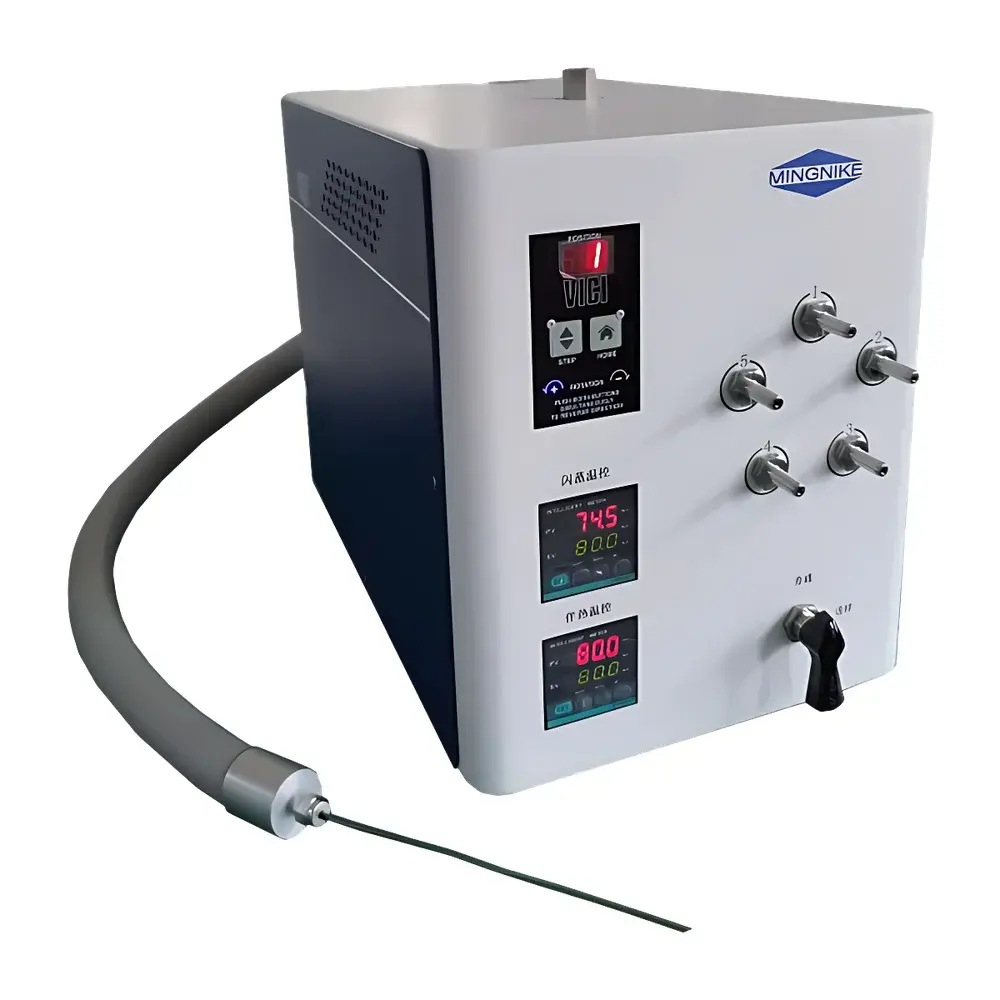
MNK MQY301 Multi-Channel Automated Flash-Vaporization Sample Introduction System
| Brand | MNK |
|---|---|
| Model | MQY301 |
| Origin | Beijing, China |
| Configuration | 5-channel gas bag sampler + 1-channel liquid flash-vaporization inlet |
| Dimensions (W×D×H) | 400 × 255 × 300 mm |
| Net Weight | 15 kg |
| Power Supply | 220 V, 50 Hz |
| Power Consumption | 300 W |
| Maximum Flash-Vaporization & Jacket Temperature | 230 °C |
| Temperature Control Accuracy | ±0.1 °C |
| Liquid Injection Pressure Range | 100–400 psi |
| Sample Transfer Line | Passivated stainless steel |
| Interface Options | AUX trigger, touch control, GC instrument control port |
| Inlet Valve | Integrated 6-position gas sampling valve with quantitative loop |
Overview
The MNK MQY301 Multi-Channel Automated Flash-Vaporization Sample Introduction System is an engineered solution for high-throughput, reproducible sample introduction into gas chromatography (GC) platforms. Designed specifically for laboratories performing routine analysis of volatile organic compounds (VOCs) and light hydrocarbons in complex gaseous or liquid matrices, the system integrates two complementary sampling modalities: (1) automated, sequential gas-phase introduction from up to five pre-collected Tedlar® or FlexFoil® gas bags; and (2) controlled flash-vaporization of liquid hydrocarbon samples (C1–C5) prior to GC injection. The core principle relies on precise pneumatic actuation of a six-port, motor-driven sampling valve—where gas samples are loaded under vacuum into a calibrated internal loop, then transferred to the GC inlet via rotary valve switching. For liquid samples, a metered micro-volume is introduced into a thermally regulated vaporization chamber; rapid phase transition generates transient overpressure sufficient to drive vaporized analytes directly into the GC column without auxiliary carrier gas assistance. This dual-path architecture eliminates manual handling, minimizes adsorption losses, and ensures consistent residence time and thermal history across replicate injections.
Key Features
- Simultaneous support for five independent gas bag inlets plus one dedicated liquid flash-vaporization channel—enabling unattended batch analysis of heterogeneous sample types.
- Integrated 6-position sampling valve with factory-calibrated quantitative loops; designed for long-term stability and minimal carryover between injections.
- Independent dual-zone temperature control: flash-vaporization zone and sample transfer line jacketing—both adjustable from ambient to 230 °C with ±0.1 °C stability, ensuring complete volatilization of C1–C5 species and prevention of condensation in transit.
- Passivated stainless-steel fluidic path (electropolished and silanized), validated for low-level sulfur compound and reactive VOC analysis, minimizing surface adsorption and catalytic degradation.
- Programmable pressure-assisted liquid injection (100–400 psi), compatible with standard GC autosampler syringe ports or direct connection to pressurized liquid handling modules.
- Native hardware-level synchronization with major GC platforms—including Agilent, Thermo Fisher Scientific, PerkinElmer, and Shimadzu—via AUX trigger, TTL signal, or Ethernet-based instrument control protocols.
Sample Compatibility & Compliance
The MQY301 accommodates a broad range of environmental and industrial sample matrices: ambient air, stack emissions, cooling tower exhaust, tobacco smoke condensates, soil vapor extracts, refinery off-gas streams, and liquefied petroleum gas (LPG) fractions. Its design adheres to analytical workflows aligned with ASTM D5504 (sulfur compounds in natural gas), EPA TO-14/TO-15 (ambient VOCs), and ISO 16017-1 (indoor air VOCs). All thermal zones meet IEC 61010-1 safety requirements for laboratory equipment. Data acquisition and sequence execution comply with GLP and GMP documentation standards when paired with 21 CFR Part 11–enabled chromatography data systems (CDS), supporting audit trails, electronic signatures, and user-access controls.
Software & Data Management
The system operates via MNK’s proprietary control software, deployable on Windows-based host PCs. It supports both standalone operation and deep integration with third-party CDS platforms (e.g., OpenLab CDS, Chromeleon, Empower). Users define multi-step sequences—including gas bag selection order, loop fill time, valve actuation delay, flash temperature ramp profiles, and GC start triggers—with full logging of all setpoints, actual temperatures, pressure readings, and valve position timestamps. Raw instrument logs are exportable in CSV and XML formats for traceability. Remote monitoring and diagnostic access are available via secure TCP/IP interface, facilitating centralized lab management across distributed GC networks.
Applications
- Regulatory compliance testing for ambient air VOCs under national air quality monitoring programs.
- Process gas analysis in petrochemical facilities—monitoring ethylene, propylene, butadiene, and isobutane in real-time QC workflows.
- Soil vapor intrusion assessment using passive or active soil gas sampling followed by automated GC-FID/TCD analysis.
- Tobacco smoke characterization, including carbonyl compounds and volatile alkaloids, where reproducible flash-vaporization prevents thermal decomposition.
- Calibration standard delivery for dynamic dilution systems requiring precise, pulse-free vapor generation from liquid surrogates.
FAQ
Can the MQY301 be integrated with GC systems not listed in the specification?
Yes—the AUX trigger interface and open communication protocol allow customization for OEM GC instruments upon provision of timing diagrams and electrical specifications.
Is the quantitative loop volume fixed or configurable?
Standard configurations include 1 mL and 5 mL loops; custom loop volumes (0.25–10 mL) are available as factory options with NIST-traceable calibration certificates.
Does the system support unattended overnight operation?
Fully supported—hardware watchdog timers, automatic fault recovery, and sequence resume-after-interruption logic ensure robust 24/7 operation in regulated environments.
How is carryover mitigated during high-concentration gas bag analysis?
The system implements programmable purge cycles (using carrier gas or zero air) between injections, with optional heated purge lines to eliminate residual condensables.
What validation documentation is provided with the instrument?
Each unit ships with Factory Acceptance Test (FAT) report, temperature uniformity mapping data, valve timing verification log, and passivation certificate per ASTM A967.




