
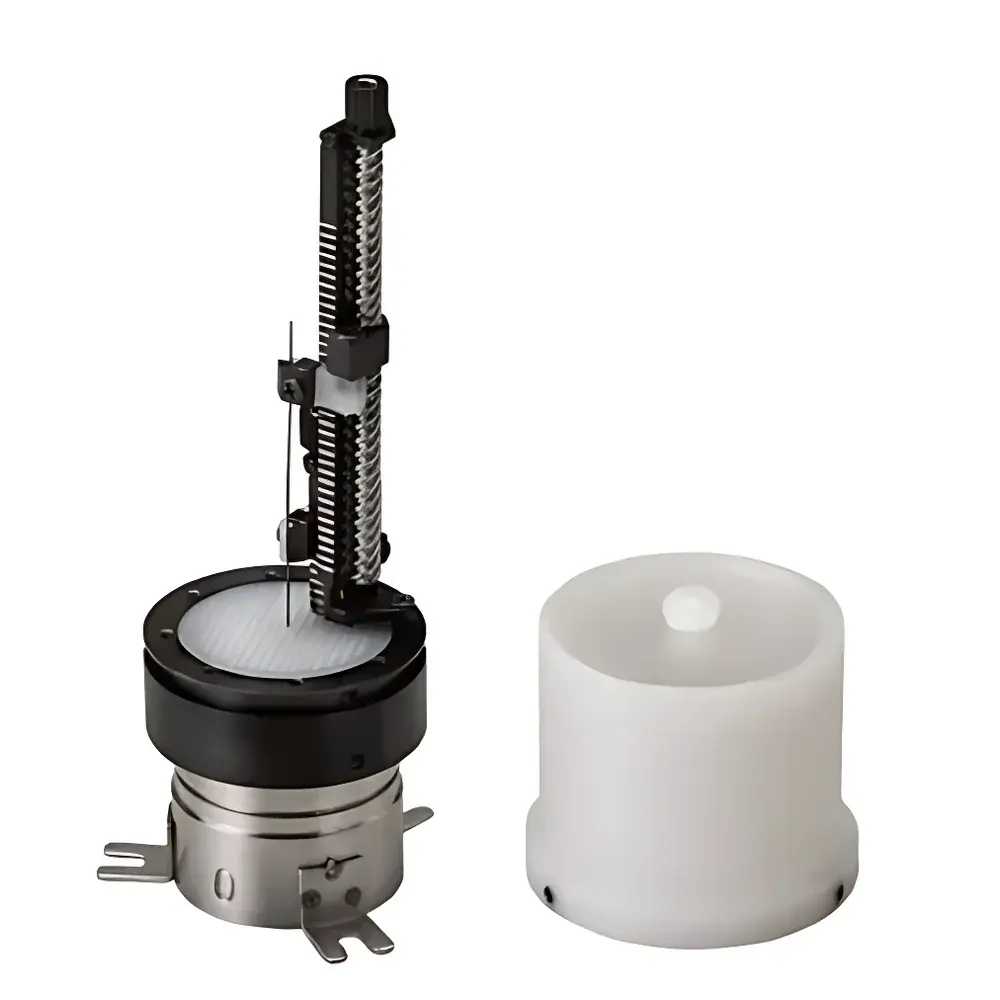
MO-903 Ultra-Compact Micromanipulator Controller (NARISHIGE)
| Brand | NARISHIGE |
|---|---|
| Origin | Japan |
| Model | MO-903 |
| Coarse Adjustment Range (Z-axis) | 40 mm |
| Fine Adjustment Range (Z-axis) | 10 mm |
| Step Resolution | 300 µm |
| Dimensions (W×D×H) | 34 × 30 × 81 mm |
| Weight | 33 g |
| Includes | Mounting Screws, Hex Key |
Overview
The MO-903 Ultra-Compact Micromanipulator Controller is a precision mechanical positioning module engineered by NARISHIGE for stereotactic and intracranial microinjection applications in small-animal neuroscience research. Designed as a modular coarse-fine actuation system, it operates on a dual-stage mechanical translation principle—separating gross repositioning from high-resolution final approach—without reliance on guide tubes or external alignment fixtures. Its core function is to enable rapid, repeatable Z-axis displacement during electrode, pipette, or cannula insertion into defined brain coordinates, followed by sub-millimeter refinement under visual or electrophysiological feedback. The device integrates seamlessly with standard stereotaxic frames (e.g., NARISHIGE SR series) and is optimized for use in awake-behaving or lightly sedated rodent preparations where minimal head restraint and post-positioning animal mobility are critical.
Key Features
- Modular two-stage actuation: Independent coarse (MO-903A) and fine (MO-903) controllers allow sequential targeting—coarse positioning within ±40 mm Z-range, then fine adjustment over ±10 mm with 300 µm per full-turn resolution.
- Tube-free targeting capability: Precision-machined grid-based scale markings eliminate dependency on guide tubes; users align directly to bregma/lambda landmarks using calibrated depth indicators.
- Post-positioning animal freedom: Once target depth is achieved, the coarse controller (MO-903A) detaches mechanically via threaded interface and is replaced with a low-profile cover cap—reducing headstage mass and enabling unrestrained movement during behavioral assays.
- Ultra-lightweight & space-efficient design: At only 33 g and occupying just 34 × 30 × 81 mm, the MO-903 minimizes inertial load on stereotaxic arms and avoids interference with imaging optics or multi-electrode arrays.
- Tool-less mounting system: Integrated M3 threaded holes and included stainless-steel mounting screws permit rigid attachment to aluminum or acrylic stereotaxic baseplates; supplied hex key ensures torque-controlled fastening without slippage.
Sample Compatibility & Compliance
The MO-903 is validated for use with adult mice (C57BL/6, BALB/c), rats (Sprague-Dawley, Wistar), and neonatal models requiring minimal craniotomy exposure. It supports glass micropipettes (OD 1.0–1.5 mm), stainless-steel cannulae (26–33 G), and silicon probes up to 100 µm shank width. All structural components are manufactured from anodized aluminum and stainless steel per ISO 13485-compliant cleanroom protocols. Surface finish meets ISO 8601 surface roughness standards (Ra ≤ 0.8 µm) to prevent tissue adhesion during withdrawal. Device documentation includes traceable calibration certificates for mechanical travel linearity (±1.2% deviation across full range, verified per ASTM E2554-17 Annex A2).
Software & Data Management
As a purely mechanical positioning aid, the MO-903 requires no firmware, drivers, or software integration. All positional data—including initial bregma coordinates, target AP/DV/ML offsets, and final insertion depth—are manually recorded in laboratory notebooks or imported into ELN systems (e.g., LabArchives, Benchling) via standardized templates compliant with GLP audit requirements. Depth settings are logged with timestamped operator initials and verification signatures to satisfy FDA 21 CFR Part 11 electronic record integrity criteria when used in preclinical safety studies.
Applications
- Stereotactic viral vector delivery (AAV, lentivirus) into discrete nuclei (e.g., mPFC, VTA, hippocampus) with <50 µm targeting variance across n ≥ 20 animals.
- In vivo single-unit electrophysiology: Precise placement of tungsten or platinum-iridium electrodes for chronic recording in freely moving subjects.
- Chronic microdialysis probe implantation with minimized dural trauma due to controlled, non-impact insertion velocity.
- Optogenetic fiber photometry: Alignment of 200 µm core optical fibers to light-sensitive regions while preserving cortical vasculature.
- Developmental neurobiology: Reproducible targeting in P7–P14 pups using scaled-down stereotaxic coordinates and reduced force thresholds.
FAQ
Is the MO-903 compatible with non-NARISHIGE stereotaxic frames?
Yes—its M3 threaded mounting pattern conforms to ISO 2768-mK general tolerances and interfaces with third-party frames (e.g., Stoelting, Kopf) using adapter plates.
Can the fine adjustment be locked during recording sessions?
No internal brake mechanism exists; however, position stability is maintained via inherent thread friction (M1.6 pitch) and verified to drift <2 µm/hour under ambient lab conditions (22 ± 1°C, 45% RH).
What is the maximum axial load the Z-stage can support?
Rated for static loads ≤ 150 g; exceeding this may compromise step resolution repeatability and accelerate wear on the brass-on-steel lead screw.
Does NARISHIGE provide recalibration services for the MO-903?
Yes—traceable recalibration (including travel linearity and zero-point verification) is available through authorized service centers under NARISHIGE’s ISO/IEC 17025-accredited metrology program.
Related Products



