
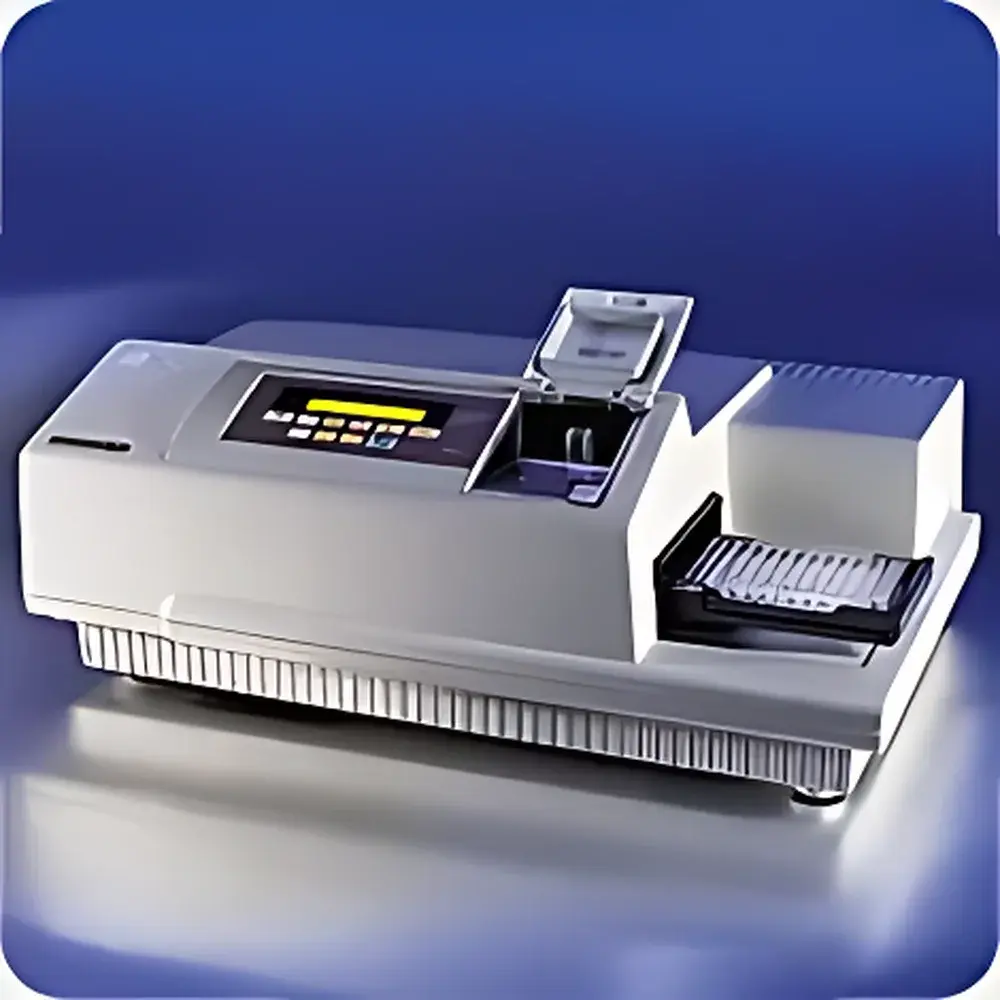
Molecular Devices SpectraMax M2/M2e Multimode Microplate Reader
| Brand | Molecular Devices |
|---|---|
| Origin | USA |
| Manufacturer Type | Original Equipment Manufacturer (OEM) |
| Origin Category | Imported Instrument |
| Model | SpectraMax M2 |
| Functionality | Multimode |
| Automation Level | Fully Automated |
| Assay Modes | Endpoint, Kinetic, Full-Wavelength Scan, Single-Well Scan |
| Curve Fitting | SoftMax Pro Software (Comprehensive Nonlinear Regression Library) |
| Detector Type | Photomultiplier Tube (PMT) |
| Wavelength Range | 250–850 nm |
| Absorbance Range | 0–4 OD |
| Absorbance Linearity | 0–3 OD |
| Plate Read Time | 18 sec per 96-well plate |
| Absorbance Precision | < ±0.005 OD |
Overview
The Molecular Devices SpectraMax M2/M2e Multimode Microplate Reader is an engineered platform for quantitative and qualitative analysis of biological and biochemical assays in microplate formats. Based on dual-grating monochromator optics and high-gain photomultiplier tube (PMT) detection, it supports absorbance (UV/Vis), fluorescence intensity (FI), and—on the M2e variant—top- and bottom-read configurations for heterogeneous assays. Its optical architecture enables continuous wavelength selection from 250 to 850 nm (with extended capability up to 1000 nm in absorbance mode), eliminating dependence on fixed-wavelength filters and enabling method flexibility across diverse assay chemistries. The instrument is designed for reproducible, traceable measurements in regulated environments and integrates seamlessly into laboratory workflows requiring compliance with GLP, GMP, and FDA 21 CFR Part 11 standards.
Key Features
- Dual-grating monochromator system: Enables independent optimization of excitation and emission wavelengths in fluorescence mode; supports 1-nm wavelength resolution and full-spectrum scanning (250–850 nm).
- PathCheck Sensor technology: Measures actual sample height in each well and automatically converts measured absorbance to equivalent 1-cm pathlength values—enabling direct concentration calculation for analytes with known extinction coefficients without standard curve generation.
- Temperature-controlled sample chamber: Utilizes virtual lid thermal regulation for precise incubation control (ambient to 45 °C), critical for kinetic enzyme assays and cell-based measurements.
- Universal microplate compatibility: Supports 6-, 12-, 24-, 48-, 96-, and 384-well plates—including flat-bottom, round-bottom, and V-bottom configurations—with consistent performance across well geometries.
- Integrated cuvette port: Dual-mode cuvette slot accommodates both standard 1-cm pathlength cuvettes and specialized low-volume formats, expanding utility beyond microplate-only applications.
- SoftMax Pro software suite: Provides real-time data acquisition, multi-plate comparative analysis, customizable protocol scripting, and built-in statistical validation tools—including outlier detection, coefficient of variation (CV) reporting, and plate uniformity metrics.
Sample Compatibility & Compliance
The SpectraMax M2/M2e accepts a broad spectrum of assay chemistries, including colorimetric (e.g., Bradford, BCA), fluorometric (e.g., PicoGreen, NanoOrange, Caspase-3 substrates), and luminescent assays (via optional upgrade). It supports both homogeneous (solution-phase) and heterogeneous (solid-phase, e.g., ELISA) formats. Regulatory compliance is facilitated through IQ/OQ documentation packages, SpectraTest ABS1 and FL1 optical verification kits, and SoftMax Pro software validation modules aligned with FDA 21 CFR Part 11 requirements—including electronic signature support, audit trail logging, and user-access controls. All calibration and verification procedures are traceable to NIST-traceable reference standards.
Software & Data Management
SoftMax Pro 7+ serves as the native acquisition and analysis engine, supporting automated data export to LIMS, ELN, and statistical platforms via ODBC and XML protocols. The software includes over 30 preconfigured assay templates, nonlinear regression models (four-parameter logistic, exponential decay, Michaelis-Menten), and batch-processing capabilities for multi-plate studies. Raw spectral data, kinetic traces, and plate heatmaps are stored in vendor-neutral .smx files with embedded metadata (instrument ID, operator, timestamp, protocol version). Audit trails record all parameter changes, data modifications, and user logins—ensuring full ALCOA+ (Attributable, Legible, Contemporaneous, Original, Accurate, Complete, Consistent, Enduring, Available) compliance.
Applications
- Nucleic acid and protein quantification and purity assessment (A260/A280, A260/A230 ratios)
- Enzyme-linked immunosorbent assays (ELISA) and immunoassays requiring high sensitivity and low background
- Enzyme kinetics (Km, Vmax, IC50, Ki) under controlled thermal conditions
- Cell viability, cytotoxicity, and apoptosis assays (e.g., MTT, LDH, Caspase-3/7)
- cAMP and second-messenger signaling studies using CatchPoint and HTRF-compatible reagents
- Ultra-low-volume nucleic acid and protein analysis using SpectraDrop microvolume plates (2–4 µL per well, 24- or 64-well format)
- High-throughput screening (HTS) workflow integration via StakMax stacker and third-party robotic arms (Tecan, Hamilton, Agilent)
FAQ
What is the difference between the SpectraMax M2 and M2e models?
The M2e adds top- and bottom-reading capability for fluorescence and luminescence assays, enabling optimal signal detection in cell-based and membrane-bound assays where orientation affects signal yield.
Does the instrument support kinetic measurements with temperature control?
Yes—the integrated thermal regulation system maintains stable incubation from ambient to 45 °C during kinetic runs, with ramp-rate control and dwell-time programming.
Can I validate optical performance in-house?
Yes—SpectraTest ABS1 (absorbance) and FL1 (fluorescence) verification kits provide automated, software-guided calibration and performance verification against NIST-traceable references.
Is SoftMax Pro compliant with FDA 21 CFR Part 11?
Yes—when deployed with enabled audit trail, electronic signatures, and role-based access controls, SoftMax Pro meets core Part 11 requirements for electronic records and signatures in regulated laboratories.
How does PathCheck improve quantitative accuracy in absorbance assays?
PathCheck eliminates pathlength variability by measuring actual liquid height in each well and mathematically normalizing absorbance to a 1-cm equivalent—reducing inter-well CVs and enabling direct concentration calculation without empirical calibration curves.



