
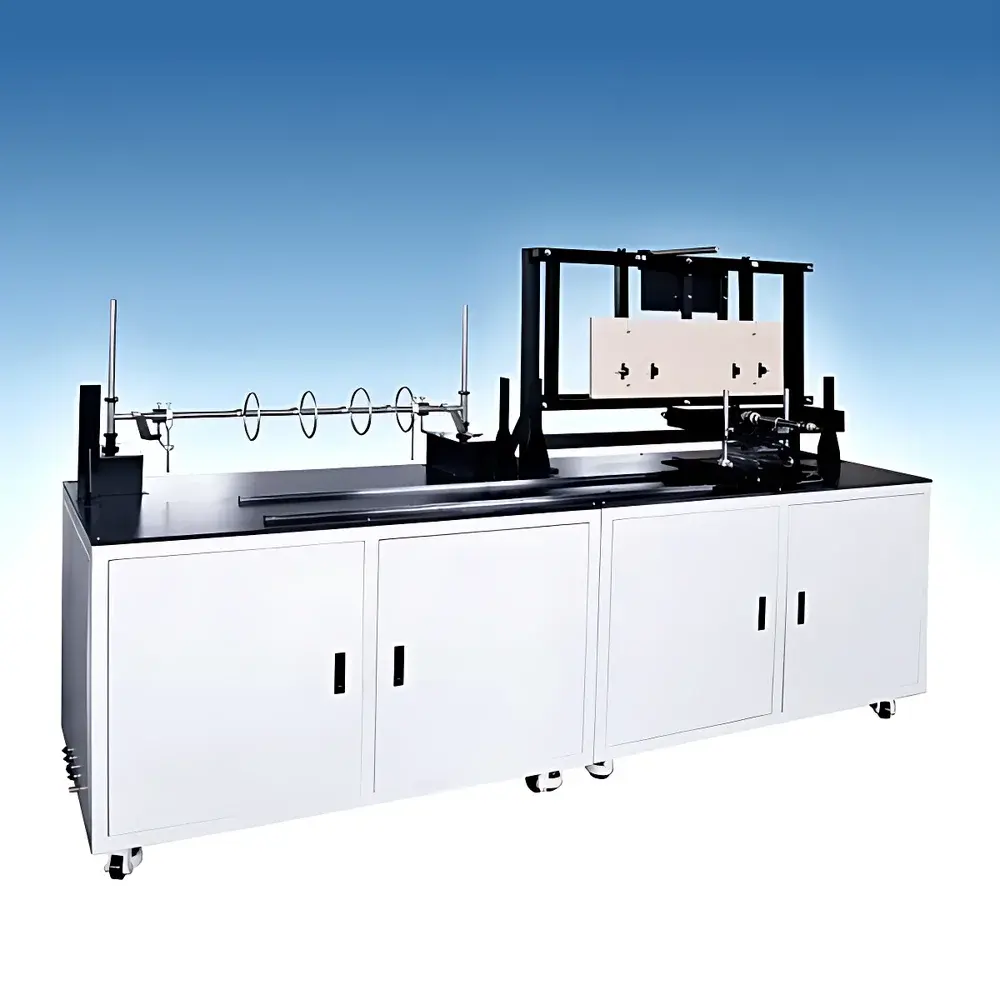
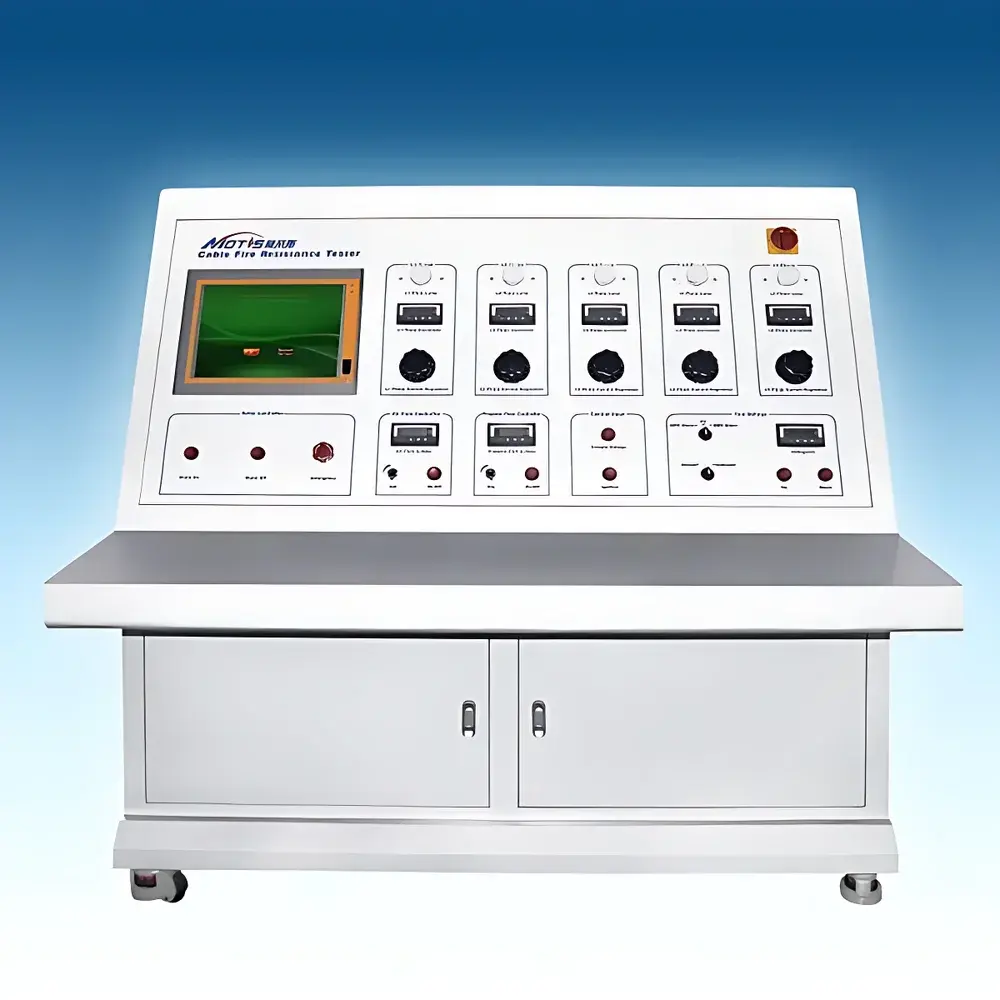
MOTIS CFMT Fire Resistance Impact Tester for Cables
| Brand | MOTIS |
|---|---|
| Model | CFMT |
| Application | Fire resistance testing of power and communication cables up to 0.6/1.0 kV |
| Compliance | GB/T 19216.11 (equivalent to IEC 60331-11) |
| Ignition Source | AGF propane ribbon burner (500 mm length, 15 mm nominal width, triple-row 1.32 mm diameter orifices, ±5% tolerance) |
| Support Fixture | Two grounded 150 mm ID metal rings spaced 300 mm apart, fabricated from 10 ± 2 mm diameter rod |
| Temperature Calibration | Omega 1.5 mm sheathed thermocouple |
| Gas Control | Imported mass flow controllers (accuracy ≥ ±1.5%), pressure regulator (0.1 MPa ± 3 Pa), 0–200 kPa pressure gauge |
| Electrical Monitoring | 0.25 A test current (resolution 0.001 A), programmable voltage (0.6/1.0 kV range), D-II type 2 A fuses per GB 13539.5, miniature circuit breakers |
| Data Acquisition | Real-time digital logging of voltage/current vs. time, automated flame stability control via Venturi-mixed propane/air, pass/fail判定 based on circuit integrity continuity |
| Software | Standards-compliant test configuration (IEC/GB selection), automatic report generation with audit-trail metadata, calibration traceability (≥10 min stabilized thermocouple sampling), GLP-aligned database storage |
Overview
The MOTIS CFMT Fire Resistance Impact Tester is an engineered solution for evaluating the circuit integrity of low-voltage power and communication cables under severe fire conditions—specifically, exposure to flames at 750 °C or 950 °C for prescribed durations per GB/T 19216.11 (technically aligned with IEC 60331-11). Unlike generic combustion chambers, this system integrates calibrated thermal exposure, real-time electrical continuity monitoring, and metrologically traceable gas flow control into a single validated platform. Its core principle is to subject cable specimens to standardized flame impingement while maintaining rated voltage across all conductors, continuously measuring current flow to determine whether the circuit remains functional—i.e., whether insulation and sheath materials retain sufficient structural and dielectric integrity to prevent open-circuit failure during and after fire exposure. The apparatus does not assess flame spread or smoke toxicity; rather, it quantifies functional survivability—the critical performance criterion for emergency circuits in fire alarm systems, emergency lighting, and life-safety infrastructure.
Key Features
- AGF-certified propane ribbon burner with precise geometric specifications: 500 mm active length, 15 mm nominal width, and three staggered rows of 1.32 mm-diameter orifices (±5% dimensional tolerance), ensuring reproducible flame geometry and heat flux distribution.
- Dual-point thermal calibration using imported Omega 1.5 mm sheathed thermocouples, with automated 10-minute stabilization and statistical averaging in software to generate auditable calibration reports compliant with ISO/IEC 17025 documentation requirements.
- Mass flow-controlled propane and auxiliary air delivery, mixed via Venturi injector and regulated by high-accuracy (±1.5%) flow controllers—enabling dynamic stoichiometric optimization for flame temperature stability and repeatability across test cycles.
- Electrically grounded mechanical support system: two 150 mm internal diameter metal rings spaced exactly 300 mm apart, constructed from 10 ± 2 mm diameter stainless steel rods, ensuring consistent specimen alignment and eliminating thermal bridging artifacts.
- Integrated continuity monitoring subsystem: programmable 0.25 A test current (0.001 A resolution), digitally adjustable voltage source (0.6/1.0 kV range), D-II type 2 A fuses per GB 13539.5, and redundant miniature circuit breakers for each conductor path.
- Real-time data acquisition architecture: synchronized logging of voltage, current, gas flow rates, and thermocouple temperatures at ≥10 Hz, stored in timestamped, immutable database records with full audit trail for GLP/GMP compliance.
Sample Compatibility & Compliance
The CFMT accommodates single-core and multi-core cables rated ≤0.6/1.0 kV, including PVC, XLPE, EPR, and mineral-insulated types. Specimens are mounted horizontally with one end clamped and the mid-span supported as specified in GB/T 19216.11 Clause 6.2. The system fully implements the mechanical impact requirement of IEC 60331-23 (where applicable) when paired with optional impact hammer modules. All electrical safety components—including fuse holders, terminal blocks, and isolation relays—conform to IEC 61000-4 series EMC standards and UL 508 industrial control equipment requirements. Flame temperature validation procedures satisfy the measurement uncertainty thresholds defined in ISO 13943 for fire testing instrumentation.
Software & Data Management
The embedded Windows-based application supports pre-test configuration of laboratory ID, operator credentials, cable construction details (conductor count, diameter, insulation type), and selection among GB/T 19216.11, IEC 60331-11, or custom protocols. During operation, the software displays live curves of conductor current versus time, superimposed with reference thresholds for pass/fail evaluation. Post-test, it auto-generates PDF reports containing raw data tables, annotated voltage/current decay plots, calibration certificates, gas flow logs, and flame temperature stability metrics—all digitally signed and archived with SHA-256 hash verification. Audit trails comply with FDA 21 CFR Part 11 requirements for electronic records and signatures, including user-level access controls and immutable change logs.
Applications
This tester is deployed in third-party certification laboratories (e.g., CNAS-accredited facilities), cable manufacturers’ R&D centers, and national quality supervision institutes for type approval testing under CCC, CE, and UKCA frameworks. Typical use cases include qualification of fire-resistive cables for subway signaling systems, hospital emergency power feeds, nuclear plant instrumentation loops, and high-rise building evacuation lighting circuits. It also supports failure mode analysis—e.g., correlating current interruption timing with char depth measurements or post-test insulation resistance degradation—to inform material formulation improvements.
FAQ
What standards does the CFMT directly implement?
It is configured to execute GB/T 19216.11 (identical technical content to IEC 60331-11) for fire resistance without mechanical shock. Optional add-ons enable IEC 60331-23 (with impact) and BS 6387 CWZ protocols.
Can the system validate flame temperature per IEC 60331 Annex B?
Yes—its dual thermocouple setup, 10-minute stabilization routine, and automated deviation reporting meet all procedural and documentation requirements of IEC 60331 Annex B.
Is remote monitoring or integration with LIMS possible?
The software exposes OPC UA and RESTful API endpoints for bidirectional data exchange with laboratory information management systems (LIMS) and SCADA platforms.
What maintenance intervals are recommended for gas train components?
Mass flow controllers require annual recalibration against NIST-traceable standards; pressure regulators and gauges should be verified every six months per ISO 5167 maintenance guidelines.
Does the system support multi-cable parallel testing?
No—it evaluates one cable specimen per test cycle to ensure unambiguous attribution of failure events and thermal boundary condition consistency.



