
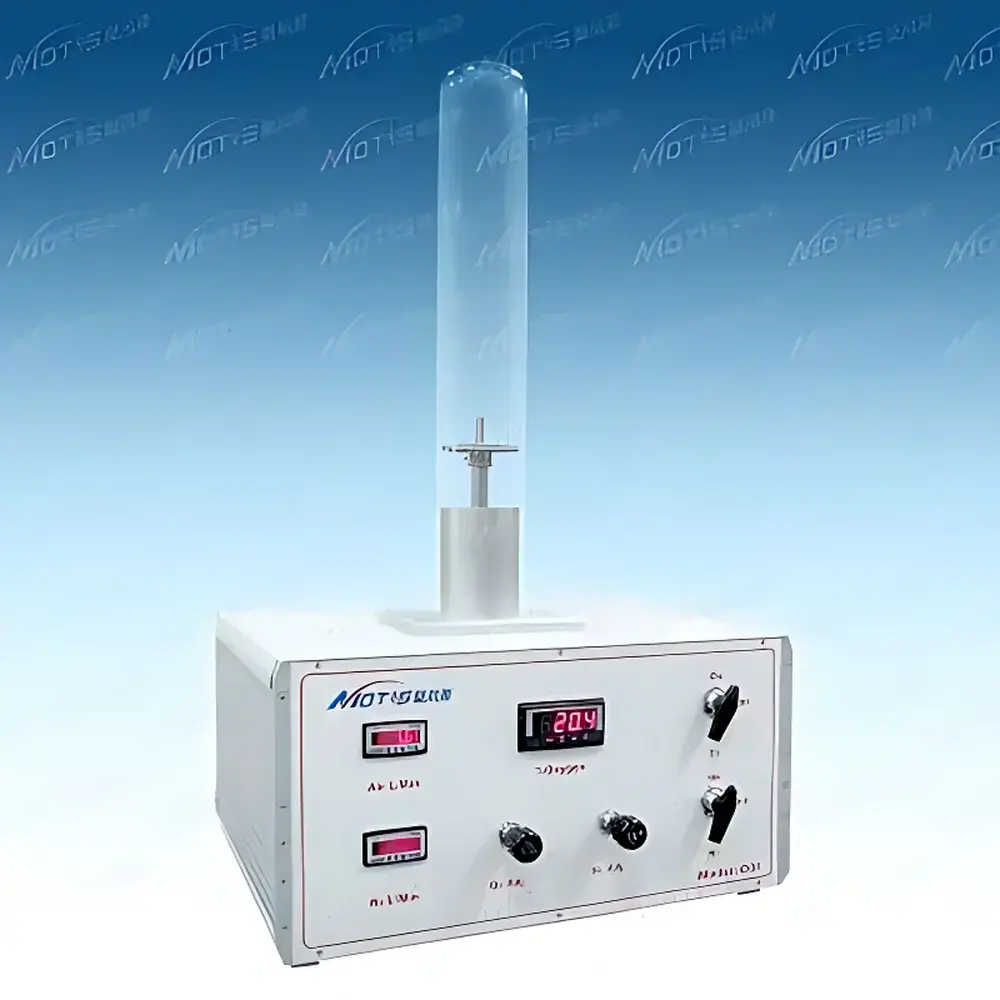
MOTIS COI Oxygen Index Tester
| Brand | MOTIS |
|---|---|
| Model | COI |
| Origin | Jiangsu, China |
| Instrument Type | Oxygen Index Tester |
| Compliance | ISO 4589-2 |
| Gas Flow Control | Digital Mass Flow Meters (O₂ & N₂) |
| Total Gas Flow | 10.6 L/min ± 0.1 L/min |
| O₂ Concentration Resolution | 0.1 vol% |
| O₂ Sensor Type | Ultrasonic |
| Combustion Tube | High-Temperature Quartz Glass |
| Ignition System | Adjustable Flame Gas Igniter |
| Sample Holder | Dual Fixture (Self-Supporting & Non-Self-Supporting) |
Overview
The MOTIS COI Oxygen Index Tester is a precision benchtop instrument engineered for the quantitative determination of the limiting oxygen index (LOI) of solid polymeric materials, textiles, foams, and composites in accordance with ISO 4589-2. LOI is defined as the minimum volume percentage of oxygen, in a mixture of oxygen and nitrogen, required to support candle-like combustion of a vertically oriented specimen under specified laboratory conditions. This test provides a reproducible, comparative metric for assessing relative flame resistance — higher LOI values indicate greater inherent flame retardancy, while lower values correlate with increased ignitability and flammability risk. The COI employs a controlled laminar flow of premixed O₂/N₂ gas through a high-purity quartz combustion tube, ensuring thermal stability up to 800 °C and optical clarity for unobstructed visual observation of flame propagation, char formation, and extinction behavior. Unlike calorimetric or heat-release-based methods, LOI testing isolates the chemical threshold of sustained combustion, making it a foundational screening tool in material safety qualification, regulatory compliance, and fire hazard modeling.
Key Features
- Ultrasonic oxygen concentration sensor with >5-year operational lifespan, eliminating routine calibration drift and electrode replacement associated with electrochemical sensors
- Dual digital mass flow controllers (MFCs) for independent, real-time regulation of O₂ and N₂ flows; total combined flow maintained at 10.6 L/min ±0.1 L/min per ISO 4589-2 requirements
- High-temperature fused quartz combustion chamber (Ø75 mm × 350 mm), resistant to thermal shock and halogen corrosion from decomposing flame-retarded polymers
- Adjustable micro-flame gas igniter with integrated shut-off valve, enabling precise ignition point control and immediate fuel cutoff after initiation
- Integrated digital display panel showing simultaneous readings of O₂ concentration (0–100 vol%, resolution 0.1%), N₂ flow rate (L/min), and total mixed-gas flow (L/min)
- Dual specimen holders: one for self-supporting rods/strips (e.g., rigid plastics), another for non-self-supporting films/fabrics requiring horizontal support during vertical orientation
- Stepwise O₂ concentration adjustment capability with 0.2 vol% increment resolution, facilitating rapid convergence to the limiting oxygen index endpoint
Sample Compatibility & Compliance
The COI accommodates specimens conforming to ISO 4589-2 geometry specifications: 150 mm × 10 mm × 3–10 mm (length × width × thickness) for rigid materials; thin films and fabrics are tested using the non-self-supporting fixture with standardized backing. The system supports both ambient-temperature LOI (standard method) and elevated-temperature variants (e.g., preheated chamber configurations, when coupled with optional thermal accessories). All hardware components—including quartz tube, gas manifolds, and flow sensors—meet ISO/IEC 17025 traceability requirements for metrological integrity. Test reports generated via connected software comply with GLP documentation standards and support audit-ready data archiving aligned with FDA 21 CFR Part 11 principles (when used with validated software modules).
Software & Data Management
While the COI operates as a standalone instrument with analog/digital front-panel interface, it is compatible with optional PC-based acquisition software (sold separately) that logs time-stamped O₂ concentration, flow rates, operator annotations, and pass/fail status per test cycle. Data export is supported in CSV and PDF formats, with configurable report templates including ISO 4589-2 clause references, environmental condition stamps (ambient T/RH), and instrument calibration certificate linkage. Audit trails record user login, parameter changes, and result finalization timestamps — essential for quality systems operating under IATF 16949, ISO 9001, or UL certification workflows.
Applications
The MOTIS COI serves critical roles across R&D laboratories, quality control departments, and third-party testing facilities engaged in polymer formulation development, cable jacket validation, automotive interior component certification, aerospace composite screening, and building material fire classification (e.g., EN 13501-1, GB/T 2406.2). It is routinely deployed to benchmark halogen-free flame retardants, assess synergistic effects in phosphorus/nitrogen systems, verify batch-to-batch consistency of flame-retarded ABS or PC blends, and support technical dossiers for CE marking or UL 94 equivalence claims. Its deterministic endpoint detection makes it particularly valuable for regulatory submissions requiring repeatable, operator-independent flammability thresholds.
FAQ
What standard does the COI comply with?
ISO 4589-2:2017 — Plastics — Determination of burning behaviour by oxygen index — Part 2: Ambient-temperature test.
Can the COI perform tests at elevated temperatures?
The base configuration is rated for ambient-temperature LOI testing; high-temperature variants require integration with an external furnace module and are subject to separate validation protocols.
Is calibration traceable to national standards?
Yes — oxygen sensor and mass flow meters are factory-calibrated against NIST-traceable reference gases and flow standards, with certificates provided upon delivery.
How often does the ultrasonic O₂ sensor require recalibration?
Under normal laboratory use, recalibration is recommended every 12 months or after 2,000 test cycles, whichever occurs first.
Does the system meet requirements for ISO/IEC 17025 accredited testing labs?
Yes — all measurement subsystems are designed to satisfy uncertainty budgeting, environmental monitoring, and equipment verification clauses outlined in ISO/IEC 17025:2017 Annex A.



