

MOTIS FMS Instrumented Thermal Manikin System
| Brand | MOTIS |
|---|---|
| Origin | Jiangsu, China |
| Model | FMS |
| Sensor Count | 124 thermocouple-based heat flux sensors |
| Calibration Compliance | ASTM F1930 (Standard Test Method for Determining the Effectiveness of Flame-Resistant Clothing Materials and Garments When Exposed to Flash Fire Simulations Using an Instrumented Manikin) |
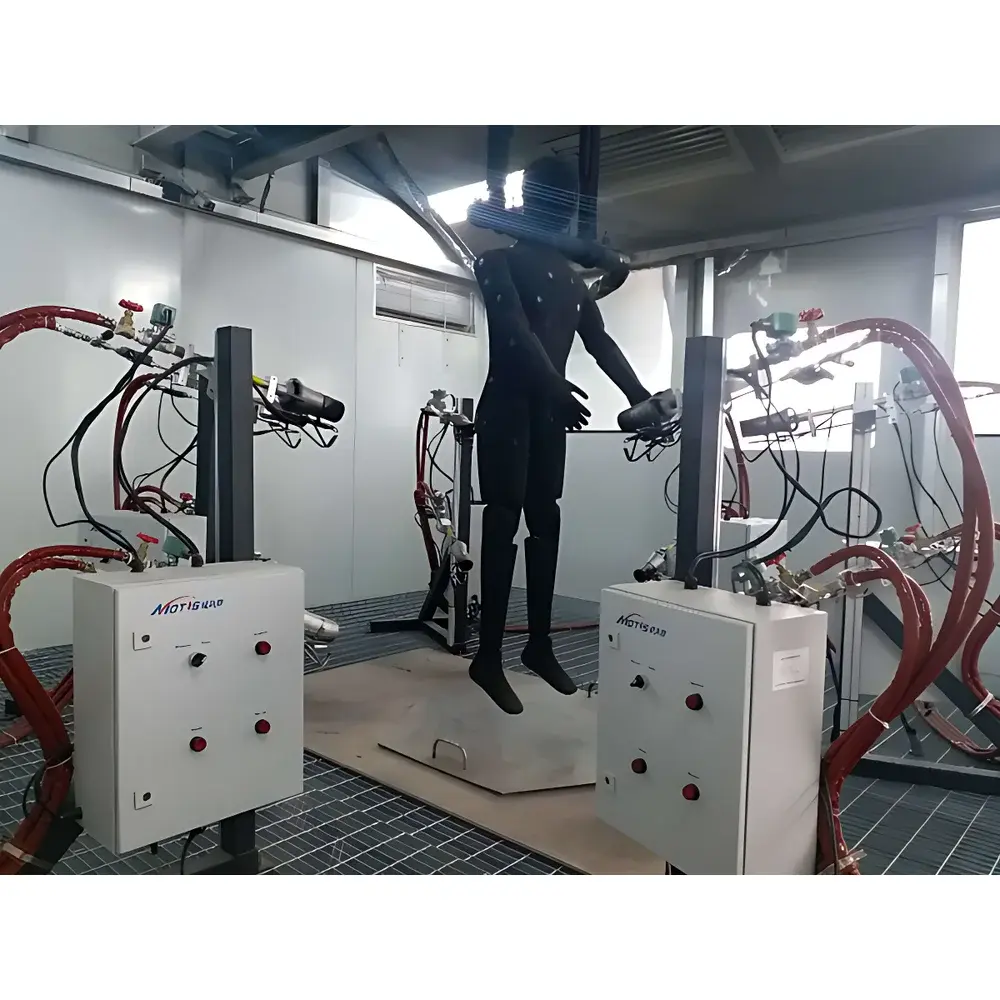
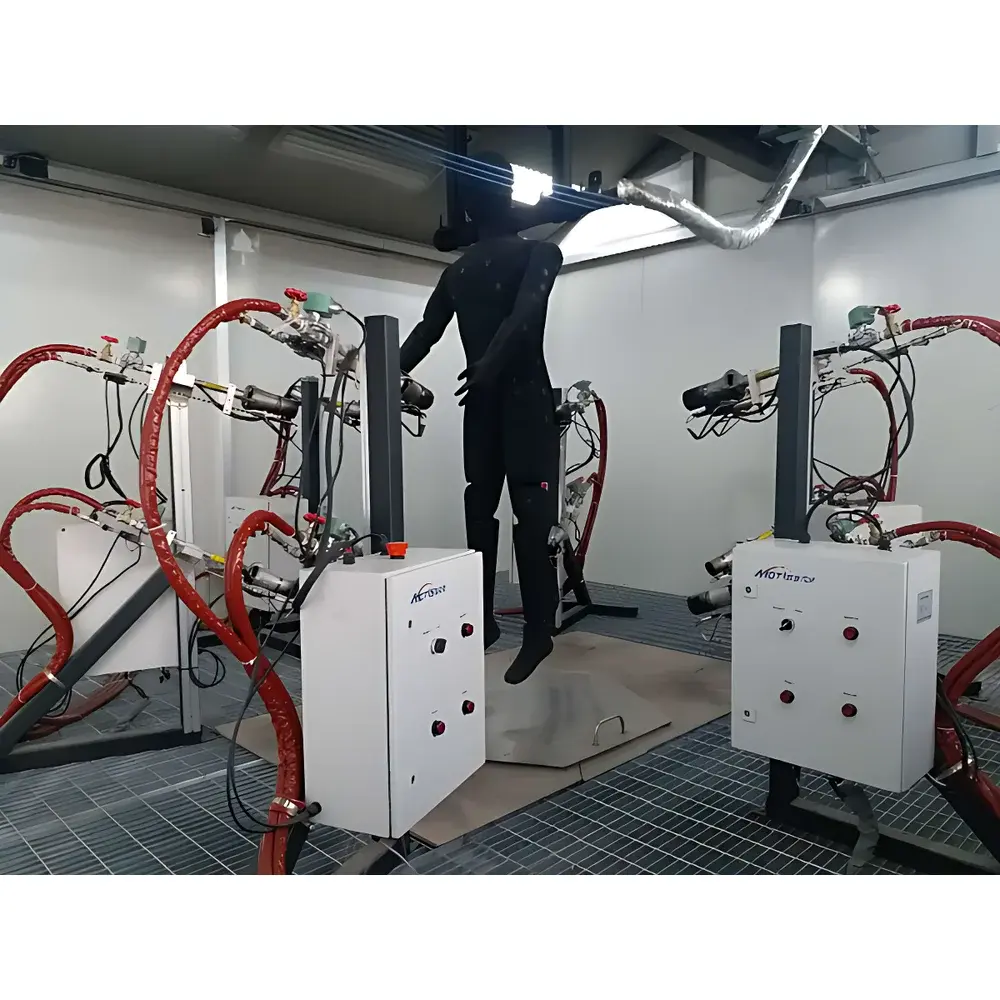
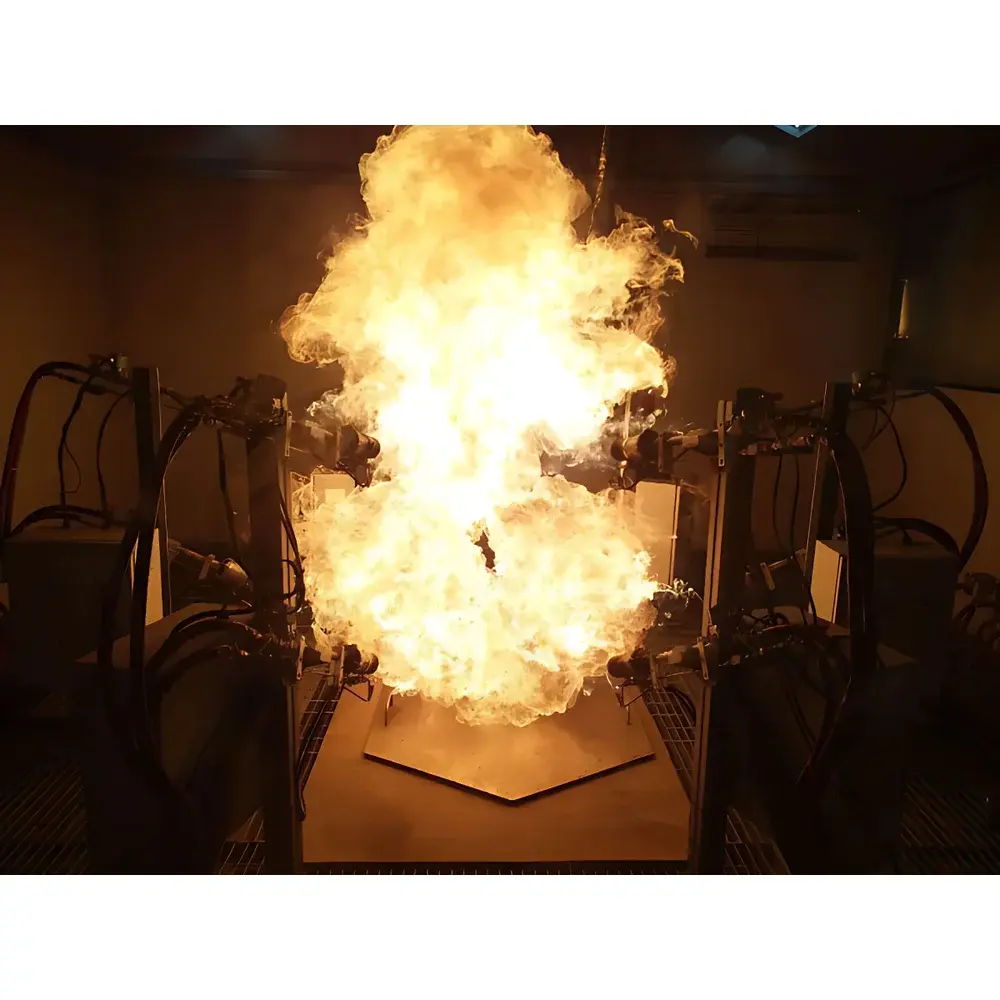
| Flame Array | Multi-nozzle butane burner array with programmable ignition and thermal profile control |
| Incident Heat Flux | Calibrated to 84 ± 2 kW/m² per ASTM F1930 |
| Data Acquisition | Synchronized high-speed thermal sampling (≥10 Hz per sensor), timestamped, GLP-compliant logging |
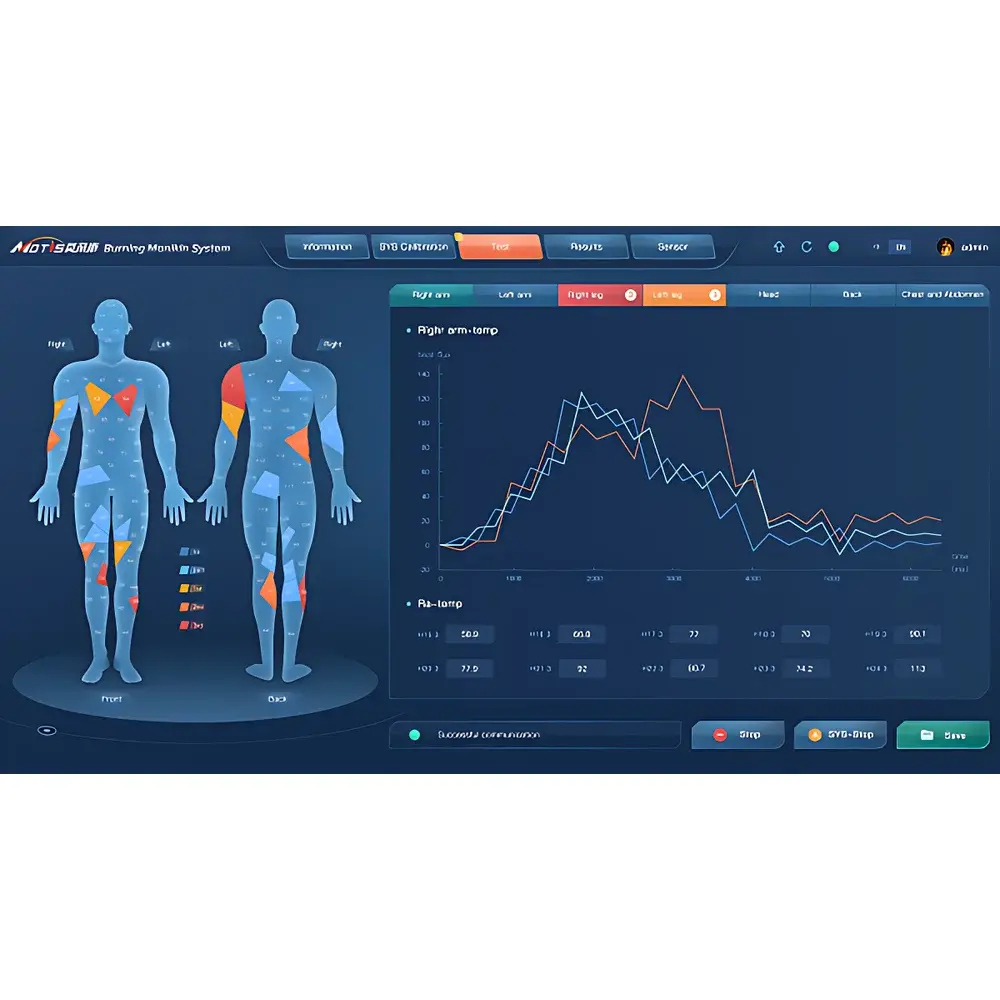
| Software Platform | FMS-Control v3.x with burn injury prediction algorithm (based on Henriques’ thermal damage integral model) |
| Structural Dimensions | Anthropometrically accurate adult male form (185 cm height, ISO 8559-compliant body geometry) |
| Enclosure | Class A fire-rated test chamber (UL 1709 compliant), integrated exhaust and gas safety interlocks |
| Regulatory Alignment | Supports ISO 13506-1:2017, NFPA 2112, EN ISO 11612, GB/T 38427–2019 |
Overview
The MOTIS FMS Instrumented Thermal Manikin System is a calibrated, anthropometric test platform engineered for quantitative evaluation of flame-resistant (FR) and heat-resistant personal protective equipment (PPE) under controlled flash fire exposure. Operating on the principle of transient thermal energy transfer measurement, the system integrates 124 precision-calibrated thermocouple-based heat flux sensors embedded across a life-sized, ISO 8559-compliant manikin surface (185 cm height). During standardized exposure—typically per ASTM F1930—the manikin, dressed in the test garment, is subjected to a reproducible, computer-controlled butane flame array delivering a nominal incident heat flux of 84 ± 2 kW/m² for 3 seconds. Real-time sensor outputs feed into a deterministic thermal damage model derived from Henriques’ integral equation, enabling spatially resolved prediction of second- and third-degree burn probability across anatomical regions. Unlike empirical pass/fail methods, the FMS delivers continuous, traceable thermal response data—critical for R&D iteration, regulatory submission, and comparative material benchmarking.
Key Features
- Anthropometric fidelity: Fully articulated, anatomically accurate male manikin conforming to ISO 8559-1:2017 dimensional standards, ensuring physiologically representative heat distribution and convective boundary conditions.
- High-density thermal sensing: 124 individually calibrated, thin-film thermocouple sensors distributed across torso, limbs, head, and neck—each traceable to NIST-traceable reference standards with documented uncertainty budgets.
- Programmable flame array: Modular butane burner configuration supporting variable flame height, stoichiometry, and spatial distribution; synchronized ignition and extinction timing controlled via PLC with redundant safety cutoffs.
- GLP-compliant data acquisition: 16-bit resolution, 10 Hz minimum sampling rate per channel; automatic time-stamping, checksum validation, and audit trail generation meeting FDA 21 CFR Part 11 requirements for electronic records.
- Integrated test chamber: UL 1709-rated fire enclosure with forced-draft exhaust, gas leak detection, emergency purge protocol, and optical-grade quartz viewport for synchronized high-speed video capture (≥1000 fps).
- Pre-validated software suite: FMS-Control v3.x includes automated calibration workflow, real-time thermal mapping, burn injury contour visualization, and export-ready reporting aligned with ASTM F1930 Annex A3 and ISO 13506-1 Clause 8.
Sample Compatibility & Compliance
The FMS accommodates full ensembles—including hoods, gloves, boots, and respirator interfaces—without sensor occlusion or thermal shadowing artifacts. Garment fit is assessed per ASTM F1930 Section 6.3 to ensure consistent air gap distribution. The system satisfies core regulatory and consensus standards including ASTM F1930 (flash fire), ISO 13506-1:2017 (thermal manikin methodology), NFPA 2112 (FR garment certification), EN ISO 11612 (heat and flame resistance), and GB/T 38427–2019 (Chinese national standard for thermal manikin testing). All calibration procedures follow ISO/IEC 17025 principles, with annual third-party verification available through MOTIS-accredited metrology partners.
Software & Data Management
FMS-Control v3.x provides a secure, role-based interface for test setup, execution, and post-processing. Raw sensor data is stored in HDF5 format with embedded metadata (test ID, operator, calibration date, ambient conditions). Burn injury prediction employs the Henriques integral with tissue-specific Arrhenius parameters (E = 102 kJ/mol, A = 2.9 × 10⁹ s⁻¹ for epidermal damage threshold). Reports include total predicted second- and third-degree burn surface area (% TBSA), regional heat accumulation maps, and statistical confidence intervals derived from sensor repeatability studies (n ≥ 5 per configuration). Audit logs record all user actions, parameter changes, and software updates—fully compliant with GLP and GMP documentation requirements.
Applications
- Development and validation of next-generation FR fabrics (e.g., modacrylic/aramid blends, bio-based char-forming polymers)
- Comparative assessment of seam integrity, closure systems, and interface zones (e.g., hood-to-jacket transition) under flash fire conditions
- Regulatory submission support for NFPA 2112, EN ISO 11612, and MIL-STD-2020B compliance dossiers
- Root-cause analysis of garment failure modes (melting, shrinkage, thermal bridging) via synchronized thermal-video correlation
- Training module integration for firefighter PPE selection protocols and hazard-specific ensemble optimization
- Academic research on human thermal response modeling and computational validation of CFD-based flame exposure simulations
FAQ
What standards does the FMS system comply with?
ASTM F1930, ISO 13506-1:2017, NFPA 2112, EN ISO 11612, and GB/T 38427–2019.
Is sensor calibration traceable to international standards?
Yes—each sensor is individually calibrated against NIST-traceable blackbody references; full calibration certificates include uncertainty budgets per ISO/IEC 17025.
Can the system accommodate non-standard exposure durations or heat flux profiles?
Yes—custom test profiles can be programmed within safety limits defined by UL 1709 chamber specifications and gas supply capacity.
Does the software support multi-language interfaces and PDF report generation?
FMS-Control v3.x supports English, German, French, and Simplified Chinese UI; reports export as password-protected PDF/A-2b with embedded digital signatures.
What maintenance is required for long-term measurement stability?
Annual sensor recalibration and chamber performance verification are recommended; MOTIS provides remote diagnostics and on-site service contracts with SLA-backed response times.



