
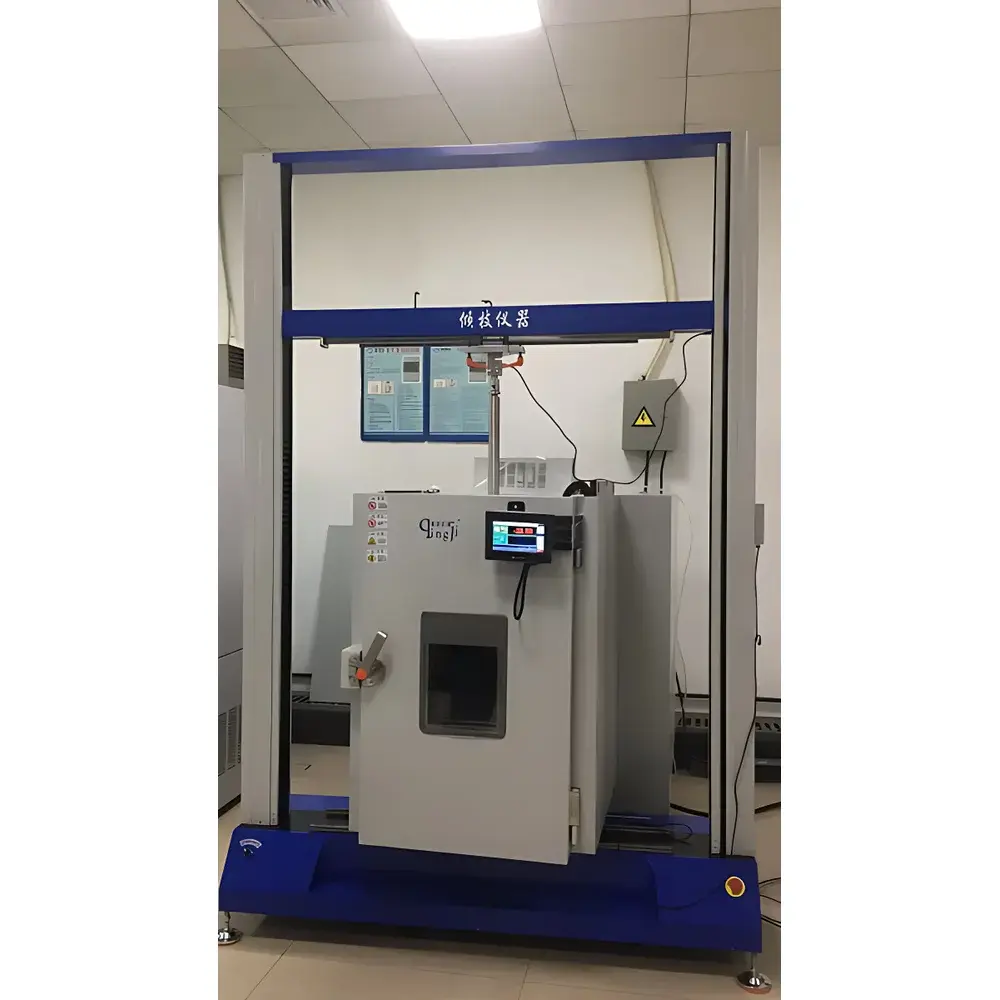
QJ211B High-Temperature Tensile Testing Machine for Metallic Materials
| Origin | Shanghai, China |
|---|---|
| Manufacturer Type | Authorized Distributor |
| Origin Category | Domestic (PRC) |
| Model | QJ211B |
| Price | USD 7,800 (FOB Shanghai) |
| Temperature Range | –70 °C to +350 °C (stabilized at 350 °C) |
| Heating/Cooling Rate | ≥5 °C/min |
| Temperature Controller Resolution | 0.1 °C |
| Load Capacity | Up to 100 kN (configurable) |
| Load Cell Accuracy | ±0.01% FS |
| Force Measurement Accuracy | ±0.5% or ±1% (per ASTM E4 & ISO 7500-1) |
| Control Mode | Dual-mode — PC-based closed-loop control + digital panel interface |
| Effective Test Width | 550 mm |
| Maximum Test Stroke | 1000 mm |
| Crosshead Speed Range | 0.001–500 mm/min (standard) |
| Speed Accuracy | ±0.5% of set value |
| Displacement Measurement Accuracy | ±0.5% of reading |
| Strain/Extension Measurement Accuracy | ±0.5% of reading |
| Safety Systems | Dual electronic limit switches, emergency stop circuit, overload cutoff |
| Net Weight | 1350 kg |
Overview
The QJ211B High-Temperature Tensile Testing Machine is an electromechanical materials testing system engineered for precise mechanical characterization of metallic specimens under controlled thermal conditions ranging from –70 °C to +350 °C. It operates on the principle of uniaxial force application in compliance with standardized test methods including ASTM E8/E21 (tension tests of metallic materials), ISO 6892-1 (room temperature) and ISO 6892-2 (elevated temperature), as well as GB/T 228.2–2015 (Chinese national standard for high-temperature tensile testing). The system integrates a robust dual-column load frame, a high-stability environmental chamber with forced-air convection heating and cryogenic cooling capability, and a precision servo-controlled actuation system. Its architecture supports static and quasi-static loading protocols required for yield strength, ultimate tensile strength, elongation, reduction of area, and modulus determination—critical parameters for quality assurance in aerospace aluminum extrusions, automotive wiring harnesses, structural steel wires, and heat-resistant alloys.
Key Features
- Thermally isolated high-temperature chamber with uniform axial temperature distribution (±2 °C across 100 mm gauge length at 350 °C), validated per ASTM E220 calibration practice
- Modular load cell options up to 100 kN capacity, traceable to NIM (National Institute of Metrology, China) with factory calibration certificate
- Dual-control architecture: Windows-based test software (compatible with Win10/11, 64-bit) plus standalone digital controller for redundancy and operational continuity
- High-resolution displacement measurement via non-contact encoder (0.1 µm resolution) and optional extensometer interfaces (ASTM E83 Class B-1 compliant)
- Comprehensive safety suite including hardware-based emergency stop, programmable software limits, dual-channel overtravel protection, and automatic thermal shutdown at chamber fault conditions
- Structural rigidity optimized for low deflection (<0.02 mm/kN vertical deformation), ensuring minimal frame compliance during high-load testing
Sample Compatibility & Compliance
The QJ211B accommodates standard and custom metallic test specimens per ISO 6892, ASTM E8, and GB/T 228 geometries—including flat sheet, round bar, wire, and extruded profiles (e.g., 6061-T6 aluminum alloy sections, copper-clad aluminum conductors, stainless steel 316L filaments). Specimen gripping utilizes pneumatic or wedge-action hydraulic grips with serrated faces to prevent slippage at elevated temperatures. All thermal and mechanical performance data comply with ISO/IEC 17025 requirements for accredited testing laboratories. The system supports audit-ready documentation for GLP and GMP environments, including electronic signature support, user access levels, and full audit trail generation per FDA 21 CFR Part 11 guidelines when configured with optional validation package.
Software & Data Management
Control and analysis are executed via proprietary MTest V5.2 software, featuring real-time force–displacement–temperature synchronization, multi-curve overlay, automated yield point detection (0.2% offset method), and modulus calculation per ASTM E111. Raw data export is supported in CSV, Excel (.xlsx), and universal .tdms formats. Calibration files are digitally signed and version-locked; all parameter changes are timestamped and user-attributed. Software includes built-in report templates aligned with ISO 5893 and ASTM E4 standards, with customizable fields for lab ID, operator, ambient conditions, and equipment ID. Optional IQ/OQ documentation packages available for regulated industries requiring installation and operational qualification per GAMP 5.
Applications
- Mechanical property evaluation of aluminum extrusions used in building façade systems under service-relevant thermal cycling
- Creep resistance assessment of copper alloy wires subjected to sustained loads at 200–300 °C in power transmission applications
- Hot tensile behavior of titanium Grade 5 (Ti-6Al-4V) weldments for aerospace component certification
- Thermal expansion coefficient derivation via simultaneous strain–temperature profiling
- Quality control of stainless steel fasteners per DIN EN ISO 898-1 under elevated temperature preconditioning
- Research-grade constitutive modeling input generation for finite element simulation of metal forming processes
FAQ
What temperature uniformity can be achieved across the gauge length at 350 °C?
Typical axial uniformity is ±2 °C over a 100 mm segment when using standard furnace configuration and calibrated thermocouples per ASTM E220.
Is the system compatible with extensometers rated for 350 °C operation?
Yes—optional high-temperature clip-on or non-contact video extensometers (e.g., DIC-based systems) can be integrated and synchronized with force and temperature channels.
Does the machine meet international calibration traceability requirements?
All load cells ship with NIM-traceable calibration certificates; temperature sensors are calibrated against ITS-90 reference standards with uncertainty budgets provided upon request.
Can test data be exported directly into LIMS or ERP platforms?
Yes—via ODBC-compliant database connectivity or REST API interface (available as add-on module) for seamless integration with laboratory information management systems.
What maintenance intervals are recommended for long-term reliability?
Preventive maintenance is advised every 12 months or 2000 operating hours, covering drive belt tension, thermal insulation integrity, load cell zero stability verification, and chamber seal inspection.
Related Products



