
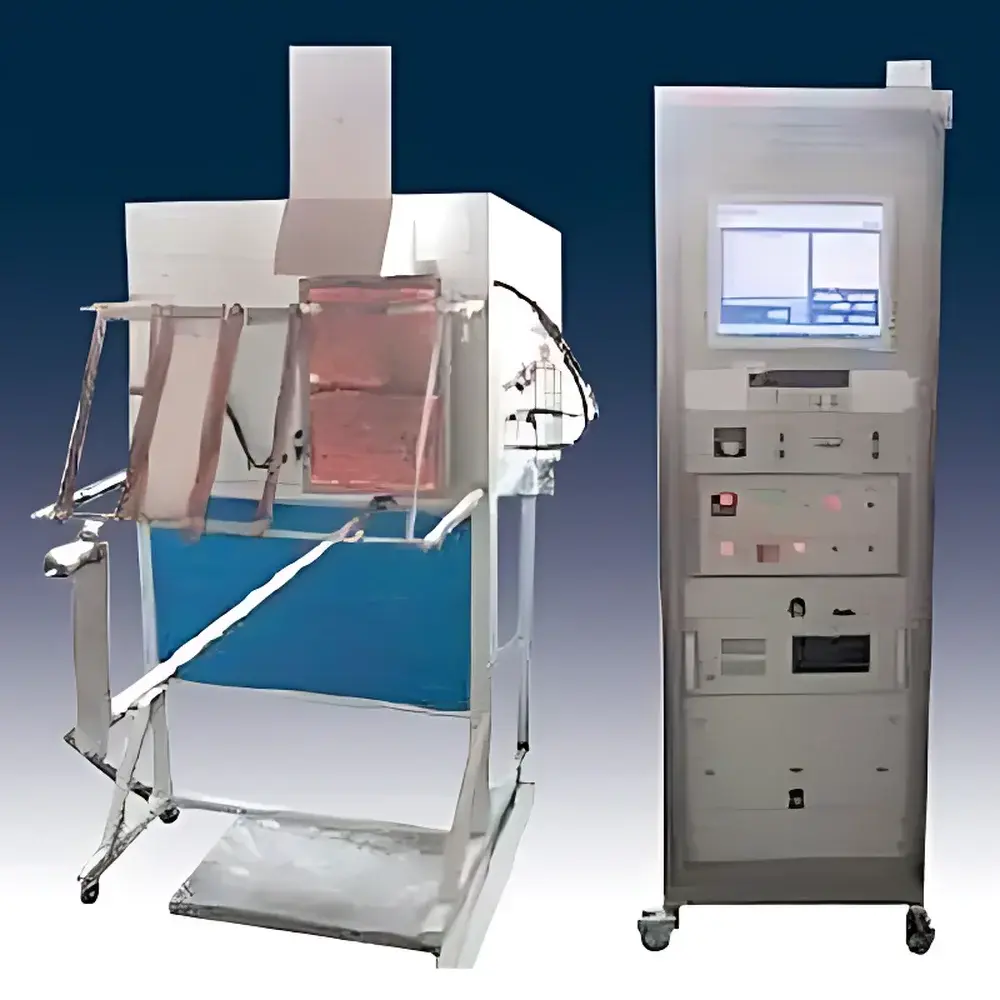
MOTIS RFS Radiant Panel Flame Spread Tester (ASTM E162 Compliant)
| Brand | MOTIS |
|---|---|
| Origin | Jiangsu, China |
| Model | RFS |
| Standards Compliance | ASTM E162, ASTM E365, ASTM D3675 |
| Radiant Panel Dimensions | 300 × 460 mm |
| Reflector Surface | 305 × 457 mm, Porous Cement |
| Max Reflector Temp | 815 °C |
| Calibration Burner | Methane (95% purity, 20 L/min @ 150 mbar) |
| Pilot Burner | Acetylene (0.5 L/min @ 150 mbar) |
| Propane Burner | 1.0 L/s @ 20 mbar |
| Compressed Air Supply | 50 L/s @ 700 Pa water column |
| Exhaust Airflow Velocity | 0.5 m/s ±0.05 m/s |
| Black-Body Temperature Control Range | 180–230 °C (±5 °C accuracy) |
| Heat Flux Measurement Range | 0–100 kW/m² (±10% full scale, Schmidt-Boelter type) |
| Data Acquisition | GPIB/USB interface DAQ system with 19" touchscreen control unit |
| Frame Dimensions | 1850 H × 700 D × 1250 L mm |
| Electrical Supply | 220 V AC, 60 Hz, 12 A |
Overview
The MOTIS RFS Radiant Panel Flame Spread Tester is a precision-engineered combustion test apparatus designed to evaluate the surface flammability behavior of solid materials under controlled radiant heat exposure, in strict accordance with ASTM E162—Standard Test Method for Surface Flammability of Materials Using a Radiant Heat Energy Source. It is also validated for use with ASTM E365 (cellular plastics) and ASTM D3675 (surface flammability of flexible cellular materials). The instrument operates on the principle of establishing a defined thermal gradient across a vertically oriented specimen using a calibrated porous-cement radiant panel maintained at elevated black-body temperatures (180–230 °C), while simultaneously measuring flame spread rate, critical heat flux (CHF), and radiant heat flux distribution. This enables quantitative derivation of the Radiant Panel Index (Is), a dimensionless metric directly correlated with flame propagation velocity and material ignition resistance. Unlike open-flame ignition methods, ASTM E162 emphasizes radiant energy transfer as the primary ignition driver—making the RFS particularly relevant for assessing fire performance in enclosed or semi-enclosed environments such as railcar interiors, aircraft cabin linings, and marine compartment panels.
Key Features
- High-stability radiant panel constructed from fine-firebrick with certified thermal endurance up to 815 °C, ensuring long-term repeatability of heat flux profiles.
- Vertically mounted reflector assembly featuring a 305 × 457 mm exposed surface fabricated from porosity-controlled, fire-resistant cementitious material, optimized for uniform radiant field distribution.
- Dual-burner gas delivery system: precision-calibrated methane burner (20 L/min, 95% purity) for radiant panel heating; acetylene pilot burner (0.5 L/min) for stable ignition and thermal stabilization.
- Integrated exhaust ducting with regulated airflow at 0.5 m/s (±0.05 m/s), compliant with ASTM E162 chamber ventilation requirements to maintain consistent oxygen replenishment and smoke evacuation.
- Real-time thermal monitoring via dual-sensor architecture: high-emissivity pyrometer for radiant panel surface temperature tracking and Schmidt-Boelter heat flux meter (0–100 kW/m² range) with portable water-cooling jacket to prevent sensor drift during extended tests.
- Modular mechanical design including motorized sliding specimen platform, rigid steel frame (1850 × 700 × 1250 mm), and integrated 19-inch industrial touchscreen PC running deterministic real-time control firmware.
Sample Compatibility & Compliance
The RFS accommodates standard ASTM E162 specimens measuring 229 mm × 508 mm × nominal thickness (up to 100 mm), mounted vertically in a non-combustible holder. It supports rigid and semi-rigid substrates including polymer composites, laminated panels, insulation foams, coated metals, and textile-reinforced composites—commonly used in transportation interior applications. All operational parameters—including radiant panel emissivity calibration, heat flux mapping, and flame front tracking—are traceable to NIST-traceable reference standards. The system architecture supports audit-ready data logging aligned with GLP principles and includes timestamped metadata (operator ID, ambient conditions, gas pressure logs, thermocouple readings) required for regulatory submissions under FAA AC 25.853, EN 45545-2, and ISO 5659-2 comparative frameworks.
Software & Data Management
The embedded control software provides two dedicated operational modules: (1) ASTM E162 Test Execution Suite, which automates pre-test conditioning, radiant panel ramp-up, specimen exposure timing (typically 90–180 s), flame front position capture via optical sensor array, and Is calculation per ASTM-defined equations; and (2) Calibration Verification Module, enabling periodic validation of burner stoichiometry, heat flux meter linearity, and pyrometer offset correction using certified reference sources. All acquired data—including time-resolved heat flux, surface temperature, flame length vs. time, and CHF determination—are stored in HDF5 format with embedded CRC checksums. Export options include CSV, XML, and PDF reports compliant with FDA 21 CFR Part 11 requirements for electronic records and signatures, including full audit trail functionality (user login history, parameter change logs, report generation timestamps).
Applications
- Fire safety qualification of interior trim materials for passenger rail vehicles (EN 45545-2 HL3 compliance verification).
- Regulatory testing of aircraft seat back panels, overhead bin liners, and sidewall composites per FAR 25.853(a) and CS-25 Appendix F.
- Development-stage screening of flame-retardant additives in polyurethane and PVC-based foams used in bus and coach seating systems.
- Comparative assessment of intumescent coatings applied to structural steel substrates under radiant heat exposure scenarios.
- Supporting technical documentation for UL 94 HB, FMVSS 302, and GB 8410 equivalence evaluations where radiant ignition dominates flame initiation.
FAQ
What standards does the RFS fully support out-of-the-box?
ASTM E162, ASTM E365, and ASTM D3675 are natively implemented in the test execution software with preconfigured test sequences, pass/fail logic, and reporting templates.
Is the heat flux meter NIST-traceably calibrated?
Yes—the Schmidt-Boelter sensor is supplied with an accredited calibration certificate (ISO/IEC 17025) valid for 12 months, and field recalibration capability is supported via the integrated reference source port.
Can the system be integrated into a centralized lab information management system (LIMS)?
The DAQ system provides native TCP/IP and Modbus TCP interfaces alongside USB/GPIB drivers, enabling seamless integration with major LIMS platforms including LabWare, Thermo Fisher SampleManager, and STARLIMS.
What maintenance intervals are recommended for gas delivery components?
Burner orifices require quarterly inspection and ultrasonic cleaning; pressure regulators and flow meters should undergo biannual verification against master gauges per ISO 5167 guidelines.
Does the RFS meet electromagnetic compatibility (EMC) requirements for installation in certified testing laboratories?
The unit complies with IEC 61326-1:2013 for laboratory equipment emissions and immunity, with CE marking and RoHS 2.0 certification documented in the Type Examination Report (TER-2023-RFS-087).



