MSI DigiGait Gait Imaging Analysis System
| Origin | Imported |
|---|---|
| Manufacturer Type | Authorized Distributor |
| Model | DigiGait |
| Speed Range | 0–100 cm/s (1 mm/s resolution) |
| Incline Adjustment | 0–60° |
| Camera Frame Rate | ≥150 fps |
| Temporal Resolution | <10 ms |
| Lighting | 25 kHz, 5000 K, 90–250 V AC |
| Treadmill Belt | Reusable polymer, high-traction |
| Animal Compatibility | Mice, rats, guinea pigs |
| Software | Proprietary DigiGait v8.x with automated paw detection and >50 spatiotemporal gait metrics |
| Compliance | Designed for GLP-compliant preclinical research environments |
Overview
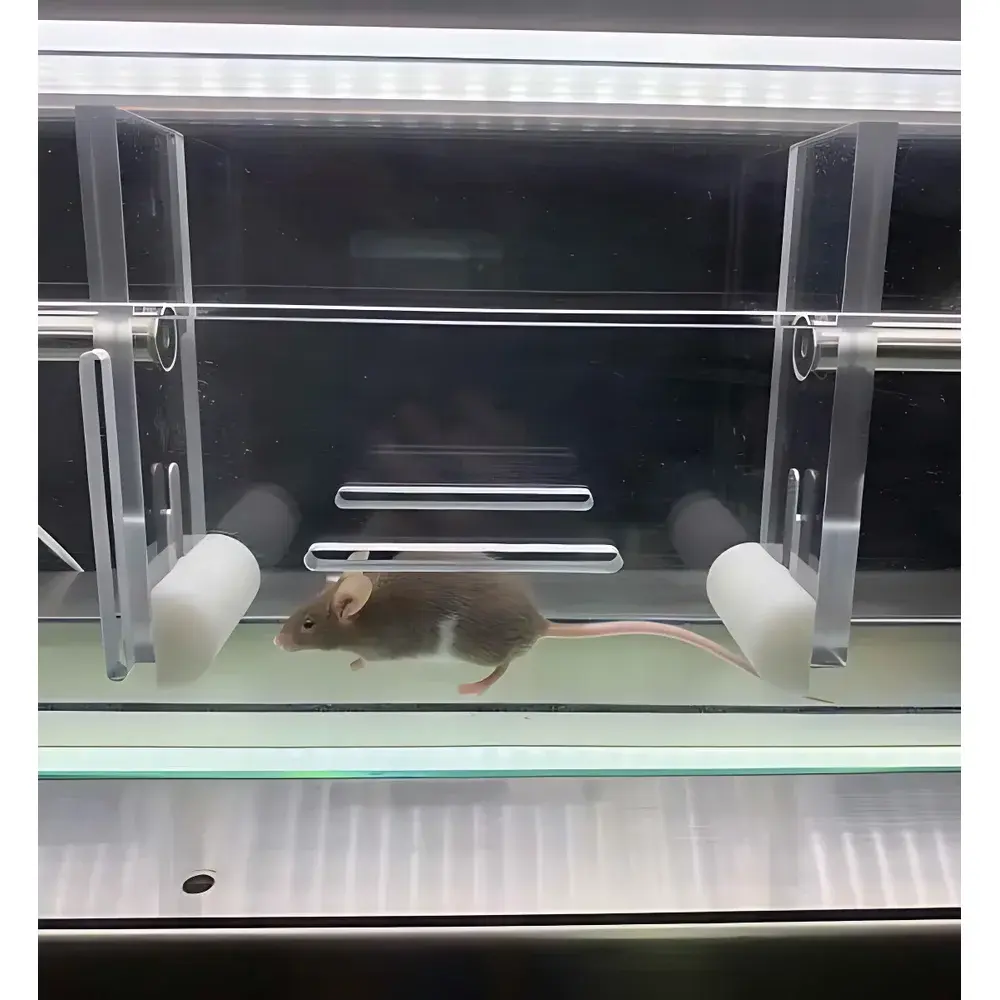
The MSI DigiGait Gait Imaging Analysis System is a patented, fully integrated, passive gait assessment platform engineered for quantitative, high-fidelity analysis of locomotor dynamics in rodent models. Unlike active force-plate or pressure-sensing systems, DigiGait employs high-speed dorsal-ventral imaging of freely walking or running animals on a transparent, motorized treadmill—capturing natural gait without restraint-induced artifacts. Its core measurement principle relies on synchronized high-resolution video acquisition (≥150 fps), real-time contrast-enhanced paw segmentation, and sub-millisecond temporal registration to extract biomechanically validated spatiotemporal parameters. The system is purpose-built for longitudinal studies in neurodegenerative, neuromuscular, musculoskeletal, and pharmacotoxicological research where objective, operator-independent gait quantification is essential for phenotypic characterization and therapeutic evaluation.
Key Features
- Patented passive imaging architecture eliminating forced treadmill acclimation bias and enabling true spontaneous gait capture.
- Motorized treadmill with digitally controlled DC drive (0–100 cm/s, ±1 mm/s precision) ensuring stable, low-noise velocity regulation—critical for dose-response and speed-matched intergroup comparisons.
- Adjustable incline range (0–60°) via integrated mechanical actuation; optional IDF incline/decline kit supports graded slope protocols for assessing proprioceptive load compensation and hindlimb propulsion deficits.
- Modular, tool-free chamber configuration: runway length adjustable from 7.6 cm (neonatal mice) to 61 cm (adult rats/guinea pigs); side walls and partition spacing reconfigurable in under 60 seconds.
- Optically optimized transparent polymer belt with micro-textured surface—provides consistent traction at speeds up to 100 cm/s while permitting unobstructed ventral-view imaging of full paw contact geometry.
- Dual-angle illumination system (25 kHz flicker-free, 5000 K color temperature) ensures robust contrast across diverse coat colors and skin pigmentation—eliminating manual ROI definition or post-hoc thresholding.
- Real-time contrast optimization engine within the graphical user interface dynamically enhances paw-background differentiation under variable ambient lighting conditions—enabling operation in standard vivarium environments without darkroom retrofitting.
Sample Compatibility & Compliance
The DigiGait system supports consistent, repeatable gait acquisition across C57BL/6, BALB/c, CD-1, FVB/N, and transgenic lines—including models with hypopigmentation (e.g., albino strains) or hyperkeratosis. It accommodates body weights ranging from 5 g (P7 pups) to 500 g (aged Sprague-Dawley rats). All hardware components comply with IEC 61000-6-3 (EMC emission standards) and UL 61010-1 (laboratory equipment safety). The software architecture supports audit trails, electronic signatures, and configurable user permissions—meeting foundational requirements for GLP-compliant data integrity per OECD Principles of Good Laboratory Practice and FDA 21 CFR Part 11 when deployed with validated IT infrastructure.
Software & Data Management
DigiGait v8.x software provides a validated, workflow-driven interface for acquisition, processing, and export. Automated paw detection uses adaptive edge-enhancement and multi-frame temporal consistency filtering—requiring zero manual tracing. Raw video, synchronized treadmill speed logs, and timestamped event markers are archived in vendor-neutral AVI + CSV format. Over 50 validated gait indices—including stance/swing phase duration, stride length CV, paw angle asymmetry, braking-to-propulsion ratio, and sciatic functional index—are computed per trial and exported directly to Excel-compatible templates. Batch processing supports longitudinal cohort analysis with built-in outlier detection and inter-session normalization. Data export modules support integration with MATLAB, Python (via .csv/.h5), and commercial biostatistics platforms (e.g., GraphPad Prism, SAS).
Applications
The DigiGait system is routinely deployed in academic and pharmaceutical preclinical labs for mechanistic and translational studies involving Parkinson’s disease (MPTP, 6-OHDA models), Huntington’s disease (R6/2, Q175), ALS (SOD1-G93A), spinal cord injury (SCI), osteoarthritis (MIA-induced), chemotherapy-induced peripheral neuropathy (paclitaxel, vincristine), lysosomal storage disorders (Naglu−/−, Hexb−/−), and aging-related sarcopenia. Its capacity to quantify subtle, progressive changes in interlimb coordination, weight-bearing asymmetry, and dynamic balance makes it particularly valuable for evaluating disease-modifying therapeutics, gene therapies, and rehabilitative interventions where conventional behavioral endpoints lack sensitivity.
FAQ
What rodent species and age ranges are supported?
Mice (P7 to adult), rats (P14 to 24 months), and guinea pigs (weanling to mature) are validated. Chamber dimensions and belt tension are adjustable to accommodate developmental changes in posture and gait kinematics.
Is the system compatible with existing vivarium infrastructure?
Yes—the lighting system operates independently of ambient light, and the treadmill requires only standard 110–240 V AC power. No dedicated RF-shielded rooms or vibration-isolation tables are required.
How is data traceability ensured for regulatory submissions?
Software-generated audit logs record user actions, parameter modifications, and processing timestamps. When deployed on validated workstations (e.g., Dell Precision T1800 with signed drivers), full 21 CFR Part 11 compliance—including electronic signatures and immutable data archives—can be achieved through site-specific validation protocols.
Can the system be upgraded for multi-animal parallel testing?
No—DigiGait is a single-animal, high-fidelity acquisition platform. Parallel throughput is achieved via sequential runs with automated chamber reset; throughput optimization is managed through batch scheduling and pre-configured protocol libraries.
What level of technical support and software maintenance is provided?
MSI offers annual software update subscriptions, remote troubleshooting, and on-site installation qualification (IQ/OQ) services. All firmware and algorithm updates undergo internal verification against NIST-traceable motion phantoms prior to release.